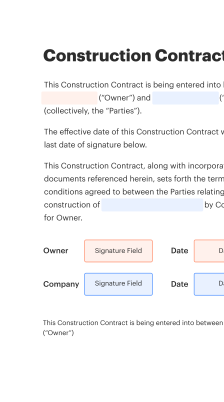
Add Collector Name with airSlate SignNow
Get the robust eSignature features you need from the solution you trust
Choose the pro service made for professionals
Set up eSignature API quickly
Collaborate better together
Add collector name, within a few minutes
Cut the closing time
Keep important data safe
See airSlate SignNow eSignatures in action
airSlate SignNow solutions for better efficiency
Our user reviews speak for themselves
Why choose airSlate SignNow
-
Free 7-day trial. Choose the plan you need and try it risk-free.
-
Honest pricing for full-featured plans. airSlate SignNow offers subscription plans with no overages or hidden fees at renewal.
-
Enterprise-grade security. airSlate SignNow helps you comply with global security standards.
Your step-by-step guide — add collector name
Using airSlate SignNow’s eSignature any business can speed up signature workflows and eSign in real-time, delivering a better experience to customers and employees. add collector name in a few simple steps. Our mobile-first apps make working on the go possible, even while offline! Sign documents from anywhere in the world and close deals faster.
Follow the step-by-step guide to add collector name:
- Log in to your airSlate SignNow account.
- Locate your document in your folders or upload a new one.
- Open the document and make edits using the Tools menu.
- Drag & drop fillable fields, add text and sign it.
- Add multiple signers using their emails and set the signing order.
- Specify which recipients will get an executed copy.
- Use Advanced Options to limit access to the record and set an expiration date.
- Click Save and Close when completed.
In addition, there are more advanced features available to add collector name. Add users to your shared workspace, view teams, and track collaboration. Millions of users across the US and Europe agree that a solution that brings everything together in a single holistic workspace, is exactly what businesses need to keep workflows working effortlessly. The airSlate SignNow REST API enables you to integrate eSignatures into your app, website, CRM or cloud. Check out airSlate SignNow and enjoy faster, easier and overall more effective eSignature workflows!
How it works
airSlate SignNow features that users love
Get legally-binding signatures now!
FAQs
-
What is difference between collector and deputy collector?
The District Collector is the highest Officer of revenue administration in the district. In revenue matters he/she is responsible to the Government through the Divisional Commissioner and the Financial Commissioner (Revenue). Deputy Commissioner is the Executive Head of a District. -
How long will it take to become an IAS officer from deputy collector?
After joining the services, it may take about 5-7 years for an IAS officer to become a District Collector. They have a well-known tenure system and all promotions dealt timely. A PCS officer starts his career depending on the state service rules. -
Does every IAS become DM?
Facts: Most of the IAS aspirants dream about the District Magistrate(DM) post and the powers associated with the post. But the reality is this, There are hundreds of IAS officers posted in a state and the post of DM is not given to everyone. ... Some IAS officers never get an opportunity to become a DM at their career. -
What is ADM post?
A District Magistrate and Collector, is an officer who is in-charge of a district, the basic unit of administration, in India. They are also known as District Collector or Deputy Commissioner in several Indian states. ... Each one of them is headed by a DM. -
Can deputy collector become IAS?
A deputy collector in AP will also become conferred IAS within 15 years. So Sindhu can one day become an IAS officer. -
Can a deputy collector become collector?
As a deputy collector, which is the top state government direct recruitment post in AP, Sindhu will become the district collector within 10 to 12 years. A deputy collector in AP will also become conferred IAS within 15 years. So Sindhu can one day become an IAS officer. -
What is difference between IAS and collector?
The District Collector is the highest Officer of Revenue administration in the district. ... A district magistrate, often abbreviated to DM, is an Indian Administrative Service (IAS) officer who is the senior-most executive magistrate and chief in charge of the general administration of a district in India. -
What is the difference between collector and deputy collector?
The District Collector is the highest Officer of revenue administration in the district. In revenue matters he/she is responsible to the Government through the Divisional Commissioner and the Financial Commissioner (Revenue). Deputy Commissioner is the Executive Head of a District. -
Is DM and Collector same?
As District Magistrate, he is responsible for law and order and heads the police and prosecuting agency. As Collector, he is the chief Officer of the revenue administration and is responsible for the collection of land revenue, and is also the highest revenue judicial authority in the district. -
What is the promotion of deputy collector?
Career progression. After completing their training, a PCS officer generally serves as Deputy Collector (SDMs). Further, they get promoted to city magistrate, and later, additional district magistrate. -
Who is more powerful DM or collector?
A district magistrate, often abbreviated to DM, is an Indian Administrative Service (IAS) officer who is the senior-most executive magistrate and chief in charge of the general administration of a district in India. ... The District Collector is the highest Judicial Authority in the District. -
Is collector an IAS officer?
Who is District Collector / Magistrate? District Collect is a member of the Indian Administrative Service (IAS) and is appointed as the chief administrative and revenue officer of an Indian district. -
Is all IAS become DM?
Some IAS officers never get an opportunity to become a DM at their career. ... A DM is only a coordinating officer for all the state government departments. He has no direct control over the various district functionaries such as the IPS, IFS and IRS officers. -
What is difference between DM and collector?
As District Magistrate, he is responsible for law and order and heads the police and prosecuting agency. As Collector, he is the chief Officer of the revenue administration and is responsible for the collection of land revenue, and is also the highest revenue judicial authority in the district. -
Is collector and DM same?
A District Magistrate and Collector, is an officer who is in-charge of a district, the basic unit of administration, in India. They are also known as District Collector or Deputy Commissioner in several Indian states. In general parlance, they are referred to by the abbreviation DM or DC. -
What is meant by additional collector?
The additional collector/ district revenue officer runs the revenue administration under various enactments in the district. He/She is also designated as an additional district magistrate. He mainly deals with civil supplies, land matters, mines and minerals, village officers etc. -
Is IAS officer and DM same?
An IPS has only the responsibility of its department, but an IAS (DM) has the responsibility of all the departments of the district. An IAS officer as DM is the head of the police department and other departments. -
Who is more powerful DM or IAS?
The job profile of both IAS and IPS services is very broad and both are posted on powerful posts, but IAS is much more powerful as a DM. An IPS has only the responsibility of its department, but an IAS (DM) has the responsibility of all the departments of the district.