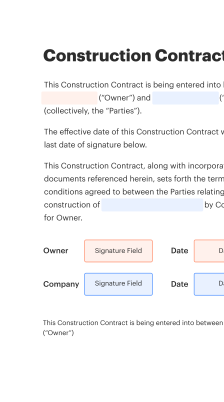
Adjust E Sign Credit Card with SignNow

Get rid of paper and automate digital document processing for more productivity and limitless possibilities. Sign anything from a comfort of your home, quick and feature-rich. Experience the perfect way of doing business with airSlate SignNow.

Award-winning eSignature solution

What adjust e sign credit card means in practice

adjust e sign credit card refers to the process of configuring, collecting, and recording credit card payment details as part of an electronic signature workflow. This includes adding payment fields to a document, specifying payment amounts or variable pricing, and capturing card authorization during signing. In U.S. contexts this workflow must preserve the signed record, authentication metadata, and a clear audit trail so that the payment element is tied to the executed document for compliance, dispute resolution, and accounting reconciliation purposes.

Why adjusting e-sign credit card fields matters

Accurate adjustment ensures payments are captured reliably and linked to signed consent, reducing reconciliation errors and improving recordkeeping for audits and customer billing.

Why adjusting e-sign credit card fields matters

Common challenges when using credit cards with e-signatures

  • Incorrect field placement can break automated payment capture and delay transaction processing.
  • Failing to set the right currency or amount rules leads to billing inconsistencies across records.
  • Weak signer authentication increases fraud risk and may invalidate card authorizations.
  • Poor retention policies can make it hard to reconcile signed payment records during audits.

Representative user roles for adjust e sign credit card

Billing Manager

Responsible for defining payment flows and reconciliation rules, the Billing Manager configures payment fields, sets currency and amount rules, and verifies that collected card authorizations reconcile with accounting systems to reduce chargebacks.

Compliance Officer

The Compliance Officer reviews consent language and retention schedules to ensure credit card capture within signed documents meets regulatory and internal policy requirements, particularly for audit trails and record retention.

Who typically configures adjust e sign credit card workflows

Teams that manage billing, legal, or client intake commonly set up card capture within signature processes to combine authorization and payment into one step.

  • Billing and finance teams handling invoices and one-time payments within signed agreements.
  • Sales operations collecting deposits or service fees at contract signing.
  • Legal or compliance staff ensuring consent language and payment authorization are recorded together.

Implementation is most effective when technical, legal, and finance stakeholders collaborate to align field configuration, authentication, and retention policies.

be ready to get more

Choose a better solution

Key tools that affect credit card capture in signNow

Adjusting credit card capture requires tools for field placement, authentication, payment handling, and recordkeeping; these features control how payments are authorized, secured, and associated with signed documents.

Payment Fields

Payment Fields let you place a secure card input on the document, support fixed or variable amounts, and optionally collect billing details so that a card authorization is linked directly to the executed signature.

Authentication Options

Authentication Options include email verification, SMS codes, and knowledge-based checks that strengthen signer identity before card authorization is accepted and recorded alongside the signed agreement.

Audit Trail

Audit Trail logs record signer actions, timestamps, IP addresses, and payment authorization results to provide an immutable record for compliance and dispute resolution.

Integrations

Integrations connect payment processors and accounting systems to transfer authorization tokens, reconcile transactions, and reduce manual entry between signNow and downstream financial platforms.

How the adjust e sign credit card flow operates

This sequence explains the typical flow from document preparation to signed record with payment captured.

  • Prepare document: Add payment and signature fields.
  • Send to signer: Deliver via web or mobile channels.
  • Collect payment: Authorize card during signing.
  • Store audit trail: Save signed document and logs.
Collect signatures
24x
faster
Reduce costs by
$30
per document
Save up to
40h
per employee / month

Quick steps to adjust an e-sign credit card field

Follow these concise steps to add or modify credit card collection as part of an e-signature document workflow.

  • 01
    Add payment field: Insert a card input element into the document.
  • 02
    Set amount rules: Configure fixed or variable pricing logic.
  • 03
    Configure authentication: Require appropriate signer verification steps.
  • 04
    Test workflow: Run a test transaction and validate logs.

Audit trail checklist for card-enabled signatures

A compact checklist of audit elements to capture when collecting credit card payments during signature workflows.

01

Signer identity:

Email and IP address
02

Timestamp:

UTC time recorded
03

Payment token:

Processor transaction ID
04

Consent text:

Exact authorization wording
05

Authentication method:

SMS or 2FA method
06

Document hash:

Immutable signature record
be ready to get more

Why choose airSlate SignNow

  • Free 7-day trial. Choose the plan you need and try it risk-free.
  • Honest pricing for full-featured plans. airSlate SignNow offers subscription plans with no overages or hidden fees at renewal.
  • Enterprise-grade security. airSlate SignNow helps you comply with global security standards.
illustrations signature

Typical configuration settings for card-enabled e-sign workflows

Key settings determine how and when payments are collected during the signing process and how records are stored and managed.

Feature Configuration
Payment Collection On-sign capture
Reminder Frequency 48 hours
Signer Authentication Email or SMS
Template Library Reusable templates
Retention Period 7 years

Platform and device considerations for card capture

Card capture and payment authorization work across supported web and mobile environments but require secure connections and compatible browsers or SDKs for tokenization.

  • Web browsers: Modern TLS-capable
  • Mobile apps: Native SDK recommended
  • APIs: Server-side tokenization

Ensure your implementation follows PCI guidelines for the chosen platform, uses TLS for all transmissions, and leverages signNow or payment-provider SDKs to avoid exposing raw card details while maintaining a consistent signer experience across devices.

Security controls relevant to e-sign credit card capture

PCI compliance: Tokenized card data
TLS encryption: Transport layer protection
Role-based access: Restricts sensitive fields
Audit logging: Immutable activity records
Two-factor auth: Optional signer verification
Data retention controls: Customizable retention

Practical examples of adjust e sign credit card workflows

Two short case descriptions show how payment capture integrates with signed documents across common business scenarios.

Subscription Onboarding

A SaaS company embeds a card-collection field in the subscription agreement for first-month payment

  • Field validates card and amount before final signature
  • Customer authorization and payment token are stored separately from raw card data

Resulting in a single recorded transaction tied to the fully executed contract and simpler monthly invoicing reconciliation.

Service Deposit

A professional services firm requires a deposit when clients sign a statement of work

  • The document includes a clearly labeled payment field and consent language
  • The firm uses tokenization to avoid storing card numbers while keeping a reference for refunds

Ensures the deposit authorization and signed SOW are linked for billing and dispute resolution.

Best practices for secure and accurate credit card capture

Follow these operational and technical best practices to minimize risk and maintain clear payment records within signed documents.

Use tokenization and avoid storing raw card data
Store only payment tokens and transaction references to reduce PCI scope and limit exposure in case of a breach; ensure your payment processor supports tokenization and that tokens are associated with the signed record for later refunds or chargebacks.
Include clear consent language for payment authorization
Place explicit, plain-language consent near the payment field so signers understand what they authorize; retain the signed consent as part of the executed document to support merchant rights and reduce disputes.
Align retention with accounting and compliance policies
Define document retention periods that satisfy accounting, tax, and regulatory requirements while minimizing unnecessary storage of sensitive metadata; document retention settings must preserve the audit trail for the required statutory period.
Test workflows and log results regularly
Run staged transactions to validate field behavior, authentication rules, and downstream reconciliation; review audit logs and payment processor reports to confirm that tokens and transaction IDs are consistently recorded.

FAQs and troubleshooting for adjust e sign credit card

Answers to frequent operational and technical questions about card capture during e-signature workflows, with practical troubleshooting steps.

Feature comparison: payment capture across leading e-sign vendors

A concise comparison of payment-related capabilities shows availability and technical notes for common payment features across three major vendors.

signNow (Recommended) | DocuSign | Adobe Sign Payment capture Payment capture Payment capture
Payment Collection Limited
Bulk Send
Advanced Authentication SMS/2FA SMS/2FA Federated SSO
Audit Trail Comprehensive Comprehensive Comprehensive
be ready to get more

Get legally-binding signatures now!

Risks and potential penalties tied to improper setup

Noncompliance fines: Regulatory penalties
Chargebacks: Financial losses
Contract disputes: Legal exposure
Data breaches: Reputational harm
Failed audits: Operational disruption
Payment delays: Cashflow issues

Pricing snapshot for card-enabled e-sign functionality

Approximate entry-level pricing and common plan distinctions for signNow and competing vendors; costs and features vary by contract and optional services.

signNow (Recommended) | DocuSign | Adobe Sign | Dropbox Sign | PandaDoc signNow (Recommended) DocuSign Adobe Sign Dropbox Sign PandaDoc
Starting Price From $8/user/month From $10/user/month From $9.99/user/month From $15/user/month From $19/user/month
Per-user monthly $8–15 billed annually $10–40 varied tiers $9.99–29 integrated plans $15–30 professional tiers $19–49 enterprise options
Payment collection fee Processor fees apply Processor fees apply Third-party required Processor fees apply Processor fees apply
Free trial Yes, limited trial Yes, limited trial Yes, part of Adobe trial Yes, limited trial Yes, limited trial
API access Included in business plans Paid API plans Included in enterprise Developer API available API on higher tiers
Enterprise options Custom contracts available Enterprise business unit Enterprise licenses available Custom enterprise plans Enterprise and volume pricing

Simplify complex workflows

Create, execute, and manage workflows of any complexity, electronically from virtually anywhere. Scalable eSignature capabilities allow you to share documents with the right people in the correct order and define roles for each recipient. Execute document workflows faster and easier than ever before.

Automate document management

Optimize complex signing processes with airSlate SignNow’s powerful features to enhance your business. Control your automated eSignature workflows to ensure they're running at peak performance with instant notifications and reminders.

Optimize in team collaboration

Bring teams together in a secure, shared environment. Manage documents, use form templates and notifications to create more efficient cross-organization collaboration. Free your employees from having to spend time on repetitive activities so that they can focus on valuable, business-critical tasks.

Integrate into your existing systems

Run your projects with industry-leading integration. Collect Salesforce, Microsoft Teams, and SharePoint all in one business flow. Connect your software to a single system for endless possibilities and more productiveness.

Stay compliant with best-in-class data protection

Feel safe knowing that your data is protected by the most recent in encryption security. airSlate SignNow is GDPR and eIDAS certified and offers you awareness into your signing experience with court-admissible audit trails. Set up user authorization and roles to control who has access to what.


walmart logo
exonMobil logo
apple logo
comcast logo
facebook logo
FedEx logo
be ready to get more

Get legally-binding signatures now!