Affix E Signature Credit Card with SignNow

Get rid of paper and automate digital document management for increased efficiency and unlimited opportunities. eSign any papers from your home, fast and feature-rich. Enjoy the best manner of doing business with airSlate SignNow.

Award-winning eSignature solution

What affix e signature credit card means and how it works

An affix e signature credit card workflow refers to electronically capturing a cardholder's agreement on a payment authorization or card-related document and attaching a verifiable electronic signature to that document. This process typically includes identity verification, secure transmission of the signed record, and an immutable audit trail showing who signed, when, and from which device. In regulated sectors, the workflow must meet U.S. e-signature laws and maintain appropriate security controls for cardholder data while enabling payment execution or recurring billing authorizations.

Legal validity and compliance considerations

Affixing an e-signature to credit card authorizations is legally valid under ESIGN and UETA in the United States when intent, consent, and association of signature with the record are demonstrable; organizations should align processes with PCI-DSS for card data and consider HIPAA or FERPA safeguards where applicable.

Legal validity and compliance considerations

Common operational challenges with card signature workflows

  • Ensuring cardholder identity reliably without adding friction to the checkout or authorization flow.
  • Maintaining PCI-DSS compliance while storing or transmitting card data linked to signed records.
  • Capturing clear consent language that satisfies ESIGN and supports dispute resolution.
  • Integrating signature capture with payment processors without breaking audit trail continuity.

Representative user roles and responsibilities

Payments Manager

Oversees card authorization flows, reconciles signed payment agreements with processor reports, and ensures operational compliance with PCI-DSS and company policies.

Compliance Officer

Defines retention, consent language, and audit requirements for signed card authorizations, and coordinates legal review to verify adherence to ESIGN, UETA, and applicable privacy regulations.

Which teams typically use affix e signature credit card processes

Payment operations, billing teams, legal, and compliance groups commonly manage card authorization signatures within digital workflows.

  • Billing and collections teams handling recurring payments and consented charges.
  • Sales and account management for one-time card authorizations and contract acceptance.
  • Healthcare and education administrators needing documented card authorizations under privacy rules.

Cross-functional coordination between finance, IT, and compliance is essential to implement a secure, auditable process that meets regulatory and business requirements.

Extended capabilities for enterprise-grade card signing workflows

Larger organizations often require additional controls and integrations to manage volume, compliance, and complex approval chains for card authorizations.

Role-based access

Granular permissions allow administrators to define who can create, send, or access signed card authorization records, helping meet separation-of-duty requirements.


Bulk send

Batch delivery and parallel processing features scale signature requests for large customer cohorts while preserving individualized audit records.

Advanced reporting

Customizable reports on signing activity, payment status, and retention help compliance and finance teams maintain oversight.

Integration APIs

Robust REST APIs enable embedding signature capture into billing systems, CRMs, and customer portals for a seamless experience.

Conditional fields

Dynamic form logic ensures only relevant consent and payment fields display based on customer responses or account type.

Enterprise SSO

Single sign-on support simplifies access control and centralizes user lifecycle management across identity providers.

be ready to get more

Choose a better solution

Essential features for efficient card authorization e-signing

When configuring an affix e signature credit card workflow, certain platform capabilities reduce risk and streamline operations.

Template Library

Reusable, centrally managed templates with required fields reduce errors and ensure consistent consent language across card authorization forms and merchant agreements.

Audit Trail

Comprehensive, tamper-evident logs capture signer identity, timestamps, IP addresses, and document changes to support legal validity and dispute resolution.

Payments Integration

Direct connectors to payment processors and tokenization services allow secure capture of payment tokens without storing full card PAN on your systems.

Multi-factor Authentication

Support for MFA and identity verification reduces fraudulent signings and strengthens evidentiary value for signed card authorizations.
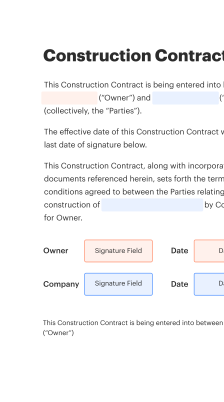
How the affix e signature credit card process flows

A typical flow moves from document creation to signature capture, verification, and storage with connected payment steps where required.

  • Create document: Author contract or authorization template for signature.
  • Send to signer: Deliver via email link, mobile, or embedded form.
  • Signer action: Complete identity checks and affix electronic signature.
  • Finalize record: Store signed document and trigger payment tokenization.
Collect signatures
24x
faster
Reduce costs by
$30
per document
Save up to
40h
per employee / month

Step-by-step: completing an affix e signature credit card authorization

Follow these concise steps to prepare, send, and finalize a card authorization using an e-signature workflow.

  • 01
    Prepare form: Include clear consent language and required fields.
  • 02
    Identity check: Verify signer via email, SMS, or ID check.
  • 03
    Attach card detail: Use tokenization; avoid storing full PAN.
  • 04
    Complete signature: Record signature, timestamp, and device info.

Managing audit trails for card authorization records

Maintain a consistent audit workflow to ensure every signed card authorization has verifiable metadata and preservation controls.

01

Capture event:

Record signature and timestamp
02

Store evidence:

Save signed PDF and metadata
03

Timestamping:

Use server-side timestamps
04

Log signer IP:

Include network evidence
05

Change history:

Preserve versioning
06

Exportability:

Allow secure export formats
be ready to get more

Why choose airSlate SignNow

  • Free 7-day trial. Choose the plan you need and try it risk-free.
  • Honest pricing for full-featured plans. airSlate SignNow offers subscription plans with no overages or hidden fees at renewal.
  • Enterprise-grade security. airSlate SignNow helps you comply with global security standards.
illustrations signature

Typical workflow configuration values for card authorization signing

A representative configuration table shows standard defaults and options to consider when implementing an affix e signature credit card workflow.

Feature Configuration
Reminder Frequency 48 hours
Signature Validity Window 30 days
Identity Verification Method Email + SMS
Card Data Handling Tokenize with gateway
Audit Log Retention 7 years

Device and browser requirements for signing card authorizations

Affix e signature credit card forms must be accessible across common devices and modern browsers to avoid friction in signing.

  • Desktop browsers: Chrome, Edge, Safari supported
  • Mobile platforms: iOS and Android supported
  • Minimum connectivity: Stable HTTPS connection required

Ensure your support documentation lists tested browser versions and recommends enabling JavaScript and cookies for form validation; provide alternative signing paths for users on legacy devices or restricted networks.

Security controls to protect card signature transactions

Transport encryption: TLS 1.2+ for all data in transit
At-rest encryption: AES-256 encryption for stored records
Access control: Role-based permissions and MFA
Data minimization: Avoid storing full card numbers
Audit logging: Immutable event logs and timestamps
Third-party reviews: Regular security assessments and scans

Industry examples of affix e signature credit card workflows

Two practical scenarios show how signed card authorizations are used across sectors and what outcomes they produce.

Subscription onboarding

A SaaS provider requires a signed card authorization to enable recurring billing and record consent for auto-renewal.

  • The e-signature form captures cardholder identity and consent fields.
  • The collected record links to the billing profile and payment token for automated charges.

Resulting in fewer manual billing errors and clearer evidence for dispute resolution.

Healthcare patient payments

A clinic uses an electronic form to capture a patient's payment agreement for co-pays and outstanding balances.

  • The document includes HIPAA-aware language and limited card data handling.
  • The signed record is attached to the patient account and triggers secure payment processing.

Leading to faster collections and preserved privacy controls for patient financial data.

Practical best practices for secure and compliant card signatures

Adopt clear operational rules and technical safeguards to reduce disputes and support legal compliance for card authorization signatures.

Use tokenization to avoid storing card numbers
Always tokenize payment card data and let a PCI-DSS–certified processor hold the PAN; retain only non-sensitive references in signed records to minimize breach risk and compliance scope.
Document explicit consent and authorization terms
Include plain-language statements that explain the charge purpose, recurrence, and cancellation process; ensure the signer affirms consent to meet ESIGN requirements and reduce chargeback exposure.
Maintain an immutable audit trail for each transaction
Capture signer identity evidence, timestamps, IP addresses, device data, and any changes; store logs with integrity checks to support regulatory inquiries and dispute resolution.
Coordinate retention policies with legal and finance
Define retention periods for signed authorizations tied to tax, billing, and regulatory requirements; ensure secure archival and controlled deletion workflows are enforced and documented.

FAQs About affix e signature credit card

Common questions and clear answers about implementing, securing, and validating card authorization e-signatures for U.S. operations.

Feature comparison for card authorization e-signature platforms

A concise capability comparison highlights how leading platforms support core requirements for card authorization signing and compliance.

Feature and Provider Capabilities Overview signNow (Recommended) DocuSign Adobe Sign
ESIGN and UETA support
Audit trail detail Comprehensive Comprehensive Comprehensive
Payments integration options Stripe, PayPal Stripe Limited direct options
BAA / HIPAA support Available Available Available
be ready to get more

Get legally-binding signatures now!

Retention and deadline considerations for signed card authorizations

Retention and access timelines should align with finance, legal, and industry-specific obligations; define clear deadlines for review and disposal.

Minimum retention for billing records:

7 years recommended

Dispute evidence retention:

Retain until dispute resolved

Periodic review interval:

Annual compliance review

Deletion after retention:

Secure purge processes

Access audit schedule:

Quarterly access audits

Risks and potential consequences of weak processes

Noncompliance fines: Regulatory penalties
Chargeback exposure: Increased dispute losses
Data breach impacts: Reputational harm
Contract disputes: Legal liability
Operational downtime: Business interruption
Customer churn: Loss of trust

Simplify complex workflows

Create, execute, and manage workflows of any complexity, electronically from virtually anywhere. Scalable eSignature capabilities allow you to share documents with the right people in the correct order and define roles for each recipient. Execute document workflows faster and easier than ever before.

Automate document management

Optimize complex signing processes with airSlate SignNow’s powerful features to enhance your business. Control your automated eSignature workflows to ensure they're running at peak performance with instant notifications and reminders.

Optimize in team collaboration

Bring teams together in a secure, shared environment. Manage documents, use form templates and notifications to create more efficient cross-organization collaboration. Free your employees from having to spend time on repetitive activities so that they can focus on valuable, business-critical tasks.

Integrate into your existing systems

Run your projects with industry-leading integration. Collect Salesforce, Microsoft Teams, and SharePoint all in one business flow. Connect your software to a single system for endless possibilities and more productiveness.

Stay compliant with best-in-class data security

Feel confident with the knowledge that your data remains secure by the newest in encryption security. airSlate SignNow is GDPR and eIDAS compliant and gives you transparence into your eSigning procedure with court-admissible audit trails. Set up user access permissions and roles to regulate who has access to what.


walmart logo
exonMobil logo
apple logo
comcast logo
facebook logo
FedEx logo
be ready to get more

Get legally-binding signatures now!