Authorize Electronically Signed Establishment with SignNow

Eliminate paperwork and automate document management for higher performance and unlimited opportunities. Sign any papers from your home, fast and accomplished. Enjoy a greater manner of doing business with airSlate SignNow.

Award-winning eSignature solution

What it means to authorize electronically signed establishment

Authorize electronically signed establishment refers to the formal process by which an organization accepts and recognizes an electronic signature and the associated signed document as valid, binding, and usable for its intended business or legal purpose. In the United States this typically requires adherence to ESIGN and UETA standards, clear audit trails, signer intent, and reliable authentication. Practical authorization also includes assigning internal roles, implementing retention and access controls, and documenting policies so signed records can be located, verified, and produced for compliance or dispute resolution.

Why authorizing electronic signatures matters for organizations

Establishing a clear authorization process reduces legal uncertainty, improves record retrieval, and supports regulatory compliance while preserving signer intent and evidentiary value across business workflows.

Why authorizing electronic signatures matters for organizations

Common challenges when authorizing e-signed records

  • Inconsistent internal policies can create gaps in evidentiary value and complicate audits or legal reviews.
  • Missing or incomplete audit trails make it difficult to prove signer identity and document integrity in disputes.
  • Insufficient signer authentication increases exposure to fraud and may undermine enforceability under ESIGN and UETA.
  • Poor retention practices risk accidental deletion or inability to produce records for compliance and litigation.

Key roles involved in authorizing e-signed documents

Compliance Officer

Responsible for defining policies that determine when an electronically signed document is considered authorized, ensuring alignment with ESIGN and UETA, overseeing audit readiness, and coordinating legal reviews where required.

System Administrator

Manages technical controls, access permissions, retention settings, and integrations with identity providers to enforce authentication, preserve audit logs, and implement backups for authorized electronic records.

Organizations that commonly authorize electronic signatures

Businesses, educational institutions, healthcare providers, and government offices routinely implement formal authorization processes for electronically signed documents.

  • Small to midsize companies handling contracts and HR paperwork.
  • Universities and schools managing enrollment, FERPA-sensitive records, and permissions.
  • Healthcare clinics and payers processing consent and HIPAA-protected documents.

A documented authorization approach helps each group meet sector-specific rules while maintaining consistent internal controls and repeatable workflows.

Key tools to support authorized electronically signed establishment

Effective authorization depends on specific platform capabilities that combine security, traceability, and administrative control to meet U.S. legal and operational standards.

Audit Trail

Comprehensive, immutable logs that capture signer actions, timestamps, IP addresses, and event metadata to establish a chain of custody for each electronically signed document.


Authentication

Multiple signer verification options including email, SMS, knowledge-based questions, and integration with SAML or OAuth identity providers to match required assurance levels.

Role Management

Granular role-based permissions for senders, approvers, and administrators that enforce separation of duties and restrict access to authorized personnel only.

Retention Policies

Configurable retention and legal-hold controls with exportable records to satisfy internal governance and external regulatory obligations for document preservation.

Document Security

Encryption at rest and in transit, access controls, and optional password protection to maintain confidentiality and integrity of authorized documents.

Integration

APIs and prebuilt connectors for CRM, document storage, and enterprise systems to ensure authorized signed records are captured within business workflows.

be ready to get more

Choose a better solution

Integrations that reinforce authorization and record control

Linking e-signature systems to core business applications helps preserve authorized records and automates retention and access controls across platforms.

Google Workspace

Two-way integration enables document send from Drive, automatic storage of signed PDFs back to a designated folder, and preservation of metadata needed for authorization and audit purposes.

CRM systems

Connectors for Salesforce and similar CRMs attach authorized signed agreements to customer records, triggering status updates and ensuring legally recognized documents are available in the sales lifecycle.

Dropbox and cloud storage

Direct saves of completed, authorized documents into cloud repositories with folder-level retention and access rules to maintain continuity with existing enterprise storage policies.

Identity providers

SAML and OAuth integrations centralize authentication, enforce single sign-on and multi-factor controls, and provide stronger assurance when authorizing electronic signatures.
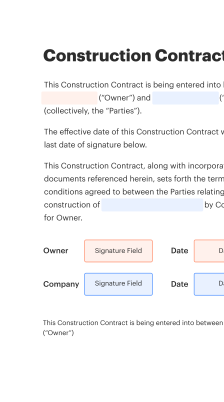
How authorization works in a typical e-signature flow

Authorization integrates policy, authentication, and recordkeeping into the signing lifecycle to produce admissible electronic records.

  • Preparation: Upload document and assign roles.
  • Authentication: Verify signer identity before signing.
  • Signing: Signer applies electronic signature.
  • Archival: Store signed record with audit trail.
Collect signatures
24x
faster
Reduce costs by
$30
per document
Save up to
40h
per employee / month

Quick setup: authorizing electronic signature records

Follow these core steps to establish authorization rules and operational controls for electronically signed documents.

  • 01
    Define policy: Specify acceptance criteria and legal requirements.
  • 02
    Configure authentication: Enable appropriate signer verification methods.
  • 03
    Enable audit trails: Record timestamps, IPs, and actions.
  • 04
    Set retention: Apply retention and access rules.

Managing audit trails for authorized electronic signatures

Maintain and present detailed logs that support the legal standing of electronically signed documents.

01

Capture:

Record signer metadata.
02

Timestamping:

UTC timestamps applied.
03

IP logging:

Store IP addresses.
04

Event history:

Sequential action list.
05

Exportability:

PDF/CSV exports.
06

Retention:

Match legal policy.
be ready to get more

Why choose airSlate SignNow

  • Free 7-day trial. Choose the plan you need and try it risk-free.
  • Honest pricing for full-featured plans. airSlate SignNow offers subscription plans with no overages or hidden fees at renewal.
  • Enterprise-grade security. airSlate SignNow helps you comply with global security standards.
illustrations signature

Workflow settings to support authorized e-signed records

Recommended technical settings map authorization policy to enforceable workflow configurations and automate record controls.

Setting Name Configuration
Reminder Frequency 48 hours
Authentication Level Email + MFA
Retention Period 7 years
Audit Log Export Daily
Document Watermarking Enabled

Platform and device considerations for authorization

Ensure the e-signature platform supports the authentication, audit, and retention features required by your authorization policy before adopting it.

  • Supported browsers: Chrome, Edge
  • Mobile platforms: iOS, Android
  • API access: REST API available

Confirm device compatibility, encryption standards, and integration capabilities so authorized electronic records can be created and accessed reliably across desktop, tablet, and mobile environments without compromising control or evidence.

Security controls supporting authorized electronic signatures

Encryption at rest: AES-256 encryption
Encryption in transit: TLS 1.2+
Access controls: Role-based access
Authentication options: Multi-factor
Audit logging: Comprehensive logs
Data isolation: Tenant separation

Industry scenarios for authorizing electronically signed establishment

Representative case studies show how different sectors formalize authorization to meet legal and operational needs.

Healthcare consent

A regional clinic digitized patient consent forms to speed intake and reduce paper handling.

  • The system used identity verification and a timestamped audit trail to show signer intent.
  • Clinicians accessed signed consents through an integrated EHR workflow, improving availability and compliance.

Resulting in clearer evidence for HIPAA compliance and easier production for audits and care coordination.

University enrollment

A university moved enrollment agreements online to streamline admissions processing and maintain FERPA controls.

  • Documents included signer authentication via institutional credentials and retention policies aligned with FERPA.
  • Admissions teams could retrieve signed records quickly for verification and reporting.

Leading to faster onboarding and defensible records for regulatory reviews and student requests.

Best practices for secure and accurate authorization

Practical controls ensure authorized electronically signed records remain reliable, accessible, and legally defensible across their lifecycle.

Establish clear written authorization policies
Define document eligibility, required authentication levels, retention settings, and roles. Keep policies accessible to staff and review them periodically to reflect legal or operational changes.
Use layered authentication for high-risk transactions
Combine identity provider SSO, multi-factor authentication, and transaction-level verification for sensitive or high-value agreements to strengthen signer assurance and evidentiary value.
Maintain an immutable audit trail and exports
Record all signing events, preserve logs in read-only formats, and enable exportable archives to support audits, e-discovery, and legal proceedings without altering original evidence.
Align retention with legal and business needs
Implement retention schedules and legal-hold processes that reflect regulatory obligations and internal risk tolerance, and test restoration and retrieval procedures regularly.

FAQs About authorize electronically signed establishment

Answers to common operational and legal questions about recognizing and managing electronically signed records in U.S. environments.

Comparison: signNow and DocuSign for authorization support

A concise feature comparison focused on capabilities that directly affect authorization and record integrity in U.S. operations.

Criteria signNow (Recommended) DocuSign
U.S. ESIGN/UETA
Audit Trail Detail Detailed logs Detailed logs
HIPAA Support BAA available BAA available
API Availability REST API REST API
be ready to get more

Get legally-binding signatures now!

Risks of inadequate authorization processes

Regulatory fines: Monetary penalties
Contract disputes: Invalidation risk
Data breaches: Exposure
Operational delays: Workflow stoppage
Reputational harm: Trust loss
Legal costs: Litigation expense

Pricing and plan notes for authorization-capable vendors

High-level pricing indicators and plan features relevant to organizations implementing authorization policies; signNow is listed first as a recommended option for clarity.

Plan / Pricing signNow (Recommended) DocuSign Adobe Sign PandaDoc Dropbox Sign
Starting Price $8/user/month (annual) $10/user/month $12.99/user/month $19/user/month $15/user/month
Enterprise Features SAML, API, CLM options SSO, API, CLM SSO, API, CLM SSO, API, Content SSO, API, Integrations
HIPAA Support BAA available BAA available BAA available Available on request Available on request
Free Trial Yes Yes Yes Yes Yes
Bulk Send Yes Yes Yes Yes Yes

Simplify complex workflows

Create, execute, and manage workflows of any complexity, electronically from virtually anywhere. Scalable eSignature capabilities allow you to share documents with the right people in the correct order and define roles for each recipient. Execute document workflows faster and easier than ever before.

Automate document management

Optimize complex signing processes with airSlate SignNow’s powerful features to enhance your business. Control your automated eSignature workflows to ensure they're running at peak performance with instant notifications and reminders.

Optimize in team collaboration

Bring teams together in a secure, shared environment. Manage documents, use form templates and notifications to create more efficient cross-organization collaboration. Free your employees from having to spend time on repetitive activities so that they can focus on valuable, business-critical tasks.

Integrate into your existing systems

Run your projects with industry-leading integration. Collect Salesforce, Microsoft Teams, and SharePoint all in one business flow. Connect your software to a single system for endless possibilities and more efficiency.

Stay compliant with industry-leading data security

Feel confident knowing that your information remains secure by the most up-to-date in encryption security. airSlate SignNow is GDPR and eIDAS compliant and gives you transparence into your signing process with court-admissible audit trails. Configure user authorization and roles to regulate who has access to what.


walmart logo
exonMobil logo
apple logo
comcast logo
facebook logo
FedEx logo
be ready to get more

Get legally-binding signatures now!