Auto Rickshaw Bill Format for Corporations

See your billing procedure become quick and effortless. With just a few clicks, you can execute all the necessary actions on your auto rickshaw bill format for corporations and other important files from any gadget with web connection.

Award-winning eSignature solution

What an auto rickshaw bill format for corporations entails

An auto rickshaw bill format for corporations is a standardized billing template and workflow that companies use to document employee or vendor auto rickshaw expenses, reconcile fares, and apply corporate policy. It typically includes fields for date, route, distance, fare, driver details, corporate cost center, approval signatures, and any tax or surcharge lines. Corporations adapt formats to integrate with expense systems, payroll, and accounting ledgers so entries are auditable and machine-readable. Using a consistent format reduces manual reconciliation, supports policy enforcement, and helps maintain accurate records for financial controls and reporting requirements.

Why standardized corporate billing matters for auto rickshaw expenses

A consistent format reduces error and streamlines approvals by aligning fields with accounting systems and policy controls.

Why standardized corporate billing matters for auto rickshaw expenses

Common challenges when managing auto rickshaw bills

  • Inconsistent receipts lacking required corporate fields delay reimbursements and force manual review.
  • Missing route or distance data makes tax and mileage allocations inaccurate and compliance difficult.
  • Paper receipts degrade or are lost in transit, preventing reliable audit trails for finance teams.
  • Multiple currencies, surcharges, and rounding rules complicate automated aggregation and accounting entries.

Representative user roles

Finance Manager

A Finance Manager configures the auto rickshaw bill format to match chart of accounts, enforces approval rules, and reviews aggregated spending reports for budgeting and audits. They require exportable data and audit trails to verify accuracy and support month-end close processes.

Field Employee

A Field Employee submits fares using the standardized bill format, attaches photo receipts if needed, and selects cost centers. Clear templates minimize rework, speed reimbursements, and ensure compliance with corporate travel policy for on-the-go expense capture.

Organizations and teams that commonly use an auto rickshaw bill format

Corporate travel teams, finance departments, and operations groups require a standardized bill format to control costs and ensure consistent reporting.

  • Finance teams reconciling employee expenses across multiple regions and vendors.
  • Operations teams tracking field transport spending and route cost optimization.
  • Human resources managing employee reimbursements and policy compliance.

Small field teams, HR for reimbursements, and third-party logistics providers also benefit from template-driven billing to reduce processing time.

Important features for reliable corporate billing

These features support accuracy, compliance, and efficiency when corporations adopt an auto rickshaw bill format for routine expense management.

Field Validation

Real-time validation of required fields reduces submission errors and incomplete records, ensuring each bill contains date, fare, route, and cost center data before it moves forward in the workflow.


Policy Rules Engine

Configurable rules automatically flag out-of-policy fares, limit allowable amounts, and route exceptions to managers to maintain spending controls without manual review of every claim.

Mobile Capture

Mobile-optimized templates let employees photograph receipts and populate fields from OCR, speeding submissions and enabling approvals from smartphones in the field.

Batch Processing

Handle multiple receipts in a single upload, apply collective approvals, and export aggregated entries to accounting systems to streamline high-volume operations.

Custom Fields

Add organization-specific fields like project codes or regulatory identifiers so exported data aligns precisely with internal reporting and compliance requirements.

Export Formats

Support CSV, XLSX, and direct ledger integration so finance teams can ingest bill data into existing accounting and ERP systems without manual reformatting.

be ready to get more

Choose a better solution

Core integrations and template capabilities

Choose features that let the auto rickshaw bill format feed downstream systems, enforce policy, and present audit-ready records for corporate controls.

Google Docs Integration

Create and edit billing templates from Google Docs, then sync fields back to your corporate system so document versions remain consistent and template changes propagate without manual re-entry.

CRM Linking

Attach trip records to customer accounts in your CRM, enabling correlation between transport spend and client activity for better sales expense analytics and client billing reconciliation.

Dropbox Storage

Automatically archive signed receipts and completed bills in Dropbox folders organized by department and date, supporting retention policies and easy retrieval for audits.

Template Library

Maintain customizable templates for different regions, departments, and approval paths to ensure each business unit uses the correct required fields and policy verbiage.
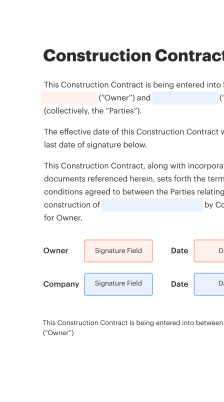
How standardized auto rickshaw billing works within corporate systems

A standardized bill format collects required data, validates entries, and routes documents through approval and accounting systems for reconciliation.

  • Capture: Employee uploads receipt and fills form fields.
  • Validate: System checks required fields and policy rules.
  • Approve: Designated approvers review and sign.
  • Post: Approved entries export to accounting ledgers.
Collect signatures
24x
faster
Reduce costs by
$30
per document
Save up to
40h
per employee / month

Quick setup: configure your auto rickshaw bill template

Follow these basic steps to create a corporate bill format that fits accounting and approval workflows.

  • 01
    Define Fields: List mandatory fields like date, route, fare.
  • 02
    Map Accounts: Connect cost centers and GL codes.
  • 03
    Set Approvals: Create approval tiers for managers.
  • 04
    Publish Template: Distribute format to employees and vendors.

Completing an auto rickshaw bill: step-by-step

A clear process for employees reduces errors and accelerates reimbursement and accounting reconciliation.

01

Start Claim:

Open the template and select expense type.
02

Enter Trip Data:

Add date, origin, destination, and distance.
03

Attach Receipt:

Upload photo or PDF of fare receipt.
04

Add Cost Center:

Select department or project code.
05

Submit for Approval:

Send to assigned manager approver.
06

Finalize Posting:

Finance posts approved entry to ledger.
be ready to get more

Why choose airSlate SignNow

  • Free 7-day trial. Choose the plan you need and try it risk-free.
  • Honest pricing for full-featured plans. airSlate SignNow offers subscription plans with no overages or hidden fees at renewal.
  • Enterprise-grade security. airSlate SignNow helps you comply with global security standards.
illustrations signature

Recommended workflow settings for corporate bill processing

These workflow settings help automate approvals and reduce manual steps when processing auto rickshaw bills at scale.

Workflow Automation Configuration Setting Name Default configuration values and examples
Daily Signer Reminder Frequency Setting 48 hours
Approval Escalation Rule Definition Manager then finance
Maximum Attachment Size Limit 25 MB
Batch Upload Processing Window Every 1 hour
Automatic Export Schedule Midnight daily

Device and browser requirements for managing bills

Corporate bill templates and signing workflows are supported on modern browsers and recent mobile operating systems for reliable capture and signing.

  • Desktop Browsers: Latest Chrome, Edge, Safari
  • Mobile OS: iOS 14+ and Android 9+
  • Supported Apps: Official mobile and web apps

For consistent behavior test templates on target devices, enable camera and file permissions for mobile capture, and ensure corporate network firewalls allow access to required API endpoints for integrations.

Security and authentication elements

Access Control: Role-based access
Encryption: In transit and at rest
Authentication: Multi-factor options
Document Lock: Prevent edits post-approval
Audit Logs: Immutable activity trail
Data Segmentation: Tenant-level isolation

Practical corporate use cases

Two concise examples show how standardized bills reduce administrative work and support compliance in corporate environments.

Regional Sales Reimbursements

A sales team captures auto rickshaw fares with a corporate template that includes client visit codes and cost centers.

  • The template enforces approved fields for date, fare, and client code.
  • Finance gets consistent data for payroll and expense reconciliation.

Resulting in faster reimbursements and clearer regional spend visibility for budgeting.

Field Service Logistics

A field service group uses a digital bill format to log trips between job sites, including distance and service order numbers.

  • The system validates distances and flags out-of-policy routes.
  • Managers receive consolidated trip reports for route optimization.

Leading to improved operational efficiency and lower transport costs.

Best practices for secure and accurate corporate billing

Adopt consistent processes and controls to maintain accuracy and compliance when using an auto rickshaw bill format across teams.

Standardize fields and validation rules across regions
Define the exact data required on every bill, enforce validation to prevent empty or misformatted fields, and maintain a single canonical template per region. Consistency reduces reconciliation time, prevents lost data, and ensures alignment with tax and accounting requirements.
Enable mobile capture with OCR and validation
Allow employees to photograph receipts and automatically extract key fields using OCR, but validate extracted data against known policies to avoid misreads. Combine OCR with mandatory manual checks for critical fields like totals and dates.
Implement tiered approvals and exception handling
Route bills automatically based on policy thresholds and cost centers, and define clear escalation paths for exceptions. Maintain a documented approval chain to simplify audits and speed dispute resolutions.
Retain immutable audit logs for all transactions
Store time-stamped, tamper-evident audit trails for submissions, approvals, and edits to satisfy internal controls and external audits. Ensure logs are exportable and retained according to corporate records retention policy.

FAQs: Common issues and resolutions

Answers to frequent questions about using a corporate auto rickshaw bill format and resolving common submission problems.

Feature comparison: eSignature and billing support

Compare common capabilities related to template integration, authentication, and compliance across leading eSignature providers used for corporate billing workflows.

Signing Criteria and Capability Descriptor signNow Recommended DocuSign Adobe Sign
Template Integration with Google Drive
Mobile Capture and OCR
Advanced Authentication Options MFA MFA MFA
Audit Trail and Tamper Evidence
be ready to get more

Get legally-binding signatures now!

Retention and reconciliation timeline recommendations

Establish schedules for submission, approval, export, and archival to keep records compliant and reconciliations timely.

Receipt Submission Window:

Within 14 days of travel

Manager Approval SLA:

3 business days

Finance Reconciliation Period:

Monthly close cycle

Automated Export Schedule:

Daily at midnight

Document Retention Duration:

Seven years or per policy

Risks of improper billing and weak controls

Financial Errors: Misstated expenses
Policy Violations: Unauthorized reimbursements
Audit Findings: Noncompliance issues
Data Breach: Exposed PII
Operational Delays: Slower approvals
Reputational Harm: Vendor disputes

Pricing and plan comparison for corporate implementations

Summary of typical plan positioning and core limits to consider when selecting an eSignature provider to support a corporate auto rickshaw bill workflow.

Plan Tier and Limits signNow Recommended DocuSign Business Pro Adobe Sign Enterprise HelloSign Business PandaDoc Business
Per-user Pricing Model Fixed per-user rates with volume discounts Per-user tiered pricing Enterprise licensing models Per-user monthly plans Per-user or team pricing
Bulk Send and Templates Included with team plans and API access Available on higher tiers Included with enterprise Available on business plans Included with templates
API Access and Rate Limits API available with clear rate limits and documentation Enterprise API with quotas Enterprise API with SSO API on business tiers API access included
Advanced Compliance Add-ons Optional eID and identity verification Identity verification add-ons Advanced compliance modules Identity verification options Compliance integrations available
Contract Storage and Retention Included cloud storage with retention controls Included with enterprise storage Extensive retention policies Limited storage tiers Cloud storage with retention settings
walmart logo
exonMobil logo
apple logo
comcast logo
facebook logo
FedEx logo
be ready to get more

Get legally-binding signatures now!