Azure Digital Signature Solutions by SignNow

Get rid of paperwork and automate digital document managing for more efficiency and unlimited possibilities. Sign anything from your home, quick and professional. Discover a better way of doing business with airSlate SignNow.

Award-winning eSignature solution

What an azure digital signature is and how it works

An azure digital signature is a cryptographic method that binds a signer to a document using public key infrastructure and standardized digital certificates, often combined with Azure platform services such as Azure Active Directory for authentication. It provides integrity, signer authentication, and non-repudiation through cryptographic hashing and certificate chaining. In practice, organizations deploy azure digital signature workflows via cloud-enabled eSignature solutions like signNow or enterprise middleware, enabling legally admissible electronic agreements while preserving audit records and verification metadata for later validation.

Why use azure digital signature in business processes

Implementing an azure digital signature accelerates signing cycles, improves auditability, and supports regulatory compliance by combining certificate-based signatures with identity management, reducing paper handling and manual errors.

Why use azure digital signature in business processes

Common implementation challenges with azure digital signature

  • Managing certificate lifecycle at scale requires processes for issuance, renewal, revocation, and secure key storage to avoid signature failures or invalidation.
  • Cross-jurisdiction validation can be complex because relying parties may apply different certificate trust rules and root store requirements.
  • Integrating identity systems like Azure AD with signing platforms involves mapping roles, configuring SAML or OAuth flows, and testing multi-factor authentication.
  • Document formatting and PDF/A or archival conversion must be handled carefully to preserve signature integrity during transformations and long-term storage.

Representative user profiles for azure digital signature workflows

IT Administrator

Responsible for configuring Azure AD federation, managing certificate authorities, and enforcing key management policies. The administrator oversees integration with eSignature platforms, sets authentication rules such as MFA, and documents operational procedures for certificate renewal and revocation to ensure uninterrupted signing capability.

Legal Counsel

Reviews signature policies, verifies compliance with ESIGN and UETA for U.S. agreements, and sets requirements for evidence retention and audit trails. Legal counsel defines acceptable signature types, retention periods, and dispute-handling procedures to preserve enforceability of digitally signed documents.

Typical teams and roles that rely on azure digital signature

Organizations across legal, procurement, HR, and IT use certificate-backed signatures to secure critical agreements and automate approvals.

  • Legal teams and compliance officers handling contracts and regulatory filings requiring non-repudiation and verifiable signing chains.
  • Procurement and finance groups executing purchase orders, vendor agreements, and invoices with enforceable electronic signatures.
  • IT and security teams managing certificate issuance, Azure AD integration, and centralized key protection within enterprise controls.

These groups typically coordinate to align identity, certificate policy, and retention requirements before live deployment.

Core capabilities for reliable azure digital signature deployments

These capabilities address authentication, signature format, auditability, and automation requirements needed to operate certificate-backed signing at scale.

Certificate Signatures

Support for X.509 certificate-based signatures, including PAdES and CMS signature formats, enabling cryptographic proof of signer identity and document integrity across verification tools.


Audit Trail

Comprehensive, time-stamped logs capture signer identity, authentication method, IP address, and document events to support dispute resolution and regulatory reviews.

Multi-factor Authentication

Integration with Azure AD and external OTP or hardware tokens to enforce stronger signer verification before issuing certificate-based signatures.

Templates and Roles

Role-based templates let administrators predefine fields, signing sequences, and certificate policies to keep documents consistent and reduce configuration errors.

Bulk Send

Batch sending automates distribution of identical documents to many recipients while preserving individualized signature and certificate bindings for each signer.

API Access

RESTful APIs enable automated generation, signing, and retrieval of signed assets, integrating with backend systems and custom business logic for enterprise workflows.

be ready to get more

Choose a better solution

Integrations that complement azure digital signature workflows

Integrations connect signing workflows with document sources and business systems to reduce friction and preserve context during signing and storage.

Google Docs

Direct integration allows documents created in Google Docs to be pulled into the signing workflow, maintain version history, and return signed copies to the original folder while preserving metadata and access controls for collaboration.

CRM integration

Embedding signing within a CRM pulls account and contact data into templates, auto-fills agreement fields, and records signature events against customer records to maintain a single source of truth for contract lifecycles.

Dropbox

A linked Dropbox connector enables automatic transfer of signed documents back to designated folders, enforces folder-level retention settings, and simplifies backup and access for downstream processes while keeping provenance information intact.

Reusable Templates

Template support stores preconfigured fields, signing roles, and certificate profiles so common document types can be issued quickly with consistent signing requirements and compliance settings across departments.
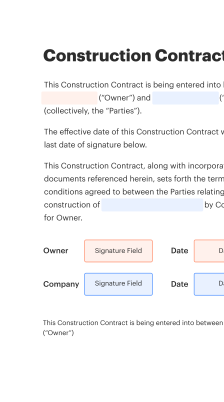
How to create and use an azure digital signature online

Creating and applying an azure digital signature online involves document upload, signer authentication, certificate application, and verification steps managed through an eSignature platform.

  • Upload document: Add the PDF or supported file to the signing system
  • Authenticate signer: Validate identity via Azure AD SSO or additional MFA
  • Apply signature: Sign using a certificate from a trusted CA or HSM
  • Verify record: Generate audit report and signature validation data
Collect signatures
24x
faster
Reduce costs by
$30
per document
Save up to
40h
per employee / month

Quick setup: configuring an azure digital signature workflow

Follow these high-level steps to prepare documents and configure identity and signing settings before rolling out certificate-backed signatures in production.

  • 01
    Prepare document: Standardize PDF formatting and required fields
  • 02
    Configure signers: Define signer order and authentication methods
  • 03
    Attach certificate: Apply certificate-based signature profile
  • 04
    Archive and verify: Store signed PDFs with audit metadata

Managing audit trails for azure digital signature transactions

A practical walkthrough for creating, storing, and retrieving audit evidence for certificate-backed signing events.

01

Capture events:

Log signer identity, timestamp, and IP
02

Store certificate chain:

Include full X.509 chain with document
03

Save validation snapshots:

Record OCSP/CRL responses at signing time
04

Protect logs:

Use append-only storage or WORM
05

Index metadata:

Tag records for quick retrieval
06

Test retrieval:

Verify you can reproduce validation steps
be ready to get more

Why choose airSlate SignNow

  • Free 7-day trial. Choose the plan you need and try it risk-free.
  • Honest pricing for full-featured plans. airSlate SignNow offers subscription plans with no overages or hidden fees at renewal.
  • Enterprise-grade security. airSlate SignNow helps you comply with global security standards.
illustrations signature

Recommended configuration settings for azure digital signature workflows

A concise table of typical workflow settings and suggested values to guide initial configuration and testing before production deployment.

Feature Value
Authentication Method for Remote Signers Azure AD SAML with MFA enforced
Certificate Authority and Issuance Policy Enterprise CA or trusted public CA
Reminder Frequency and Escalation 48 hours then manager escalate
Signing Order and Conditional Routing Sequential with conditional branches
Document Retention and Archival Location Encrypted cloud storage, 7 years

Supported platforms for applying azure digital signature

Azure digital signature workflows run on modern browsers, mobile apps, and desktop integrations when supported by the signing provider and identity integration.

  • iOS & Android app: Native mobile signing
  • Browser support: Chrome, Edge, Safari up-to-date
  • Desktop integration: Windows and macOS clients

Ensure client devices meet current OS and browser security patches, have access to required certificate stores or HSM connectors, and that mobile apps are configured to use Azure AD single sign-on for consistent authentication.

Security controls commonly used with azure digital signature

Encryption at rest: AES-256 encryption
Transport protection: TLS 1.2 or higher
Hardware key storage: HSM-backed keys
Identity integration: Azure AD SSO/SAML
Access controls: Role-based permissions
Immutable logs: Append-only audit trail

Industry examples showing azure digital signature in practice

Two practical implementations illustrate how azure digital signature supports common enterprise workflows across regulated and transactional environments.

Healthcare consent and records

A hospital uses certificate-based signatures for patient consent forms to ensure signer identity and document integrity.

  • Platform applies Azure AD-based authentication for clinician and patient access.
  • This reduces paper handling and secures consent metadata for audits.

Resulting in reliable evidence for compliance with HIPAA and internal audit needs.

Financial services onboarding

A bank implements azure digital signature for account opening documents using corporate certificates and HSM-protected keys.

  • The system enforces multi-factor authentication and automated document tagging.
  • It streamlines verification and reduces manual review time.

Leading to faster customer onboarding while preserving a defensible audit trail for regulators.

Operational best practices for secure azure digital signature use

Adopt these practices to reduce operational risk, preserve legal validity, and maintain consistent signing processes across teams.

Use strong signer authentication methods
Enforce multi-factor authentication through Azure AD and map user accounts to certificate identities to ensure signatures are tied to verified, auditable identities under organizational control.
Retain comprehensive audit trails and metadata
Store time-stamped logs, certificate chains, and validation snapshots with each signed document to support legal admissibility, dispute resolution, and regulatory examinations over the document retention period.
Standardize document templates and roles
Create centrally managed templates with predefined fields and role assignments to reduce errors, control signing order, and guarantee that required clauses and disclosures are consistently included.
Plan certificate lifecycle and key protection
Define processes for certificate issuance, renewal, revocation, and secure HSM-backed key storage; test recovery and replacement procedures to prevent signing interruptions.

FAQs and troubleshooting for azure digital signature

Common questions and practical solutions for errors, verification issues, and operational problems encountered with certificate-based signing.

Feature comparison: azure digital signature support across vendors

Comparing core capabilities for certificate-backed signature support and enterprise integration across leading eSignature providers, with signNow listed first as Recommended.

Feature signNow (Recommended) Adobe Sign DocuSign
Certificate-based signing
Azure AD integration Native SAML SAML
HSM key management Supported Partner HSM Supported
Bulk send capability Bulk Send Bulk Send Bulk Send
be ready to get more

Get legally-binding signatures now!

Document retention and backup timelines for signed records

Define retention and backup schedules that meet legal, regulatory, and operational needs for signed agreements and audit data.

Retention period for signed agreements:

7 years for many financial and contractual records

Audit log preservation period:

Minimum 3–7 years depending on regulations

Backup frequency for signature repositories:

Daily incremental backups plus weekly full

Offsite archival schedule:

Quarterly transfer to long-term archive

Certificate revocation records retention:

Keep OCSP/CRL snapshots for retention window

Risks and potential penalties for improper azure digital signature use

Regulatory fines: Monetary penalties possible
Contract disputes: Invalidated agreements
Data breaches: Confidentiality exposure
Operational downtime: Signing failures interrupt business
Reputational harm: Customer trust loss
Legal costs: Litigation and remediation

Pricing and plan comparison for certificate-capable eSignature solutions

High-level cost and feature indicators for organizations evaluating providers for azure digital signature deployments; signNow appears first with a Recommended label.

Plan signNow (Recommended) Adobe Sign DocuSign HelloSign PandaDoc
Entry-level price per user per month $8–$12 $24 $30 $15 $19
API access included Yes (available) Paid add-on Paid add-on Paid add-on Paid add-on
Enterprise deployment options SAML, SCIM, HSM Enterprise only Enterprise only Enterprise only Enterprise
Document storage and retention Configurable cloud storage Adobe Cloud DocuSign Vault Google Drive link Cloud and local
Compliance certifications ESIGN, UETA, HIPAA ESIGN, eIDAS ESIGN, eIDAS ESIGN ESIGN, SOC 2

Simplify complex workflows

Create, execute, and manage workflows of any complexity, electronically from virtually anywhere. Scalable eSignature capabilities allow you to share documents with the right people in the correct order and define roles for each recipient. Execute document workflows faster and easier than ever before.

Automate document management

Optimize complex signing processes with airSlate SignNow’s powerful features to enhance your business. Control your automated eSignature workflows to ensure they're running at peak performance with instant notifications and reminders.

Optimize in team collaboration

Bring teams together in a secure, shared environment. Manage documents, use form templates and notifications to create more efficient cross-organization collaboration. Free your employees from having to spend time on repetitive activities so that they can focus on valuable, business-critical tasks.

Integrate into your existing systems

Run your projects with industry-leading integration. Collect Salesforce, Microsoft Teams, and SharePoint all in one business flow. Connect your software to a single system for endless possibilities and more performance.

Stay compliant with best-in-class data safety

Feel safe understanding that your data is protected by the most recent in encryption security. airSlate SignNow is GDPR and eIDAS certified and provides you exposure into your eSigning process with court-admissible audit trails. Configure user access permissions and roles to control who has access to what.


walmart logo
exonMobil logo
apple logo
comcast logo
facebook logo
FedEx logo
be ready to get more

Get legally-binding signatures now!