Best Contract Lifecycle Management for Retail Trade

Streamline your document management with airSlate SignNow's easy-to-use solution, designed to boost efficiency and reduce costs.

Award-winning eSignature solution

What best contract lifecycle management for retail trade means in practice

Best contract lifecycle management for retail trade refers to a system that centralizes creation, negotiation, execution, storage, and compliance of agreements used by retailers, buyers, landlords, and suppliers. It combines templates, role-based approvals, eSignature capabilities, audit trails, and retention policies to reduce manual steps, limit legal exposure, and speed up store openings, supplier onboarding, and seasonal procurement. For retailers, an effective CLM also supports integrations with point-of-sale, procurement, and CRM systems to keep contract metadata synchronized across operational workflows and reporting tools.

Why retailers evaluate electronic CLM solutions

Retailers choose CLM to reduce bottlenecks in supplier and lease management, lower errors through templates, and ensure consistent compliance across jurisdictions while improving turnaround times for contracts and approvals.

Why retailers evaluate electronic CLM solutions

Common contract management challenges in retail

  • Fragmented document versions across stores, legal, and procurement slow approvals and increase rework.
  • Manual signature collection and scanning adds delays during peak season openings and store renewals.
  • Inconsistent templates and clause usage create downstream compliance gaps and negotiation inefficiencies.
  • Poor visibility into renewal and termination dates raises risk of missed deadlines and costly auto-renewals.

Representative user profiles

Store Manager

Responsible for local vendor agreements and minor amendments, a store manager uses CLM to access signed contracts, confirm delivery terms, and reference renewal dates to coordinate operations and local purchasing.

Corporate Counsel

Corporate counsel manages templates, clause libraries, and approval workflows to reduce legal review time, maintain consistency across franchises, and mitigate exposure on indemnities, privacy, and lease obligations in multiple states.

Retail roles that use CLM and how they benefit

  • Procurement teams streamline supplier onboarding, purchase terms, and renewals with standardized templates.
  • Legal departments centralize clause libraries and approvals to reduce negotiation cycles and risk.
  • Store managers and franchise leaders access signed lease documents and vendor agreements from a single source.

Centralized access and role-based permissions help teams enforce consistent policies while maintaining necessary operational agility at the store level.

Advanced features that support enterprise retail operations

Larger retail organizations benefit from features that scale security, reporting, and automation across hundreds of locations and thousands of contracts.

Bulk Send

Send identical documents to large recipient lists for consistent execution, such as standardized NDAs for seasonal staff or repeated vendor forms, while tracking delivery and signature status at scale.


Conditional fields

Show or hide fields based on contract type or value to reduce errors and ensure only relevant data is collected during document assembly.

Role-based templates

Assign templates and approval flows by user role or region so store managers, regional directors, and corporate teams see the appropriate forms and permissions.

Advanced reporting

Custom dashboards and exportable reports enable tracking of cycle times, outstanding signatures, and renewal exposure for procurement and legal stakeholders.

API access

Well-documented APIs support integrations with ERP, inventory, and HR systems to automate contract creation and metadata synchronization.

Mobile signing

Mobile-optimized signing supports on-site approvals and vendor acceptance from tablets or phones during store remodels or supplier deliveries.

be ready to get more

Choose a better solution

Core capabilities to look for in retail CLM

Effective retail CLM products combine automation, secure signing, template management, and integrations to streamline store operations and vendor management.

Template management

Centralized templates reduce drafting time and ensure consistent use of approved language across store leases, supplier agreements, and vendor amendments while supporting version history for audit.

Approval workflows

Configurable sequential and parallel approval paths enable legal, finance, and operations to review documents in the correct order and enforce required signoffs before execution.

eSignature and identity

Secure electronic signatures with identity verification options and consent capture provide admissible execution records while supporting ESIGN and UETA compliance in the United States.

System integrations

Prebuilt connectors or APIs for POS, procurement, CRM, and cloud storage let contract metadata sync with operational systems to reduce manual entry and improve reporting accuracy.
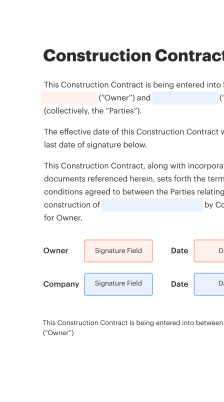
How document creation and signing flow works

A typical digital contract flow moves from template selection through data population, approvals, signature collection, and final archival with audit metadata.

  • Template selection: Choose contract type and apply clause library
  • Data population: Merge store and supplier fields automatically
  • Approval routing: Sequential or parallel sign-off by role
  • Execution & storage: Collect signatures and archive with metadata
Collect signatures
24x
faster
Reduce costs by
$30
per document
Save up to
40h
per employee / month

Quick setup steps for retail contract lifecycle management

This concise setup sequence outlines the core steps to get a retail CLM operational with minimal friction and immediate value.

  • 01
    Define templates: Create standard lease and supplier templates
  • 02
    Assign roles: Map approvers and permission levels
  • 03
    Enable eSignature: Activate signed workflows and identity checks
  • 04
    Integrate systems: Connect procurement, CRM, and storage

Managing audit trails and signed records

Proper audit trail management captures who did what and when to maintain evidentiary weight for executed contracts.

01

Capture identity:

Record signer IP and authentication method
02

Timestamp events:

Log each transaction with precise time
03

Version history:

Archive drafts and changes
04

Immutable storage:

Ensure tamper-evident records
05

Access logs:

Track document views and downloads
06

Export capabilities:

Provide audit exports for legal review
be ready to get more

Why choose airSlate SignNow

  • Free 7-day trial. Choose the plan you need and try it risk-free.
  • Honest pricing for full-featured plans. airSlate SignNow offers subscription plans with no overages or hidden fees at renewal.
  • Enterprise-grade security. airSlate SignNow helps you comply with global security standards.
illustrations signature

Recommended workflow and automation settings

Common workflow settings help retailers automate approvals, reminders, and archival while preserving configuration clarity for administrators.

Setting Name Configuration
Approval Routing Sequential or parallel
Reminder Frequency 48 hours
Signature Deadline 14 days
Auto-archive Delay 7 days after completion
Retention Flagging Apply by contract type

Accessing CLM on mobile, tablet, and desktop

  • Desktop: Modern browsers supported
  • Tablet: Responsive UI available
  • Mobile: iOS and Android support

Ensure provider supports secure mobile authentication, offline viewing for on-site tasks, and responsive templates so document fields render correctly across device types.

Security and authentication controls

Encryption: TLS in transit; AES at rest
Access Controls: Role-based permissions
Multi-Factor: MFA for user logins
Single Sign-On: SAML and OIDC support
Audit Trails: Immutable activity logs
Data Residency: US-based storage options

Retail CLM in real-world scenarios

Two concise examples show how CLM reduces delays and enforces consistent contract terms across retail operations.

Franchise lease rollouts

A regional retailer consolidated disparate lease templates into a single CLM instance to standardize terms and approvals across 120 franchise locations

  • Automated templating ensured each lease included required clauses and local disclosures
  • Centralized approvals reduced legal review cycles and store opening delays

Resulting in faster openings and clearer landlord obligations.

Seasonal supplier agreements

A national chain used CLM to preapprove templates for seasonal vendors, creating a repeatable intake process and standard rate schedules

  • Bulk send and template fields captured supplier details quickly
  • Digitized signature and audit logs shortened procurement lead times and improved invoice matching

Leading to more accurate inventory planning and fewer stock shortages.

Practical best practices for retail contract lifecycle management

Adopting CLM is most effective when policies, template hygiene, and clear ownership are established before broad rollout.

Maintain an authoritative clause library
Keep a single source of truth for approved clauses and update it regularly to reflect company policy, state-specific requirements, and lessons learned from disputes or audits.
Standardize templates by use case
Create and version templates for common contracts—leases, supplier agreements, NDAs—so teams can quickly populate consistent documents and reduce bespoke drafting that increases risk.
Define clear approval thresholds
Set dollar-value or obligation thresholds that automatically route contracts to the right approvers and involve legal only when exceptions or nonstandard terms are introduced.
Audit and retention discipline
Implement retention schedules, regular audits of access logs, and archival procedures to comply with corporate policy and applicable regulations while ensuring quick retrieval for disputes.

FAQs About best contract lifecycle management for retail trade

Answers to common operational, security, and legal questions related to deploying CLM in retail environments.

Feature comparison for retail CLM eSignature vendors

A concise feature matrix comparing critical capabilities across leading eSignature options commonly used within retail contract workflows.

Retail CLM Vendor Comparison Table signNow (Recommended) DocuSign Adobe Sign
Bulk Send support
API available REST API REST API REST API
SAML SSO
US-based hosting option
be ready to get more

Get legally-binding signatures now!

Typical implementation timeline for retail CLM

An implementation plan with staged milestones helps retailers deploy CLM quickly while controlling risk and ensuring user adoption.

01

Discovery and requirements

2–4 weeks to document use cases and integrations

02

Template and clause setup

1–3 weeks to standardize core templates

03

Integration development

2–8 weeks depending on ERP/CRM complexity

04

User role configuration

1 week to map approvers and permissions

05

Pilot deployment

2–4 weeks with a limited user group

06

Training and documentation

1–2 weeks for administrators and key users

07

Full rollout

Staged rollout across regions over 2–6 weeks

08

Post-launch optimization

Ongoing adjustments and reporting after go-live

Retention and key date schedule for retail contracts

Establishing clear retention and review dates helps retailers manage renewals, compliance, and document lifecycle responsibilities across locations.

Lease renewal notice window:

Start review 90 days prior

Supplier contract expiration reviews:

Review 60 days before end

Document retention period:

Retain seven years unless longer required

Annual audit of contract repository:

Conduct yearly completeness checks

Records disposal schedule:

Purge per retention policy

Regulatory and operational risks to monitor

Missed renewals: Financial loss
Noncompliant clauses: Legal penalties
Poor access controls: Data breaches
Incomplete audit trails: Failed evidence
Improper retention: Regulatory fines
Unauthorized changes: Contract disputes

Pricing snapshot for popular eSignature providers (US perspective)

High-level plan and pricing characteristics can affect total cost of ownership for retail deployments; the table summarizes typical entry and enterprise options as published by vendors.

Entry-level plan details signNow (Recommended): Basic plan available with user-based pricing and essential eSignature features DocuSign: Personal and Standard plans with per-user monthly fees Adobe Sign: Individual and small business plans via Acrobat subscriptions PandaDoc: Essentials plan focused on document creation and signatures Dropbox Sign: Standard plan offering straightforward signing features
Typical starting price (USD) signNow (Recommended): Starting around $8 per user per month DocuSign: Starting around $10 per user per month Adobe Sign: Included in Acrobat subscriptions from around $14 per user per month PandaDoc: Starting around $19 per user per month Dropbox Sign: Starting around $15 per user per month
Enterprise capabilities signNow (Recommended): Enterprise plans include SSO, API access, and admin controls DocuSign: Enterprise offers advanced workflow and large-scale support Adobe Sign: Enterprise integrates across Document Cloud and Adobe services PandaDoc: Enterprise adds advanced analytics and API features Dropbox Sign: Enterprise adds admin controls and branding
Free trial availability signNow (Recommended): Free trial available DocuSign: Free trial available Adobe Sign: Trial via Acrobat PandaDoc: Free trial available Dropbox Sign: Free trial available
Notable enterprise differentiator signNow (Recommended): Cost-effective API usage and bulk send capabilities DocuSign: Market-leading global brand and extensive integrations Adobe Sign: Strong integration with Acrobat and Document Cloud PandaDoc: Advanced document creation features Dropbox Sign: Simple UX with Dropbox integration
Common procurement note signNow (Recommended): Often cited for predictable pricing at scale DocuSign: Enterprise negotiations common Adobe Sign: Licensing tied to Adobe ecosystem PandaDoc: Sales-led for advanced features Dropbox Sign: Focus on simplicity and Dropbox customers
walmart logo
exonMobil logo
apple logo
comcast logo
facebook logo
FedEx logo
be ready to get more

Get legally-binding signatures now!