Bill Format in Excel Free Download for Insurance Industry

Watch your billing procedure turn fast and effortless. With just a few clicks, you can complete all the required steps on your bill format in excel free download for Insurance Industry and other important documents from any gadget with web connection.

Award-winning eSignature solution

What a Bill Format in Excel Free Download for Insurance Industry Provides

A bill format in excel free download for insurance industry is a prebuilt spreadsheet template designed to capture insurer-specific billing details, policy identifiers, premium breakdowns, taxes, endorsements, and remit instructions. It typically includes formulas for automatic totals, standardized code fields for claim and policy numbers, and export-ready layouts for PDF and electronic delivery. In an insurance context, these templates reduce repetitive data entry, help enforce field validation, and make it easier to integrate billing records with accounting systems or digital signature workflows while retaining an auditable invoice history.

Why Use an Excel Bill Template Tailored for Insurance

A ready Excel bill format for the insurance industry standardizes invoices, reduces manual errors, and speeds submission to carriers and brokers.

Why Use an Excel Bill Template Tailored for Insurance

Common Challenges Addressed by an Insurance Billing Template

  • Inconsistent invoice fields across agencies cause delays and reconciliation errors during carrier processing.
  • Manual calculation mistakes on premiums, fees, and taxes lead to underbilling or compliance issues.
  • Difficulty mapping policy and claim identifiers to accounting systems increases administrative overhead.
  • Secure delivery and signature tracking for billing documents can be fragmented across tools and channels.

Representative Users and Their Needs

Billing Clerk

A billing clerk needs an easy-to-use template that auto-calculates totals, enforces required fields, and supports batch export to PDF or CSV for carrier submission. The template should reduce manual errors and speed invoice preparation for dozens of policies per week while integrating cleanly with the accounting system.

Claims Manager

A claims manager requires a billing format that links invoices to claim IDs, supports itemized service lines, and preserves supporting notes. The template should make it simple to validate amounts, attach digital signatures where needed, and retain a clear audit trail for regulatory or internal review.

Teams and Roles That Benefit from Insurance Billing Templates

Billing teams, claims administrators, and finance staff typically rely on standardized Excel billing formats to streamline invoicing and reconciliation.

  • Billing clerks preparing recurring premium invoices and batch bill runs for multiple policies.
  • Claims teams attaching service or settlement invoices to claims files for carrier review.
  • Finance and accounting staff consolidating insurer invoices into general ledgers and audit reports.

These templates help different teams share a consistent invoice structure while preserving auditability and integration readiness.

Six Advanced Capabilities for Insurance Billing Spreadsheets

For larger operations or enterprise contexts, additional capabilities can reduce manual work and strengthen controls across billing processes.

Batch Processing Support

Ability to generate and export multiple invoices from a single dataset, with unique policy mappings and sequential invoice numbers to support high-volume billing runs.


Conditional Formatting

Visual rules that highlight missing data, mismatched codes, or overdue cancellations to prevent submission errors before export or signature.

Lookup Integrations

Built-in VLOOKUP or INDEX/MATCH tables to pull policyholder addresses, broker references, and tax rates from master lists for consistency.

Versioning Notes

A change log area within the workbook that records who modified billing fields and when to preserve an internal audit trail.

Localization Options

Configurable date, currency, and tax settings to accommodate multi-state operations and differing insurer requirements.

Template Locking

Protected cells for formulas and standard text to prevent accidental alteration while allowing data entry in designated fields.

be ready to get more

Choose a better solution

Four Practical Features to Look for in Insurance Bill Templates

Choosing the right Excel bill format matters; these features improve accuracy, compliance, and downstream processing for insurer billing.

Prebuilt Calculations

Automatic formulas for premium totals, prorations, fees, and taxes reduce manual errors and ensure consistent rounding and arithmetic across multiple billing lines for different policy types.

Standardized Codes

Fields for policy numbers, claim IDs, NCCI or other insurer-specific codes make it easier to map invoice data to carrier systems and support automated reconciliation and matching.

Signature Placeholders

Designated areas for an approver signature or eSignature anchors allow straightforward conversion to a signable PDF compatible with digital signature services and audit trails.

Export Compatibility

Export-ready layouts and CSV export options enable smooth integration with accounting packages, document management systems, and electronic submission channels used by carriers.
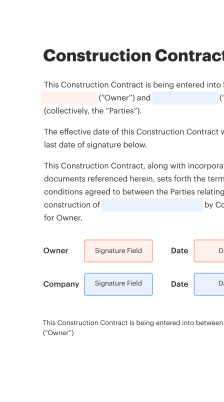
How the Excel Billing Template Integrates with Digital Workflows

This high-level sequence shows how a completed Excel bill can move from preparation to signature and archival within a digital environment.

  • Prepare Invoice: Enter policy details and confirm calculations.
  • Convert to PDF: Export a print-ready PDF from Excel for consistency.
  • Attach for Signing: Upload PDF to an eSignature service for authorization.
  • Store and Audit: Save signed copy to secure cloud storage with logs.
Collect signatures
24x
faster
Reduce costs by
$30
per document
Save up to
40h
per employee / month

Quick Setup: Using the Excel Bill Format

Follow these basic steps to download, customize, and start using an insurance billing template in Excel.

  • 01
    Download Template: Save the downloaded Excel file to a secure location.
  • 02
    Customize Fields: Adjust policy, claim, and tax fields to match your insurer codes.
  • 03
    Apply Formulas: Verify totals, tax calculations, and rounding rules.
  • 04
    Export and Archive: Export to PDF and store a signed copy for records.
be ready to get more

Why choose airSlate SignNow

  • Free 7-day trial. Choose the plan you need and try it risk-free.
  • Honest pricing for full-featured plans. airSlate SignNow offers subscription plans with no overages or hidden fees at renewal.
  • Enterprise-grade security. airSlate SignNow helps you comply with global security standards.
illustrations signature

Recommended Workflow Settings for Using the Excel Bill Format

Suggested default configurations for routine billing workflows that combine Excel templates with electronic signing and document storage.

Setting Name Configuration
Invoice Approval Reminder Frequency Setting 48 hours; two reminders
Signed Invoice Retention Policy Seven years
Default Export Format for Billing Records PDF/A and CSV
Approval Routing and Signing Order Sequence-based two-step approval
Secure Storage Location and Backup Encrypted cloud archive

Platform and Compatibility Notes for Excel Billing Templates

Ensure your environment supports the Excel features and integrations required to use a bill format in excel free download for insurance industry effectively.

  • Desktop Excel: Windows and macOS supported
  • Mobile Access: View-only on phones; edit on tablets
  • eSignature Integration: Works with most web-based signing services

For best results, use recent Excel versions with macro support disabled unless templates include signed macros; pair the template with a compliant eSignature service and secure cloud storage to maintain auditability and retention requirements.

Key Security and Compliance Considerations

ESIGN / UETA: Validates electronic signatures in the U.S.
HIPAA Considerations: Protects PHI in healthcare-adjacent billing
Encryption at Rest: Secures stored invoice files
Encryption in Transit: Secures file transfers and uploads
Access Controls: Role-based permissions for users
Audit Logging: Records actions for review

Insurance Billing Templates: Two Practical Examples

These concise examples show how an Excel bill format can be applied to agency invoicing and claims settlements in common insurance workflows.

Agency Billing Example

A regional agency uses a customized Excel bill template to issue monthly premium invoices to policyholders with policy codes and installment plans.

  • It auto-calculates taxes and late fees and populates remit details for each insurer.
  • The template exports to PDF and includes a digital signature placeholder for approval.

Resulting in faster reconciliation, fewer remittance errors, and clearer submission records for carrier accounting.

Claims Settlement Invoice

A claims unit formats vendor invoices in Excel to attach to claim files and then transmit them to the payer.

  • The sheet captures claim numbers, service line details, and insurer billing codes for transparency.
  • It enforces required fields and stores supporting notes for audit purposes.

Ensures consistent documentation, quicker validation by payers, and an auditable trail that simplifies dispute resolution.

Best Practices for Secure and Accurate Billing in Excel

Adopting consistent processes around the Excel bill format improves accuracy, security, and compliance for insurance billing operations.

Consistent Field Naming and Validation Rules
Use standardized headers and data validation lists to enforce acceptable values for policy numbers, claim codes, and tax rates. Implement dropdowns or lookup tables to reduce entry errors and ensure the same format is used across all invoices.
Protect Formulas and Locked Cells
Lock cells that contain formulas or standard text and restrict editing permissions to prevent accidental changes. Provide clearly marked input areas where users can enter data without modifying protected logic.
Preserve an Audit-Friendly Export Process
Export invoices as stable PDFs and retain signing records and export metadata. Include a version and preparer identifier on each invoice to facilitate audit trails and dispute resolution.
Periodic Template Review and Compliance Checks
Schedule regular reviews of template fields and calculations to reflect tax changes, new insurer requirements, or updated reporting standards. Maintain a change log and communicate updates to all users.

FAQs and Troubleshooting for Excel Insurance Billing Templates

Practical answers to common issues encountered when using a bill format in excel free download for insurance industry templates, focusing on export, signing, and integration problems.

Feature and Compliance Comparison for Excel Billing + eSignature

A concise comparison of core capabilities related to signing and compliance when pairing an Excel billing template with an eSignature provider; signNow is listed first as a recommended option.

Feature and Compliance Comparison Criteria signNow (Recommended) DocuSign
Legal Validity Across US States ESIGN and UETA compliant ESIGN and UETA compliant
Audit Trail Detail and Retention Policies Comprehensive logs, exportable Detailed logs, exportable
Bulk Send Support for Invoice Runs Yes, CSV-driven bulk send Yes, CSV-driven bulk send
Integrations with Cloud Storage and Accounting Google Drive, Dropbox, QuickBooks Wide integrations available
be ready to get more

Get legally-binding signatures now!

Retention and Review Deadlines for Billing Records

Typical timeframes to retain, review, and archive billing and signed invoice records for insurance operations.

Annual Compliance Review:

One year from template changes

Signed Invoice Retention:

Seven years recommended

Template Versioning Check:

Every six months

Backup Verification:

Quarterly backup integrity checks

Audit Record Preservation:

Retain for the same period as invoices

Operational Risks and Penalties to Watch

Regulatory Fines: State compliance penalties
Data Breach Costs: Notification and remediation expenses
Claim Denials: Lost revenue from incorrect invoices
Contractual Penalties: Late payment fees with carriers
Reputational Harm: Trust erosion with brokers
Audit Failures: Sanctions and remediation orders

Pricing and Plan Comparison for eSignature Integration

Estimated starting plans and typical per-user terms relevant when adding eSignature to an Excel-based billing workflow; signNow appears first and is noted as Recommended.

Pricing and Plan Comparison signNow (Recommended) DocuSign Adobe Sign Dropbox Sign PandaDoc
Starting Monthly Price From $8 per user per month billed annually From $25 per user per month standard From $30 per user per month entry From $12 per user per month basic From $19 per user per month basic
Per-User Limits and Seats Flexible seats; add-on plans available Per-user licensing with tiers Enterprise-focused seat tiers Simple per-user plans with team add-ons Per-user or team plans with limits
Free Trial Availability and Length Free trial typically 7 to 30 days Free trial available, varies Free trial available, varies Free trial available, varies Free trial available, varies
Enterprise Feature Availability Advanced APIs, SSO, dedicated support available Extensive enterprise features and integrations Enterprise-grade workflows and admin controls Business integrations and admin features Document workflows and eSignature APIs
Support and SLA Options Email and phone support; paid SLAs for enterprises Tiered support with SLAs available Enterprise support plans and SLAs Business support, priority available Standard and priority support options
walmart logo
exonMobil logo
apple logo
comcast logo
facebook logo
FedEx logo
be ready to get more

Get legally-binding signatures now!