Check Caller Number with SignNow's Secure Solutions

Get rid of paper and automate digital document processing for higher productivity and unlimited opportunities. Sign any papers from a comfort of your home, quick and accomplished. Experience a greater strategy for running your business with airSlate SignNow.

Award-winning eSignature solution

What check caller number does and why it matters

check caller number is a phone-based verification capability used to confirm a caller's phone number as part of an identity or transaction flow. It pairs caller ID validation and optional SMS or voice one-time codes with eSignature events to reduce impersonation risk and strengthen signer binding. In signNow, this function can be tied to authentication steps, logging, and consent capture so the verified phone number is recorded with the transaction audit trail for compliance and later dispute resolution.

Legal and compliance context for phone verification

Using check caller number supports signer authentication practices that align with ESIGN and UETA principles by providing a reliable electronic identifier and an auditable record tied to the signer and transaction.

Legal and compliance context for phone verification

Common implementation challenges

  • Unreliable caller ID data across carriers can produce false negatives and require fallback authentication methods.
  • International numbers and roaming may complicate verification when carrier metadata is inconsistent or absent.
  • User privacy concerns arise if phone numbers are stored without clear retention policies and consent.
  • Integration requires mapping verified numbers to signer records without introducing manual reconciliation work.

Representative user profiles

Small Business

A small-business operations manager uses check caller number to confirm customer phone numbers before completing service agreements. They rely on concise audit records and minimal configuration so verification adds trust without complex integrations or extra administrative overhead.

Healthcare Admin

A healthcare administrator implements phone verification as a secondary authentication step for telehealth consent forms. They need HIPAA-aware handling of phone data and a clear audit trail linking the verified number to the signed consent document for regulatory review.

Typical users and organizational contexts

Teams that handle remote onboarding, finance approvals, and regulated documentation commonly adopt check caller number to strengthen identity assertions during eSignature flows.

  • Sales teams handling contracts with remote prospects.
  • HR teams onboarding employees remotely.
  • Healthcare administrators managing patient authorizations.

Adoption tends to be highest where phone records are already part of customer profiles and where an auditable phone-based authentication step reduces downstream risk and manual verification work.

Additional capabilities that complement phone verification

Beyond basic verification, consider complementary features that enhance identity assurance and workflow robustness.

Multi-Factor Support

Ability to combine phone verification with email confirmation and knowledge-based checks to raise assurance levels for high-risk transactions and regulatory needs.


API Hooks

APIs expose verification status and allow external systems to trigger or consume verification events for automated decisioning, system synchronization, and reporting.

Custom Error Handling

Administrators can define fallback messages, alternate channels, or manual review triggers when verification fails to preserve completion rates without eroding security.

Regional Carrier Support

Support for major carriers and country-specific delivery considerations reduces failures and improves OTP delivery reliability for domestic and cross-border signers.

Configurable Timeouts

Settings control code expiration and retry windows so administrators balance security posture with user convenience and expected response times.

Reporting Dashboards

Operational reports show verification success, failure reasons, and throughput to support continuous improvement and compliance monitoring.

be ready to get more

Choose a better solution

Core tools for effective phone verification

Key capabilities support practical deployment: configurable authentication, clear audit trails, integration with signer records, and fallback options for delivery failures.

Configurable Authentication

Administrators can select between SMS OTP, voice OTP, and caller ID checks and set parameters such as code expiration, retry limits, and regional carriers to match organizational risk and user population needs.

Audit Integration

Every verification event is logged with timestamps, method used, and the phone number validated so the audit trail shows the exact authentication step tied to the signature for compliance and dispute resolution.

Signer Field Mapping

Verified numbers are linked to signer profile fields and document metadata, enabling downstream workflows to reference the authenticated phone without manual reconciliation or separate record keeping.

Delivery Fallbacks

When a chosen verification channel fails, the system can automatically attempt an alternate method or display secure guidance, reducing failed transactions while preserving security and user experience.
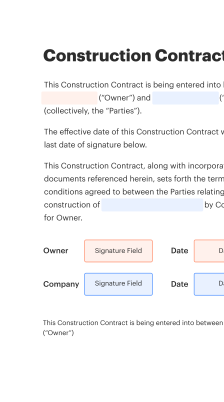
How check caller number integrates with signing flows

Phone verification is invoked as an authentication step during signing, either prior to or during the signature action, and recorded in the final document audit trail.

  • Pre-Sign: Verify phone before signer accesses document.
  • During-Sign: Request OTP while signer completes signature.
  • Record: Attach verification event to audit log.
  • Fallback: Offer alternate verification if SMS fails.
Collect signatures
24x
faster
Reduce costs by
$30
per document
Save up to
40h
per employee / month

Quick setup: enabling check caller number

A short setup sequence configures phone verification for signing events; this covers enabling the feature, selecting authentication methods, and mapping to signer fields.

  • 01
    Enable Feature: Turn on phone verification in security settings.
  • 02
    Choose Method: Select SMS or voice OTP as preferred.
  • 03
    Map Fields: Link verified number to signer profile.
  • 04
    Test Flow: Run a test signature with verification active.

Operational steps for running a verification-enabled signing session

A typical flow includes configuration, signer notification, verification action, and record capture—each step is straightforward to implement and monitor.

01

Configure:

Set verification parameters.
02

Notify:

Send signing link with instructions.
03

Verify:

Trigger SMS or voice OTP.
04

Sign:

Complete eSignature action.
05

Log:

Record verification details.
06

Review:

Monitor outcomes and metrics.
be ready to get more

Why choose airSlate SignNow

  • Free 7-day trial. Choose the plan you need and try it risk-free.
  • Honest pricing for full-featured plans. airSlate SignNow offers subscription plans with no overages or hidden fees at renewal.
  • Enterprise-grade security. airSlate SignNow helps you comply with global security standards.
illustrations signature

Configuration settings for verification-enabled workflows

Below are example workflow settings and suggested values to enable check caller number in a signing process.

Setting Name Configuration
Caller ID Verification Mode Caller ID check
OTP Method SMS or Voice
Code Expiration 5 minutes
Retry Limit 3 attempts
Audit Record Level Full event log

Supported devices and technical prerequisites

check caller number works on common desktop and mobile platforms when the signer can receive SMS or voice calls.

  • Web Browsers: Modern TLS-capable
  • Mobile Devices: SMS or voice-capable phones
  • API Access: REST endpoints supported

For best results, ensure phone numbers are normalized to international E.164 format, that the signing environment supports secure TLS connections, and that your SMS/voice provider supports the regions where signers are located.

Security controls associated with phone verification

Caller ID Validation: Checks presenting number
SMS One-Time Code: Time-limited code
Voice OTP: Automated call delivery
Audit Logging: Timestamped events
Encryption in transit: TLS-protected channels
Access Controls: Role-based limits

Industry examples of check caller number in use

Practical examples show how phone verification reduces manual checks and creates an auditable, phone-linked signer record for common workflows.

Telehealth consent

A clinic requests telehealth consent forms by email and triggers a phone-based OTP before allowing signature

  • The system confirms the patient's phone number on file
  • The clinic records the verified number alongside consent metadata

Leading to clearer audit evidence and fewer contested signatures when care records are reviewed.

Remote account opening

A financial services intake flow uses caller ID plus SMS OTP before completing account agreements

  • The intake system matches the verified number to the applicant profile
  • Verifying the number reduces reliance on manual ID checks

Resulting in faster onboarding and a stronger audit trail for regulatory review.

Recommended practices for secure and reliable verification

Follow established practices to minimize friction, protect privacy, and maintain reliable verification records across your signNow workflows.

Obtain explicit consent and inform users before verification
Before triggering check caller number, provide clear notice describing why the phone number will be verified, how it will be used, and how long verification records will be retained. This promotes transparency and aligns with privacy obligations while reducing user confusion.
Use multi-channel authentication with fallback options
Combine caller ID checks with SMS or voice OTP as needed and configure automatic fallbacks to ensure successful verification even when a single channel is unreliable, improving completion rates without weakening security.
Limit retention and document where numbers are stored
Keep verified phone numbers only as long as required for compliance and operational needs, and document retention policies tied to each workflow to satisfy audits and privacy regulations such as HIPAA where applicable.
Monitor verification performance and error rates
Track delivery failures, retry rates, and geographic patterns to refine carrier selection and retry logic; use monitoring to detect fraud trends or systemic issues that may require policy or technical changes.

FAQs and troubleshooting for check caller number

These frequently asked questions cover common setup, failure, and compliance scenarios encountered when deploying phone-based verification within signing processes.

Feature comparison: phone verification across eSignature vendors

A concise comparison highlights where vendor capabilities differ for phone-based verification and related audit features.

Criteria signNow (Recommended) DocuSign Adobe Sign
Caller ID verification
SMS OTP
Audit trail detail Comprehensive Comprehensive Comprehensive
API verification support
be ready to get more

Get legally-binding signatures now!

Retention milestones and recommended timeframes

Establish documented retention points for verified phone numbers and verification logs to support audits and regulatory requirements.

Immediate audit log capture:

Store verification event at transaction time.

Short-term retention for disputes:

90 days recommended for routine dispute windows.

Long-term archival:

Retain for up to 7 years if required by policy.

Purge schedule:

Automate deletion after retention period.

Consent records retention:

Keep consent proof for five years.

Risks and compliance consequences

Misattribution: Invalid identity claims
Privacy breach: Unauthorized data exposure
Regulatory fines: Noncompliance penalties
Contract disputes: Signature challenges
Operational delays: Verification failures
Reputational harm: Loss of trust

Representative pricing snapshot for verification-capable plans

Pricing varies by plan and verification support; the table lists typical entry-level or verification-ready tiers and indicative monthly pricing to help compare costs.

Plan signNow (Recommended) DocuSign Adobe Sign HelloSign PandaDoc
Free or trial Free trial available Free trial available Free trial available Free trial available Free trial available
Entry monthly price $8/user/mo $10+/user/mo $14.99/user/mo $15/user/mo $19/user/mo
Verification included Included (limits may apply) Add-on or higher tier Add-on or higher tier Included basic Included basic
API access Available with plans Available with plans Available with plans Available with plans Available with plans
Enterprise options Custom enterprise pricing Custom pricing Custom pricing Custom pricing Custom pricing

Simplify complex workflows

Create, execute, and manage workflows of any complexity, electronically from virtually anywhere. Scalable eSignature capabilities allow you to share documents with the right people in the correct order and define roles for each recipient. Execute document workflows faster and easier than ever before.

Automate document management

Optimize complex signing processes with airSlate SignNow’s powerful features to enhance your business. Control your automated eSignature workflows to ensure they're running at peak performance with instant notifications and reminders.

Optimize in team collaboration

Bring teams together in a secure, shared environment. Manage documents, use form templates and notifications to create more efficient cross-organization collaboration. Free your employees from having to spend time on repetitive activities so that they can focus on valuable, business-critical tasks.

Integrate into your existing systems

Run your projects with industry-leading integration. Collect Salesforce, Microsoft Teams, and SharePoint all in one business flow. Connect your software to a single system for endless possibilities and more productiveness.

Stay compliant with best-in-class data protection

Feel safe with the knowledge that your information is protected by the newest in encryption security. airSlate SignNow is GDPR and eIDAS certified and offers you exposure into your eSigning procedure with court-admissible audit trails. Configure user authorization and rights to regulate who has access to what.


walmart logo
exonMobil logo
apple logo
comcast logo
facebook logo
FedEx logo
be ready to get more

Get legally-binding signatures now!