Clear Conversion Rate Optimization Proposal Template Initial

Eliminate paperwork and improve document management for more productivity and limitless possibilities. eSign any papers from a comfort of your home, quick and accomplished. Explore a greater strategy for doing business with airSlate SignNow.

Award-winning eSignature solution

What a clear conversion rate optimization proposal template initial is

A clear conversion rate optimization proposal template initial is a structured document designed to outline objectives, scope, methods, deliverables, timelines, and pricing for a first-phase CRO engagement. It standardizes client-facing proposals so teams can present hypotheses, planned A/B tests, analytics requirements, and success metrics consistently. The template helps align stakeholders on conversion goals, data sources, required access, and expected incremental improvements while providing a repeatable starting document for legal and procurement reviews. For U.S. businesses it also supports inclusion of compliance and data-handling notes relevant to customer data and tracking.

Legal validity and compliance considerations for the initial proposal

The initial proposal can be executed and retained as a binding agreement when combined with an appropriate signature process that complies with ESIGN and UETA requirements in the United States.

Legal validity and compliance considerations for the initial proposal

Common challenges when using an initial CRO proposal template

  • Unclear hypotheses that make it difficult to design measurable tests and determine success criteria within the project timeline.
  • Incomplete data access or analytics permissions that delay baseline measurement and slow rollout of optimization experiments.
  • Overly technical language in the proposal that confuses stakeholders and reduces alignment on scope and deliverables.
  • Lack of documented responsibilities for implementation, QA, and reporting which leads to missed deadlines and diluted results.

Representative user profiles for the template

In-house CRO Lead

An in-house CRO lead uses the template to document test hypotheses, data requirements, and prioritization for internal stakeholders. They require clear deliverables, timeline estimates, and access lists to coordinate engineering and analytics resources across sprints.

Agency Project Manager

An agency project manager uses the template to present a first-phase engagement to new clients, clarifying responsibilities, reporting cadence, and expected outcomes so contracts and kickoff activities proceed without ambiguity.

Teams and roles that commonly use the initial CRO proposal

Marketing, product, UX, analytics, and agency teams use the initial CRO proposal to align on goals and resources.

  • Product managers who need a clear scope and measurable objectives for experiments and feature-related optimization.
  • Marketing teams planning conversion funnels, landing page tests, and budget allocation across campaign variants.
  • External CRO agencies that require a repeatable client onboarding document to standardize scoping and timelines.

The template supports cross-functional communication and creates a single source of truth for initial conversion optimization work.

Additional elements to include in a robust initial template

These supplementary items help with operational clarity, stakeholder alignment, and smoother handoffs during optimization work.

Acceptance criteria

Define how success is verified for each deliverable, including reporting formats, acceptance windows, and sign-off authorities to avoid post-delivery disputes.


Access checklist

A concise list of system permissions, analytics account access, and any third-party credentials required to run tests and collect baseline data.

Budget breakdown

Line-item costs for discovery, implementation, and reporting phases, including any third-party tool licenses and expected engineering effort estimates.

Communication plan

Regular status update frequency, primary contacts, and escalation paths so stakeholders know how and when progress will be reported.

Risk log

A short register of known technical and business risks with mitigation measures to make the client aware of potential blockers and contingencies.

Post-test actions

Outline how winning variations are implemented, validated, and rolled into production along with expected QA checks and measurement follow-up.

be ready to get more

Choose a better solution

Core template features that improve clarity

Include these four structural elements to make the initial CRO proposal concise, complete, and easier to approve.

Scope summary

A brief statement of the project scope that lists included pages, user segments, and primary conversion actions, allowing stakeholders to confirm boundaries before work begins.

Measurement plan

A detailed section that identifies baseline metrics, events to be tracked, required analytics permissions, and the statistical approach for A/B testing to ensure results are measurable and reproducible.

Deliverables and timeline

A clear schedule of artifacts such as wireframes, test implementations, and reporting deliverables paired with milestone dates and responsible parties to reduce ambiguity.

Compliance notes

A section that declares data handling practices, references ESIGN and UETA for signatures, and flags industry-specific requirements such as HIPAA or FERPA when applicable.
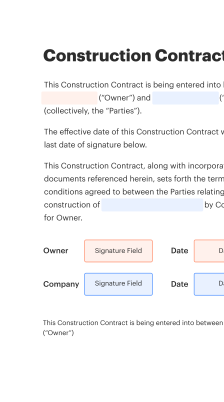
How to create and distribute the initial proposal online

This sequence describes creating, reviewing, and sharing the proposal using online document tools and eSignature platforms.

  • Draft: Populate the template with project specifics.
  • Internal review: Obtain technical and legal sign-off.
  • Send to client: Share secure link for review and signature.
  • Store: Retain signed copy in secure archive.
Collect signatures
24x
faster
Reduce costs by
$30
per document
Save up to
40h
per employee / month

Step-by-step setup for using the initial proposal template

Follow these practical steps to prepare and issue the initial conversion optimization proposal.

  • 01
    Define goals: State primary conversion KPI and target.
  • 02
    List assumptions: Capture hypotheses and known constraints.
  • 03
    Specify data needs: Detail analytics events and access.
  • 04
    Set timeline: Provide test dates and reporting windows.
be ready to get more

Why choose airSlate SignNow

  • Free 7-day trial. Choose the plan you need and try it risk-free.
  • Honest pricing for full-featured plans. airSlate SignNow offers subscription plans with no overages or hidden fees at renewal.
  • Enterprise-grade security. airSlate SignNow helps you comply with global security standards.
illustrations signature

Workflow automation settings to support the proposal lifecycle

Set up automation to manage reminders, approvals, and storage for the initial proposal to reduce manual follow-up and ensure consistent retention.

Workflow automation setting name header Default configuration values for automation and routing
Reminder Frequency 48 hours
Approval Sequence Two-step approval
Retention Policy 7 years
Signature Authentication Email OTP
Document Storage Location US region archive

Device and platform compatibility for proposal creation and signing

The initial proposal and signing workflows should work consistently across desktop, tablet, and mobile browsers and within supported vendor mobile apps.

  • Desktop browsers: Chrome, Edge, Safari supported
  • Mobile browsers and apps: Responsive pages and native apps
  • Offline signing considerations: Limited; requires sync when online

Verify that required authentication methods and document rendering are tested across the platforms used by signers to avoid accessibility or formatting issues during execution.

Security and authentication features to include

Encryption at rest: AES-256 standard
Transport encryption: TLS 1.2+ enforced
Multi-factor authentication: Optional for accounts
Role-based access: Granular permission control
Audit logging: Immutable action records
Data residency options: US-based storage available

Industry examples using the initial CRO proposal

Two short case examples show how the template frames scope, tests, and reporting across different industries.

Ecommerce optimization

A retailer needed clearer test prioritization to reduce cart abandonment

  • Documented three primary hypotheses for checkout, shipping, and discounts
  • Defined analytics events and sample sizes for tests

Resulting in a structured experiment calendar and clearer reporting that reduced time-to-insight and improved conversion measurement accuracy.

Higher education lead generation

A university admissions office wanted measurable improvements in form completions

  • The template defined funnel steps and required privacy controls for student data
  • It specified FERPA-friendly tracking and consent language for campaigns

Leading to a compliant test plan that preserved data protections while improving lead quality and reporting consistency.

Best practices for secure and accurate initial proposals

Apply these practices to keep proposals clear, auditable, and aligned with legal and operational requirements.

Use clear, measurable objectives and avoid vague language
Write objectives as specific conversion metrics with target values and timeframes so there is an objective basis for evaluating test outcomes and project success.
Include a documented measurement plan and sample size calculations
Provide the statistical approach and required sample sizes up front to prevent underpowered tests and ambiguous findings that cannot support decisions.
Record required data access and permissions explicitly
List analytics accounts, user roles, and any tagging or event changes needed before tests to prevent delays during the execution phase.
Keep compliance and data privacy considerations visible
Note ESIGN/UETA requirements, and where relevant reference HIPAA or FERPA controls and data minimization practices to maintain legal alignment.

FAQs and common troubleshooting for the initial proposal

Answers to frequent questions and steps to resolve common issues when preparing or executing the initial CRO proposal.

Feature availability: signNow compared to a market leader

A concise feature matrix compares core capabilities for initial proposal workflows across two platforms.

Feature and vendor capability matrix signNow (Recommended) DocuSign
Basic eSignature
Bulk Send
Template library
HIPAA support
be ready to get more

Get legally-binding signatures now!

Key legal and operational risks to note

Noncompliance exposure: Regulatory penalties possible
Data breach risk: Custodial liability increases
Contract ambiguity: Disputes over deliverables
Delayed access: Project timelines slip
Incorrect metrics: Misleading performance claims
Intellectual property: Ownership conflicts occur

Pricing and commercial features across eSignature providers

Compare entry-level pricing, trial availability, API access, HIPAA support, and enterprise SLA information across five vendors to inform procurement considerations.

Pricing comparison table signNow (Recommended) DocuSign Adobe Sign Dropbox Sign PandaDoc
Starting price per user From $8.00 per user per month billed annually From $10.00 per user per month billed annually From $12.99 per user per month billed annually From $8.25 per user per month billed annually From $19.00 per user per month billed annually
Free trial availability Free trial available for new accounts Free trial available with limited features Free trial for business plans Free trial available via Dropbox Free trial available for new accounts
API and developer access REST API with SDKs and sandbox environment Comprehensive API and developer tools Robust API with Adobe integrations API access via Dropbox developer tools Public API with extensive documentation
HIPAA/compliance options HIPAA-ready offerings and BAAs available HIPAA support on specific enterprise plans Business Associate Agreement available HIPAA support requires enterprise discussion HIPAA support available with agreement
Enterprise support and SLA Enterprise plans include SLA and dedicated support Enterprise-level SLAs and account teams SLA offered on enterprise contracts Enterprise support with prioritized SLAs Enterprise plans include response SLAs

Simplify complex workflows

Create, execute, and manage workflows of any complexity, electronically from virtually anywhere. Scalable eSignature capabilities allow you to share documents with the right people in the correct order and define roles for each recipient. Execute document workflows faster and easier than ever before.

Automate document management

Optimize complex signing processes with airSlate SignNow’s powerful features to enhance your business. Control your automated eSignature workflows to ensure they're running at peak performance with instant notifications and reminders.

Optimize in team collaboration

Bring teams together in a secure, shared environment. Manage documents, use form templates and notifications to create more efficient cross-organization collaboration. Free your employees from having to spend time on repetitive activities so that they can focus on valuable, business-critical tasks.

Integrate into your existing systems

Run your projects with industry-leading integration. Collect Salesforce, Microsoft Teams, and SharePoint all in one business flow. Connect your software to a single system for endless possibilities and more efficiency.

Remain compliant with best-in-class data security

Feel safe knowing that your data is protected by the most up-to-date in encryption security. airSlate SignNow is GDPR and eIDAS certified and offers you exposure into your eSigning experience with court-admissible audit trails. Configure user authorization and rights to manage who has access to what.


walmart logo
exonMobil logo
apple logo
comcast logo
facebook logo
FedEx logo
be ready to get more

Get legally-binding signatures now!