Contract Creation Software for Customer Support

Transform the way you manage documents with easy-to-use eSigning solutions. Empower your team to collaborate efficiently and enhance customer satisfaction.

Award-winning eSignature solution

What contract creation software for customer support is and why it matters

Contract creation software for customer support is a set of tools that lets teams draft, send, and manage agreements and consent documents within customer interactions. It combines templates, field logic, signature capture, and integrations with CRMs and knowledge bases so agents can complete approvals during a ticket or chat. For customer support contexts the focus is speed, clarity, and auditability: documents must be accurate, signed by the correct parties, and tracked for compliance. Properly configured software reduces manual error, shortens resolution times, and preserves an evidentiary record of agreements tied to support cases.

Why accurate contract creation matters in support workflows

Using contract creation software for customer support standardizes documents and captures legally valid signatures while reducing processing time and errors.

Why accurate contract creation matters in support workflows

Common operational challenges support teams face

  • Fragmented templates across agents create inconsistent contract language and increase legal review time.
  • Manual signature collection causes delays and forces multiple follow-ups with customers by phone or email.
  • Poorly integrated systems require copy/paste work and increase the chance of attaching incorrect documents to tickets.
  • Insufficient audit trails make it difficult to verify who signed what and when for compliance purposes.

Typical user roles and responsibilities

Support Agent

Primary users who prepare and send contracts during customer interactions. They select templates, populate fields with ticket information, request eSignatures, and attach the signed document back to the case record while following preset approval rules.

Support Manager

Oversees configuration and access, monitors turnaround and compliance metrics, and coordinates with legal or IT on retention, audit logs, and escalation for disputed or high-risk agreements.

Teams that typically use contract creation software for customer support

Support organizations use contract creation tools to resolve billing, returns, and consent items directly within customer interactions.

  • Frontline support agents handling order changes, returns, and account authorization requests.
  • Support managers and QA teams reviewing signed interactions for accuracy and compliance.
  • Legal and compliance teams maintaining templates and retention policies across support documentation.

These tools are also used by adjacent teams such as legal, sales operations, and compliance to ensure consistent document handling.

Key features customer support teams rely on

Support workflows require specific document tools; these features reduce friction and keep records accurate and auditable.

Templates

Prebuilt, legally reviewed templates with merge fields and conditional logic enable agents to produce consistent, context-specific contracts without manual drafting or repeated legal review for routine support scenarios.


Bulk Send

Ability to send the same document to multiple recipients or many customers at once for common notices or updates while tracking individual status and responses for each recipient.

Conditional Fields

Fields that appear or change based on answers or account attributes reduce errors and ensure customers only see relevant clauses, simplifying completion on any device.

Multi-party Signing

Support for sequential or parallel signing flows that include customers, internal approvers, and third parties, with clear routing and acceptance records for each signer.

Audit Trail

Immutable event logs capture signatures, timestamps, and verification methods, producing an evidentiary record suitable for compliance and dispute resolution.

APIs

APIs and webhooks let ticketing systems automate document generation, status updates, and archival, preserving context and reducing manual handling.

be ready to get more

Choose a better solution

Core integrations that streamline support workflows

Integrations reduce manual work by syncing data and documents between support systems, CRMs, and file storage services.

CRM integration

Two-way syncing with systems like Salesforce lets agents pull account fields into contracts and push signed documents back to the contact or case record for consistent recordkeeping and reporting across teams.

Cloud storage

Connectors to Google Drive and Dropbox provide centralized storage and versioning so signed documents are archived under controlled folders and easily retrievable by support and legal teams.

Knowledge base linking

Link templates and clause libraries to the knowledge base so agents use approved language and reduce legal review for frequently used customer agreements or consent forms.

Ticketing platform

Embed document generation within ticket UIs to let agents start, send, and track contract workflows without leaving the support console, speeding resolution and preserving context.
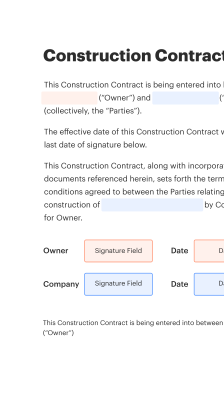
How online contract creation works in a support interaction

A typical online flow integrates document assembly with the ticketing process, from draft to signed record.

  • Assemble: Populate a template using ticket or CRM data.
  • Send: Deliver the document by email or in-chat link.
  • Sign: Customer signs electronically on any device.
  • Store: Attach the signed file and audit log to the ticket.
Collect signatures
24x
faster
Reduce costs by
$30
per document
Save up to
40h
per employee / month

Quick setup to get agents creating customer contracts

A short sequence to configure templates, permissions, and common workflows before using contract creation in live support.

  • 01
    Create templates: Draft standardized documents with placeholders for ticket data.
  • 02
    Define roles: Assign who can send, edit, and approve contracts.
  • 03
    Set automations: Configure reminders and routing rules for approvals.
  • 04
    Test flow: Run sample tickets to validate fields and attachments.

How audit trail management works within support contracts

Audit trails capture the lifecycle of a document to support compliance and dispute resolution.

01

Event capture:

Record each user action with timestamp.
02

Signature metadata:

Store signer IP, method, and time.
03

Version control:

Preserve original and final document versions.
04

Access logs:

Log viewer identities and downloads.
05

Exportable reports:

Provide CSV or PDF compliance exports.
06

Retention linkage:

Tie logs to retention policies securely.
be ready to get more

Why choose airSlate SignNow

  • Free 7-day trial. Choose the plan you need and try it risk-free.
  • Honest pricing for full-featured plans. airSlate SignNow offers subscription plans with no overages or hidden fees at renewal.
  • Enterprise-grade security. airSlate SignNow helps you comply with global security standards.
illustrations signature

Typical workflow settings to configure for support contracts

These configuration items represent common defaults and settings support teams adjust to match operational needs.

Feature Default Value
Reminder Frequency 48 hours
Signature Routing Sequential
Default Template Folder Support Templates
Document Expiration 30 days
Webhook Notifications Enabled

Supported devices and platform requirements for contract creation

Contract creation software for customer support is typically accessible via web browsers, mobile apps, and integrations embedded in support consoles.

  • Desktop browsers: Chrome, Edge, Safari supported.
  • Mobile apps: iOS and Android native apps.
  • Ticketing embeds: Widget or API integration supported.

Ensure browser versions meet vendor requirements, mobile apps are updated, and API credentials are provisioned for embedded use; confirm accessibility and security configurations before rolling out to agents.

Security and protection features for support contracts

Encryption at rest: AES-256 encryption applied to stored documents.
TLS in transit: TLS 1.2+ for data transmission security.
Role-based access: Granular permissions for agents and admins.
Audit logging: Immutable event records for every action.
SOC 2 compliance: Third-party attestation of controls.
HIPAA support: BAA available for regulated data.

Industry use cases showing how support teams employ contract creation

Real-world examples illustrate how contract creation tools shorten workflows and document outcomes across common support scenarios.

Onboarding and service add-ons

Support agents present standard add-on agreements during onboarding to capture customer consent efficiently

  • Template-driven fields pull account data automatically
  • Customers complete and eSign directly in the support interaction, reducing follow-up emails

Resulting in faster provisioning and clear acceptance records that link to the customer account for audit purposes.

Refunds and liability waivers

When refunds require a signed acknowledgment, agents use preapproved waiver templates to document terms

  • Conditional fields display only relevant clauses based on refund reason
  • Signed waivers are attached to the ticket and stored with an unalterable audit trail

Leading to consistent decisions, demonstrable consent, and faster dispute resolution when customers question chargebacks.

Best practices for secure and accurate contract creation in support

Follow these operational and security practices to keep customer contracts reliable, auditable, and compliant.

Use standardized, legally reviewed templates only
Maintain a template library controlled by legal or compliance so agents cannot alter core clauses. This reduces inconsistent language, limits risk, and ensures any required disclosures are always present. Templates should include clearly labeled placeholders and conditional logic to prevent missing or irrelevant clauses.
Limit editing rights and use role controls
Grant edit permissions sparingly and use role-based access to separate drafting, sending, and admin functions. Restricting rights reduces accidental changes and ensures a clear chain of custody for who prepared or modified a document prior to signature.
Enable audit trails and retention policies
Capture a complete, tamper-evident audit log including timestamps, IP addresses, and signer authentication method. Combine logs with documented retention schedules to meet legal and internal recordkeeping requirements and simplify audits.
Train agents on data minimization and verification
Instruct support staff to include only necessary personal data in contracts, confirm customer identity before sending, and verify that the selected template and terms match the support outcome to avoid disputes.

FAQs About contract creation software for customer support

Answers to common questions support teams and administrators ask when adopting or operating contract creation software in customer-facing workflows.

Vendor feature comparison for digital signing in support workflows

A concise feature comparison between common digital-signature providers frequently used in customer support contexts.

Feature Comparison signNow (Recommended) DocuSign Adobe Sign
Legally binding in US
API availability
Mobile app support
HIPAA BAA option
be ready to get more

Get legally-binding signatures now!

Document retention and backup timelines for support contracts

Define retention periods that reflect legal, regulatory, and business needs for signed support documents.

Short-term operational records:

30-90 days for temporary support artifacts.

Customer agreement retention:

Typically 3-7 years depending on jurisdiction.

Financial and billing contracts:

Retain for seven years where required.

HIPAA-regulated records:

Follow HIPAA retention and BAA terms.

Backup frequency:

Daily backups with 30-day restore windows.

Risks and potential penalties from poor handling

Regulatory fines: Monetary penalties.
Breach liability: Legal exposure.
Invalid agreements: Contracts may be unenforceable.
Reputational damage: Loss of customer trust.
Data retention failures: Noncompliance with retention rules.
Dispute costs: Increased legal expenses.

Pricing and plan characteristics across popular eSignature vendors

High-level pricing attributes to consider; actual price and plan details should be confirmed on each vendor's official pricing pages.

Providers signNow (Recommended) DocuSign Adobe Sign HelloSign PandaDoc
Free trial or tier Trial available Trial available Trial available Limited free Trial available
Entry-level monthly price From $8/user From $10/user From $12/user From $15/user From $19/user
Enterprise offerings Available Available Available Available Available
API availability Included in paid plans Included in paid plans Included in paid plans Included in paid plans Included in paid plans
HIPAA support option BAA available BAA available BAA available BAA available upon request BAA available
walmart logo
exonMobil logo
apple logo
comcast logo
facebook logo
FedEx logo
be ready to get more

Get legally-binding signatures now!