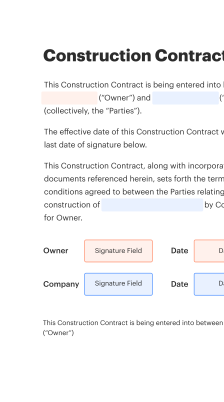
Contract Recipient Initial for Secure eSignatures
What contract recipient initial means and why it matters
Why consistent initial capture is important for contracts
Using contract recipient initial fields reduces ambiguity and supports enforceability, while helping organizations meet ESIGN and UETA standards for electronic intent and recordkeeping.
Common challenges when collecting recipient initials
- Recipients miss initial fields because placement is unclear or fields are optional, creating incomplete records.
- Multiple-party documents require initials on specific pages, increasing chance of omissions and delays.
- Legacy paper processes make reconciliation of initials across versions error-prone and audit-intensive.
- Inconsistent authentication increases risk that initials are later contested in compliance reviews.
Who interacts with initial fields and why
Contract Manager
Contract Managers prepare documents, place initial fields at required locations, and enforce field requirements. They review transaction logs to confirm each recipient completed required initials and resolve missing initials before finalizing agreements, ensuring each page has documented acknowledgement.
Field Sales Rep
Sales representatives send contracts with initial fields to customers for quick acknowledgement of terms. They monitor reminders and expiration settings so that deals do not stall due to missing initials, and coordinate with legal for any exceptions or amendments.
Teams and roles that commonly use recipient initials
Legal, sales, HR, and operations teams all rely on recipient initials for page-level consent and traceability.
- Legal teams who need page-by-page acknowledgement for clauses and redlines.
- Sales and account teams who require initials on order confirmations and SOWs.
- HR and benefits administrators collecting initials on policy acknowledgements.
Organizations implementing initials in digital workflows see clearer audit trails and fewer post-execution disputes when processes are configured consistently.
Choose a better solution
Core features that support reliable recipient initial capture
Initial Field Types
Distinct initial field objects allow senders to require initials separately from full signatures, customize field labels, and control placement to ensure recipients provide page-level acknowledgement where necessary.
Required Initials
Enforce initial completion before allowing progression or final signature; this prevents incomplete documents and ensures all required pages are acknowledged prior to document finalization.
Conditional Initials
Display or require initials only when specific conditions are met, such as selected options or contract values, reducing unnecessary fields and streamlining recipient experience.
Bulk Initialing Tools
Support for repeating initial placement across similar documents or template-driven batches speeds processing for multi-page, high-volume agreements and maintains consistent field locations.
How recipient initials are captured in an electronic workflow
-
Sender configures: Defines initial fields and requirements
-
Recipient receives: Opens document via secure link
-
Initials applied: User taps or types initials in fields
-
System logs: Records event in audit trail
Quick setup: add recipient initial fields to a document
-
01Prepare document: Upload final PDF or Word file
-
02Place initial fields: Drag initial objects to required pages
-
03Assign recipients: Map initials to specific signer roles
-
04Send and monitor: Send envelope and track completions
Why choose airSlate SignNow
-
Free 7-day trial. Choose the plan you need and try it risk-free.
-
Honest pricing for full-featured plans. airSlate SignNow offers subscription plans with no overages or hidden fees at renewal.
-
Enterprise-grade security. airSlate SignNow helps you comply with global security standards.
Recommended workflow settings for initial-heavy documents
| Setting Name | Configuration |
|---|---|
| Reminder Frequency | 48 hours |
| Expiration Period | 30 days |
| Initial Field Enforcement | Required |
| Recipient Authentication | Email+SMS |
| Audit Logging Enabled | Always on |
Platform and device requirements for capturing initials reliably
Most modern desktop and mobile browsers support initial capture, but optimal results depend on using supported versions and secure connections.
- Desktop browsers: Chrome, Edge, Safari
- Mobile platforms: iOS and Android
- Network: TLS-secured access
For enterprise deployments, verify browser compatibility matrices, enable secure TLS connections, and ensure mobile apps are installed and updated; confirm that authentication methods like SMS and MFA are available to recipients to maintain auditability and compliance.
Practical examples of recipient initial usage
Real Estate Closing
A closing package requires initials on disclosures and page-by-page acknowledgements to confirm borrower receipt and review
- Initial fields placed on each disclosure page
- Reduces errors and ensures each clause is acknowledged
Resulting in streamlined closings and clearer audit records.
Healthcare Consent Forms
A hospital uses initials on multi-page consent forms to document patient acknowledgement of specific procedures and risks
- Initial fields are set as required and paired with user authentication
- This provides clear proof of informed consent and maintains record integrity for audits
Leading to stronger compliance with HIPAA and institutional policies.
Best practices for secure and accurate recipient initials
Common issues and troubleshooting for recipient initials
- Recipient cannot find initial fields
Confirm the sender placed initial fields on the correct pages and assigned them to the recipient role; check for overlapping objects and ensure the document version matches the one sent so fields render correctly for the recipient.
- Initials not recorded in audit trail
Verify that the platform logging feature is enabled and that the event filters include initial field events; if logging is enabled, export the transaction report to confirm timestamps and IP addresses for the initial events.
- Initials rejected during verification
Check field validation settings and accepted character rules; if initials are image-based, ensure the system's verification settings accept graphical initials or require typed initials per policy.
- Recipient reports a signing error
Confirm the recipient's browser or app is up to date, advise clearing cache or using a supported browser, and check that any required authentication steps such as SMS codes were completed correctly.
- Missing initials after document completion
Review the completed document to confirm initial fields were not set as optional; if optional, request a corrected execution with required initial fields enforced and record the amended transaction.
- Dispute over who initialed a page
Provide the full audit trail with timestamps, authentication events, and IP addresses; corroborate initials with the signer’s authenticated session details to support dispute resolution.
Feature availability for recipient initials across vendors
| signNow (Recommended) | DocuSign | Adobe Acrobat Sign | Initial support | Initial support | Initial support |
|---|---|---|---|
| Initial fields support | |||
| Bulk initials | |||
| Page-level enforcement | |||
| HIPAA-ready options |
Get legally-binding signatures now!
Risks and penalties from poor initial management
Comparing common plan features related to initials and workflows
| Features | signNow (Recommended) | DocuSign | Adobe Acrobat Sign | Dropbox Sign | PandaDoc | Initial fields included | Initial fields included | Initial tools included | Initial features included | Initial support included |
|---|---|---|---|---|---|
| API availability | Yes, REST API available | Yes, robust API | Yes, REST API | Yes, API available | Yes, API available |
| Mobile apps | iOS and Android apps | iOS and Android apps | iOS and Android apps | iOS and Android apps | iOS and Android apps |
| Enterprise workflows | Advanced workflow options | Advanced workflow options | Enterprise workflows | Workflow templates | Workflow automation |
| Free trial or plan | Free trial available | Free trial available | Free trial available | Free tier available | Free trial available |
| Customer focus | SMBs and enterprises | Large enterprises | Enterprises and teams | Small businesses | Sales and document teams |
Simplify complex workflows
Create, execute, and manage workflows of any complexity, electronically from virtually anywhere. Scalable eSignature capabilities allow you to share documents with the right people in the correct order and define roles for each recipient. Execute document workflows faster and easier than ever before.
Automate document management
Optimize complex signing processes with airSlate SignNow’s powerful features to enhance your business. Control your automated eSignature workflows to ensure they're running at peak performance with instant notifications and reminders.
Optimize in team collaboration
Bring teams together in a secure, shared environment. Manage documents, use form templates and notifications to create more efficient cross-organization collaboration. Free your employees from having to spend time on repetitive activities so that they can focus on valuable, business-critical tasks.
Integrate into your existing systems
Run your projects with industry-leading integration. Collect Salesforce, Microsoft Teams, and SharePoint all in one business flow. Connect your software to a single system for endless possibilities and more productiveness.
Stay compliant with best-in-class data security
Feel confident knowing that your information remains secure by the most up-to-date in encryption security. airSlate SignNow is GDPR and eIDAS certified and offers you visibility into your eSigning experience with court-admissible audit trails. Configure user authorization and rights to control who has access to what.