Contract Signature Verification with SignNow

Eliminate paperwork and automate document management for increased performance and unlimited possibilities. Sign anything from a comfort of your home, quick and feature-rich. Discover a better manner of doing business with airSlate SignNow.

Award-winning eSignature solution

What contract signature verification means in practice

Contract signature verification refers to the processes and technical controls used to confirm that a digital signature on a contract is authentic, that the signer consented, and that the document has not been altered. In U.S. contexts verification commonly combines identity checks, cryptographic evidence, and an immutable audit trail that records timestamps, IP addresses, and user actions. Proper verification supports legal enforceability under ESIGN and UETA, helps meet industry rules like HIPAA where applicable, and reduces disputes by preserving verifiable metadata tied to the signing event.

Why reliable verification matters for contracts

Effective contract signature verification reduces legal risk, speeds agreement acceptance, and preserves evidentiary detail for audits and disputes. It ensures signatures are attributable, documents remain intact, and organizations meet relevant U.S. compliance expectations.

Why reliable verification matters for contracts

Common verification challenges

  • Incomplete signer identity information can weaken the evidentiary value of a signature and invite disputes.
  • Missing or poorly formatted audit trails make it difficult to demonstrate sequence of events in legal or regulatory reviews.
  • Inconsistent authentication methods across systems create gaps that complicate cross-platform verification and chain-of-custody.
  • Relying on manual checks or paper records increases processing time and raises the chance of human error.

Representative user profiles

General Counsel

A General Counsel relies on contract signature verification to confirm signatory identity, ensure chain-of-custody for important agreements, and preserve admissible audit trails for potential disputes while aligning practices with ESIGN and UETA.

HR Manager

An HR Manager uses verification to collect employment documents and benefits consents securely, to authenticate remote signers, and to maintain compliant records that limit exposure to privacy and retention risks.

Organizations and roles that use contract signature verification

Companies across legal, HR, sales, and healthcare functions use verification to secure signed contracts and meet regulatory demands.

  • Legal teams validating enforceability and preserving evidentiary details for litigation or compliance.
  • HR departments obtaining signed employment and benefits documents while protecting sensitive personal data.
  • Sales and procurement teams accelerating deal cycles with verifiable signatures and automated records.

Verified signatures reduce administrative friction and provide documented proof of consent and document integrity across business functions.

Key features that support accurate verification

Effective verification relies on a combination of features that together prove identity, capture intent, and protect document integrity.

Identity checks

Options such as email verification, SMS codes, knowledge-based authentication, and government ID checks provide increasing levels of signer assurance depending on risk and regulatory needs.


Tamper seals

Cryptographic document hashing and sealed PDF capabilities detect post-signature modifications and preserve an auditable fingerprint tied to the exact content at signing time.

Detailed audit trail

Time-stamped logs include signer actions, IP addresses, and device metadata, forming the core evidence package used to confirm the sequence and authenticity of a signing event.

Role-based controls

Granular permissions let administrators restrict who can send, modify, or access verified documents, aligning verification processes with organizational policies and separation-of-duty requirements.

Retention & export

Configurable retention policies and export options enable compliant long-term storage of verified contracts along with their associated metadata for audits and legal holds.

API access

Developer APIs support embedding verification workflows into custom applications, enabling automated identity checks and programmatic retrieval of verification artifacts for downstream systems.

be ready to get more

Choose a better solution

Integration points for contract signature verification

Integrations extend verification into the systems users already rely on, reducing friction and keeping records centralized.

Google Docs

Embed signing workflows directly within Google Docs to initiate verified signatures from familiar documents, preserve original formatting, and send with predefined authentication settings for consistent verification across collaborators.

CRMs

Connect verification to CRM records to auto-populate recipient data, trigger signature requests from sales workflows, and store signed contracts on the corresponding account for an auditable sales history.

Dropbox

Store executed, verified contracts in Dropbox folders with metadata; automated archiving ensures signed documents remain accessible to teams while preserving verification artifacts.

Single sign-on

Integrate SSO to centralize user identity, simplify authentication for signers within an organization, and align access controls with corporate policies for verified transactions.
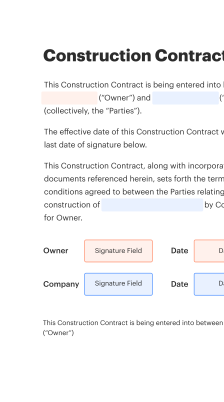
How online contract signature verification typically works

A streamlined verification flow balances signer convenience with evidentiary controls to produce legally sound signed contracts.

  • Initiate: Upload file and configure fields.
  • Authenticate: Apply chosen signer authentication step.
  • Sign: Signer applies signature and confirms.
  • Record: System stores signature metadata and audit trail.
Collect signatures
24x
faster
Reduce costs by
$30
per document
Save up to
40h
per employee / month

Quick steps to perform contract signature verification

Follow these core steps to configure and complete a verified signature transaction using an eSignature solution.

  • 01
    Prepare document: Upload and place signature fields.
  • 02
    Set authentication: Choose email, SMS, or ID check.
  • 03
    Send for signature: Notify recipients and set reminders.
  • 04
    Verify and store: Capture audit trail and archive.

Managing audit trails and verification records

Maintain reliable records by following consistent capture, storage, and access practices for verification artifacts.

01

Capture events:

Log every signer action and timestamp.
02

Store metadata:

Archive IP, device, and auth details.
03

Protect records:

Restrict access to authorized personnel.
04

Preserve originals:

Keep final signed PDF and hashes.
05

Export options:

Provide export in common formats.
06

Audit procedures:

Document access and review cycles.
be ready to get more

Why choose airSlate SignNow

  • Free 7-day trial. Choose the plan you need and try it risk-free.
  • Honest pricing for full-featured plans. airSlate SignNow offers subscription plans with no overages or hidden fees at renewal.
  • Enterprise-grade security. airSlate SignNow helps you comply with global security standards.
illustrations signature

Typical verification workflow settings

These common settings are used to configure verification across signing workflows to meet operational and compliance requirements.

Workflow Setting Name For Table Default Configuration Values For Settings
Signer authentication method Email verification or SMS code
Audit trail retention period Seven years
Document tamper protection Apply cryptographic seal
Automated reminders 48 hours, 72 hours
Recipient role sequencing Sequential or parallel signing

Supported platforms for verification workflows

Contract signature verification works across web, desktop, and native mobile environments, allowing signers to complete transactions on multiple device types.

  • Web browsers: Recent Chrome, Edge, Safari
  • Mobile apps: iOS and Android native
  • Desktop support: Windows and macOS compatible

Ensure devices run supported OS and browser versions and use secure networks; enforce up-to-date TLS and device security policies to preserve verification integrity and reduce the risk of interception or tampering.

Core security and verification controls

Audit trail: Comprehensive event log
Encryption at rest: AES-256 encryption
Encryption in transit: TLS 1.2+ transport
Two-factor auth: Optional 2FA methods
Document hashing: SHA-256 digest
Access controls: Role-based policies

Industry examples of verification in use

Representative case scenarios show how different teams apply contract signature verification to reduce friction and support compliance.

Healthcare provider

A hospital implements electronic consent forms with identity verification and a secure audit trail to protect PHI and meet HIPAA requirements

  • Uses two-step signer verification and signed timestamps
  • Speeds patient intake and reduces paper handling

Resulting in auditable consent records and lower administrative overhead.

Commercial leasing

A property management firm deploys verified eSignatures for lease agreements and tenant addenda to ensure enforceability

  • Adds email verification and IP logging for each signer
  • Reduces move-in delays and supports remote execution

Leading to faster occupancy processing and clearer dispute resolution.

Best practices for secure and accurate verification

Follow these practical controls to strengthen the reliability and legal defensibility of verified electronic signatures.

Use appropriate authentication level
Match the authentication method to transaction risk: email or SMS for low risk, and stronger ID or two-factor methods for high-value or regulated contracts.
Standardize audit capture
Ensure every signing workflow consistently records timestamps, IP addresses, device metadata, and document hashes to preserve a complete evidence set.
Protect signed documents
Apply tamper-evident seals and encryption, and restrict access via role-based permissions to reduce the chance of unauthorized changes or exposure.
Document retention and policy
Define and enforce retention schedules and legal-hold procedures that comply with regulatory requirements and support potential audits or litigation.

FAQs About contract signature verification

Answers to frequently asked questions address common concerns about legal validity, technical setup, and troubleshooting verification results.

Feature comparison for verification capabilities

A concise vendor capability matrix focusing on core verification features and platform availability among common providers.

Criteria signNow (Recommended) DocuSign Adobe Sign
ESIGN & UETA validity
Detailed audit trail Full metadata Full metadata Full metadata
REST API
Mobile apps (iOS/Android)
be ready to get more

Get legally-binding signatures now!

Retention and review milestones for verification records

Common retention and review milestones help organizations manage verification records over their lifecycle in compliance with policy and legal needs.

Initial retention review:

90 days for operational checks

Audit log preservation:

Seven years typical for contracts

Security review cycle:

Annual configuration review

Policy update checkpoint:

Every 12 months

Legal hold process:

Immediate upon notice

Risks of weak verification

Contract disputes: Harder to defend
Regulatory fines: Potential penalties
Data breaches: Exposure of PII
Operational delays: Slower approvals
Reputational harm: Loss of trust
Audit failures: Noncompliance findings

Pricing and plan-level verification features

High-level comparison of plan features that affect verification capabilities and typical availability across common providers.

Pricing Feature signNow (Recommended) DocuSign Adobe Sign HelloSign PandaDoc
Free plan availability Trial available Trial available No free plan Limited free plan Free eSign plan
Starting price (user/month) Affordable SMB tiers Higher enterprise focus Included in Adobe subscriptions Low-cost tiers Free to paid tiers
API included Included with plans Enterprise/API plans Available with business plans API in paid plans API with paid plans
Enterprise SSO support Yes Yes Yes Yes Yes
Advanced workflow features Conditional logic and templates Advanced routing and admin Enterprise workflows Basic templates Document automation

Simplify complex workflows

Create, execute, and manage workflows of any complexity, electronically from virtually anywhere. Scalable eSignature capabilities allow you to share documents with the right people in the correct order and define roles for each recipient. Execute document workflows faster and easier than ever before.

Automate document management

Optimize complex signing processes with airSlate SignNow’s powerful features to enhance your business. Control your automated eSignature workflows to ensure they're running at peak performance with instant notifications and reminders.

Optimize in team collaboration

Bring teams together in a secure, shared environment. Manage documents, use form templates and notifications to create more efficient cross-organization collaboration. Free your employees from having to spend time on repetitive activities so that they can focus on valuable, business-critical tasks.

Integrate into your existing systems

Run your projects with industry-leading integration. Collect Salesforce, Microsoft Teams, and SharePoint all in one business flow. Connect your software to a single system for endless possibilities and more efficiency.

Stay compliant with industry-leading data security

Feel confident with the knowledge that your information remains secure by the newest in encryption security. airSlate SignNow is GDPR and eIDAS certified and gives you awareness into your eSigning experience with court-admissible audit trails. Configure user access permissions and roles to regulate who has access to what.


walmart logo
exonMobil logo
apple logo
comcast logo
facebook logo
FedEx logo
be ready to get more

Get legally-binding signatures now!