Countersign Certificate with SignNow

Get rid of paper and automate digital document managing for increased efficiency and unlimited opportunities. Experience a better strategy for doing business with airSlate SignNow.

Award-winning eSignature solution

What a countersign certificate is and when it's used

A countersign certificate records that two or more parties have formally endorsed a document after the initial signature. It typically attaches metadata about the countersigning event—who countersigned, when, and which cryptographic key or credential was used—so the document's provenance and approval sequence are verifiable. In electronic workflows, a countersign certificate can be generated automatically as part of the signing transaction and stored with the document and audit trail to support compliance, dispute resolution, and long-term recordkeeping practices.

Why countersign certificates matter in eSignature workflows

Countersign certificates create a tamper-evident record that links signatures to identities and approval steps, helping to demonstrate chain-of-approval and meet internal controls for governance and compliance.

Why countersign certificates matter in eSignature workflows

Common challenges when implementing countersign certificates

  • Confusion about which signing order requires countersignatures, causing delays and rework in approval flows.
  • Inconsistent certificate generation across platforms leads to gaps in audit trails and verification problems.
  • Managing cryptographic keys and certificate lifecycles can add technical and administrative overhead for teams.
  • Misconfigured retention policies may remove certificates before they are needed for audits or legal disputes.

Representative user roles that interact with countersign certificates

Contracts Manager

A Contracts Manager configures signing sequences and ensures countersign certificates capture each step. They review certificate details to confirm authorized signatories and maintain records for legal and audit purposes, coordinating with IT to preserve cryptographic integrity and retention settings.

IT Security Lead

An IT Security Lead defines key management and certificate handling policies, integrates signing platforms with identity providers, and monitors certificate issuance and revocation to ensure cryptographic controls align with enterprise security standards.

Who typically relies on countersign certificates

Countersign certificates are used by organizations that require multi-step approvals or legally attested consent trails before documents become effective.

  • Legal and contract teams verifying execution order and approval authority on commercial agreements.
  • Finance departments completing multi-party approvals for payments, purchase orders, and treasury documents.
  • Human resources and compliance groups capturing sequential approvals for sensitive personnel records.

These records support internal controls, regulatory inspections, and forensic analysis when proving who approved what and when.

Six additional capabilities that support effective countersign certificate use

These complementary features enhance the reliability and manageability of countersign certificates across enterprise processes.

Role templates

Reusable role templates let administrators define who can countersign and in what sequence, reducing configuration errors and ensuring each countersign event produces consistent certificate metadata for auditability.


Conditional logic

Conditional routing triggers countersign steps only when certain criteria are met, which helps avoid unnecessary certificate generation and keeps approval records aligned with policy.

Bulk processing

Bulk send and batch countersign processes support high-volume workflows while still generating individual certificates per transaction to maintain per-document traceability and evidence.

Exportable audit bundles

Exportable bundles package documents, certificates, and audit logs for off-platform archiving, legal review, or migration while keeping cryptographic links intact for later verification.

Access controls

Granular role-based access and permissions restrict who can view or export countersign certificates, reducing the risk of unauthorized disclosure of sensitive metadata.

Integration hooks

Webhooks and API callbacks notify downstream systems when certificates are issued, enabling automated archival, notifications, or compliance workflows tied to countersign events.

be ready to get more

Choose a better solution

Core features to look for in countersign certificate support

Effective countersign certificate functionality depends on traceable metadata, strong authentication, and integration with storage and audit systems.

Sequential signing

Defines and enforces the order of signers so each countersign event generates a certificate reflecting that specific approval step and its relationship to preceding signatures.

Verifiable timestamps

Uses trusted timestamping services so countersign certificates include authoritative time records that help prove when an approval occurred for compliance and dispute resolution.

Certificate bundling

Automatically attaches certificate files and cryptographic metadata to the executed document and audit trail to keep evidence together for long-term retention and verification.

Key lifecycle

Manages cryptographic key issuance and revocation so countersign certificates remain verifiable and can be checked for revocation or expiry during later audits.
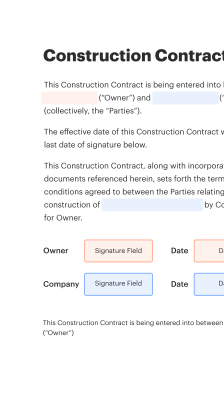
How countersign certificates are generated and attached

This sequence describes how signing platforms produce and associate a countersign certificate with the executed document.

  • Identity validation: Confirm signer identity via configured authentication.
  • Signing action: Signer applies signature, triggering certificate generation.
  • Certificate creation: System records metadata, timestamp, and signature hash.
  • Attachment: Certificate is bundled with the document and audit log.
Collect signatures
24x
faster
Reduce costs by
$30
per document
Save up to
40h
per employee / month

Step-by-step: Adding a countersign certificate to a document

Follow these essential steps to include a countersign certificate as part of an electronic signing workflow.

  • 01
    Prepare document: Finalize content and identify countersigner roles.
  • 02
    Define order: Set signing sequence and countersign step.
  • 03
    Activate certificate: Enable certificate generation in workflow settings.
  • 04
    Store record: Attach certificate to document and archive.
be ready to get more

Why choose airSlate SignNow

  • Free 7-day trial. Choose the plan you need and try it risk-free.
  • Honest pricing for full-featured plans. airSlate SignNow offers subscription plans with no overages or hidden fees at renewal.
  • Enterprise-grade security. airSlate SignNow helps you comply with global security standards.
illustrations signature

Typical workflow settings for issuing countersign certificates

Configure these workflow settings to automatically generate and retain countersign certificates as part of the signing lifecycle.

Workflow Setting Name and Configuration Options Default configuration value assigned in the workflow
Signing Order Policy Sequential by role
Certificate Generation Enabled for countersign steps
Timestamp Authority Third-party timestamping
Retention Duration 7 years or per policy
Audit Export Include certificate data

Supported platforms and device considerations

Countersign certificates are generated server-side in most modern eSignature platforms and are accessible across devices once attached to the executed document.

  • Web browsers: Chrome, Safari, Edge support
  • Mobile apps: Native iOS and Android apps
  • APIs: REST API access available

Ensure device compatibility for identity verification methods (for example, MFA prompts or platform authenticators) and confirm that the platform preserves certificates and audit logs consistently across web, mobile, and API channels.

Security controls commonly attached to countersign certificates

Timestamping: Trusted time source
Signature Hash: SHA-256 or stronger
Certificate Authority: CA-issued credentials
Key Protection: Hardware-backed keys
Audit Link: Embedded transaction ID
Revocation Info: CRL or OCSP record

Practical industry examples using countersign certificates

Case examples show how countersign certificates solve sequential approval needs across sectors and document types.

Healthcare Authorization

A hospital requires clinician and administrator approval for treatment consents, captured as countersign certificates

  • Two-step approval by clinician then admin
  • Ensures both clinical review and operational confirmation

Resulting in a verifiable patient record that meets HIPAA documentation expectations.

Vendor Contract

A procurement team needs buyer authorization followed by legal countersignature for supplier contracts

  • Buyer approves scope and budget
  • Legal confirms contract terms and compliance

Leading to a clear execution trail that supports audits and enforces contract validity.

Best practices for reliable countersign certificates

Follow these recommended practices to ensure countersign certificates are trustworthy, auditable, and aligned with organizational policies.

Define clear signing sequences and authority levels
Map required approvers and their sequence in policy documents. Ensure workflow templates reflect role-based authority to avoid misordered countersigns and to maintain an accurate certificate chain.
Use strong identity verification and multi-factor authentication
Require MFA or enterprise identity provider integration for countersigners. Strong authentication ties certificates to verified identities and reduces the risk of fraudulent countersignatures.
Preserve certificate and audit logs with retention policies
Store countersign certificates with the document for the full retention period required by regulations and internal policy. Ensure backups and immutable logs are part of the retention strategy.
Monitor key management and revocation procedures regularly
Implement controls for key issuance, rotation, and revocation. Periodic reviews reduce exposure from compromised keys and keep certificate verification reliable over time.

FAQs About countersign certificate

Answers to frequently asked questions about how countersign certificates work, common issues, and steps for verification in eSignature systems.

Feature availability for countersign certificates across providers

This table compares essential countersign certificate features available from widely used eSignature vendors in the U.S. market.

Feature Comparison Across Top Providers US signNow (Recommended) DocuSign Adobe Sign
Automatic certificate generation
Trusted timestamping
Hardware key support Optional Optional
Audit export with certificates
be ready to get more

Get legally-binding signatures now!

Risks and potential penalties without proper countersign certificates

Contract disputes: Higher litigation risk
Regulatory fines: Noncompliance exposure
Operational delays: Approval bottlenecks
Evidence gaps: Weak audit records
Data loss: Insufficient retention
Security breaches: Key compromise risk

Pricing and plan details relevant to countersign certificate usage

Pricing tiers and available features for countersign certificate capabilities vary; the table below summarizes common entry-level and advanced plan distinctions among major providers.

Plan Pricing Overview signNow (Recommended) DocuSign Adobe Sign Dropbox Sign PandaDoc
Starting monthly price $8 per user/month billed annually $10 per user/month billed annually $14.99 per user/month billed annually $15 per user/month billed annually $19 per user/month billed annually
Developer API access Included in Business plans Available on Developer plan Available on API plan Included with Business plans Included with Business plans
Advanced authentication support SAML, OAuth available SAML, OAuth available SAML, OAuth available OAuth and SSO SSO and OAuth
Enterprise features available Role-based controls and retention Enterprise-grade admin controls Enterprise controls and integrations Team management and SSO Enterprise workflows and automation
HIPAA compliance option Business-tier BAAs available Enterprise BAA available BAA offered for enterprise BAA via Dropbox enterprise HIPAA options via enterprise

Streamline complex workflows

Create, deliver, and maintain workflows of any complexity, electronically from near any place. Scalable eSignature capabilities allow you to share contracts with the right users the proper order and define roles for every receiver. Perform document workflows faster and simpler than ever before.

Automate document flow

Enhance complicated signing tasks with airSlate SignNow�s highly effective features to improve your business. Manage your automatic signature workflows to make sure they're operating at maximum performance with instant notifications and reminders.

Optimize in team communication

Join teammates together in a protected, shared environment. Manage paperwork, use form templates and notices to produce more effective cross-company communication. Relieve your employees from having to spend time on repetitive actions so that they can center on valuable, business-critical tasks.

Integrate into your existing systems

Run your projects with industry-leading integration. Capture Salesforce, Microsoft Teams, and SharePoint all in one business stream. Link up your software to a single system for endless possibilities and more productiveness.

Stay compliant with best-in-class data security

Feel safe understanding that your data remains secure by the newest in encryption security. airSlate SignNow is GDPR and eIDAS compliant and gives you awareness into your eSigning process with court-admissible audit trails. Configure user authorization and roles to manage who has access to what.


walmart logo
exonMobil logo
apple logo
comcast logo
facebook logo
FedEx logo
be ready to get more

Get legally-binding signatures now!