CPQ Software Solutions for Public Relations

cpq software solutions for Public Relations

Award-winning eSignature solution

What cpq software solutions for public relations do and why they matter

CPQ software solutions for public relations centralize the process of configuring services, calculating fees, and generating client-facing proposals and quotes. These tools combine standardized rate cards, modular service packages, and approval workflows so teams can produce consistent estimates quickly. For public relations firms, CPQ reduces manual spreadsheet work, enforces discount and margin rules, and streamlines the transition from approved quote to contract by producing ready-to-sign documents and ensuring data flows into CRM and billing systems.

Why PR teams adopt CPQ to reduce friction

CPQ brings consistency to pricing, shortens proposal cycles, and reduces errors in client estimates, letting PR teams scale complex packaging without sacrificing margin controls.

Why PR teams adopt CPQ to reduce friction

Common operational challenges CPQ addresses

  • Inconsistent pricing across accounts leading to margin erosion and client confusion.
  • Slow manual approvals that extend proposal-to-contract timeframes and delay campaign starts.
  • Complex bundled services that require manual calculation and frequent spreadsheet updates.
  • Lack of a single source of truth for contract versions and signed agreements.

Typical users and responsibilities

Account Executive

Account Executives use CPQ to assemble tailored PR packages from predefined modules, apply approved discounts, and deliver client-ready proposals. The system reduces time spent on manual calculations and ensures pricing adheres to company policies, enabling faster negotiation and clearer client communication.

Finance Manager

Finance Managers configure pricing rules, set margin guards, and review approval thresholds. They rely on CPQ data to reconcile quotes with invoicing systems and to monitor discount usage across accounts for accurate revenue forecasting and compliance with internal controls.

Teams and roles that rely on CPQ in PR organizations

CPQ is used across client-facing and back-office teams to streamline offers and approvals.

  • Account executives who prepare proposals and need fast, accurate quotes.
  • Finance and revenue operations teams that enforce pricing rules and margins.
  • Senior leadership needing standardized reporting on win rates and average deal value.

When deployed correctly, CPQ reduces rework and keeps sales, account management, and finance aligned.

Core CPQ capabilities tailored for public relations

The following capabilities support accurate pricing, consistent proposals, and rapid turnarounds for PR engagements.

Template Library

Centralized templates for proposals and contracts reduce drafting time, maintain consistent legal and brand language, and allow field placeholders to be populated automatically from client and quote data.


Pricing Rules

Rule engines enforce margins, volume discounts, and referral credits so account teams can configure custom packages without violating pricing policies or affecting profitability.

Approval Workflows

Multi-step routing ensures that discounts, nonstandard terms, or high-value deals receive the correct approvals before client delivery, preserving audit trails and accountability.

Quote Generation

Automated generation of PDF and HTML proposals includes line-item details, terms, and optional add-ons, producing client-ready documents quickly and consistently.

eSignature Integration

Built-in eSignature connections allow approved quotes to become signed contracts directly, capturing signer identity and timestamped audit logs to meet legal standards.

Reporting & Analytics

Dashboards and exportable reports track quoting velocity, average deal size, discount usage, and win rates to inform pricing strategy and resource allocation.

be ready to get more

Choose a better solution

Integrations that matter for PR CPQ workflows

Integrations connect CPQ to authoring, client, and storage systems used daily by PR teams, reducing duplication and errors.

Google Docs

Two-way integration allows proposal text and templates to be authored in Google Docs and pulled into CPQ templates, preserving formatting while enabling dynamic fields and version control when generating final client documents.

CRM systems

Native or API-driven links to CRM allow CPQ quotes to inherit account data, sync approved quotes as opportunities, and automatically update pipeline stages for consistent sales reporting.

Dropbox/Drive

Document storage integration centralizes final proposals and signed contracts in enterprise storage for retention, access control, and backup consistent with corporate policies.

Analytics

Integrations with analytics or BI tools export pricing and win-rate data to measure proposal performance and optimize service packaging over time.
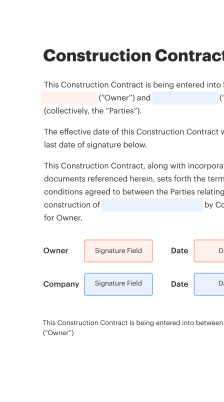
How a typical quote-to-contract flow works

A streamlined CPQ process moves a request through configuration, approval, and signature while preserving auditability.

  • Configure: Select services and apply rules
  • Review: Route for required approvals
  • Quote: Generate client-ready proposal
  • Close: Execute contract and update CRM
Collect signatures
24x
faster
Reduce costs by
$30
per document
Save up to
40h
per employee / month

Quick setup steps for cpq software solutions for public relations

Follow these high-level steps to move from pilot to production with CPQ in a PR practice.

  • 01
    Define packages: Map standard services into bundles
  • 02
    Set pricing rules: Establish list prices and discounts
  • 03
    Configure approvals: Create thresholds and reviewers
  • 04
    Integrate systems: Connect CRM and billing
be ready to get more

Why choose airSlate SignNow

  • Free 7-day trial. Choose the plan you need and try it risk-free.
  • Honest pricing for full-featured plans. airSlate SignNow offers subscription plans with no overages or hidden fees at renewal.
  • Enterprise-grade security. airSlate SignNow helps you comply with global security standards.
illustrations signature

Typical workflow settings to configure for PR CPQ

Below are common configuration items to set during CPQ deployment for public relations teams.

Setting Name Configuration
Approval Routing Manager approval
Reminder Frequency 48 hours
Quote Validity Period 30 days
Default Currency USD
Document Retention 3 years

Supported platforms and minimum requirements

CPQ and connected signature services run across desktop and mobile environments; confirm platform parity for team tools.

  • Desktop: Chrome, Edge
  • Mobile OS: iOS 14+ Android 10+
  • Browser Support: Latest stable releases

Ensure browsers are current, mobile OS versions meet vendor minimums, and desktop users have supported browsers to maintain security and compatibility across quoting, document generation, and signature steps.

Security and data controls relevant to CPQ for PR

Data encryption: At rest and in transit
Access controls: Role-based permissions
Audit logging: Comprehensive event trails
Transport security: TLS/HTTPS enforced
Third-party attestations: SOC 2 available
Retention policies: Configurable storage rules

Practical examples: CPQ in public relations workflows

Real-world scenarios show how CPQ reduces cycle time and strengthens contract accuracy for PR teams.

Mid-size agency proposal

A regional PR agency standardized media outreach and measurement packages into modular options to avoid bespoke pricing per client

  • Template modules were mapped to rate cards for consistent pricing
  • Approval routing required manager sign-off for discounts

Leading to faster proposal delivery, fewer pricing errors, and a measurable increase in accepted proposals within a month.

Enterprise retainer quoting

An enterprise communications team consolidated multiple service lines into a single CPQ catalog to simplify retainer assembly

  • Automated recurring pricing and multi-month discounts were applied automatically
  • Integration pushed approved quotes into billing and CRM systems

Resulting in reduced manual billing reconciliations, clearer client invoices, and faster contract renewal conversations.

Operational best practices for accurate CPQ output

Adopting consistent policies and simple governance reduces errors and improves user adoption of CPQ systems in PR teams.

Standardize service modules and terminology
Define a single canonical catalog with clear descriptions for each service module, avoid overlapping items, and document dependency rules so sellers consistently assemble packages without ambiguity, improving client understanding and internal reporting accuracy.
Enforce pricing approval thresholds
Set conservative approval limits for discounts and nonstandard terms, route exceptions automatically to finance or leadership, and monitor override frequency to identify training or policy gaps that cause margin erosion.
Integrate CPQ with CRM and billing
Automate data flow from quote to opportunity to invoice to reduce rekeying errors. Ensure field mappings are maintained and test integrations after schema changes to prevent sync failures that delay revenue recognition.
Maintain audit trails and retention settings
Keep immutable logs of quote creation, approval, and signature actions to support internal audits and client disputes, and configure retention policies in line with legal and corporate requirements for document storage.

FAQs about cpq software solutions for public relations

Common questions and practical answers to help teams avoid pitfalls and keep CPQ implementations aligned with PR operations.

Feature availability: signNow versus major eSignature providers

This comparison highlights common capabilities PR teams consider when connecting CPQ outputs to signature providers.

Criteria signNow (Recommended) DocuSign Adobe Sign
ESIGN/UETA validity ESIGN/UETA ESIGN/UETA ESIGN/UETA
Native CPQ integrations Limited Extensive Limited
API availability REST API REST API REST API
Mobile apps iOS/Android iOS/Android iOS/Android
be ready to get more

Get legally-binding signatures now!

Typical retention and deadline settings for PR CPQ documents

Set clear retention and validity windows to support legal, billing, and client expectations.

Proposal validity period:

30 days standard

Signed contract retention:

3 years minimum

Audit log retention:

7 years

Quote expiration reminders:

Send at 7 days

Invoice generation window:

Within 30 days

Legal and operational risks without CPQ controls

Contract disputes: Ambiguous terms
Compliance fines: Regulatory exposure
Revenue leakage: Unapproved discounts
Data breaches: Sensitive client data
Client churn: Mistakes erode trust
Audit failures: Missing traces

Representative pricing and capability comparison for signature providers

High-level pricing and capability points for common providers; confirm current plans and enterprise options directly with vendors.

Pricing Tier signNow (Recommended) DocuSign Adobe Sign PandaDoc Dropbox Sign
Entry Price $8/user/month $10/user/month $9.99/user/month $19/user/month $15/user/month
Free Plan Limited No No Yes (trial) Yes (basic)
API Access Available Available Available Available Available
Bulk Send Included Add-on Included Included Add-on
Advanced Workflows Available Available Available Limited Limited
walmart logo
exonMobil logo
apple logo
comcast logo
facebook logo
FedEx logo
be ready to get more

Get legally-binding signatures now!