Bulk apply
Apply a logo update across many templates at once to reduce manual updates and ensure consistency across large document libraries.




Adding a custom logo reinforces brand recognition, improves recipient trust in document authenticity, and produces consistent professional communications across contract workflows without changing legal effect of signatures.

A Brand Manager oversees approved logo files, enforces brand guidelines, and authorizes updates. They coordinate with legal and operations to ensure the correct assets are available in templates and verify that new logo versions are applied consistently across document libraries.
An IT Administrator configures platform-level controls for uploading, storing, and restricting access to logo assets. They set permissions, enforce file-format constraints, and integrate image management into document templates or API-driven workflows.
Legal, HR, sales, and administrative teams commonly add custom logos to standard documents to present a consistent brand to external parties and internal stakeholders.
Incorporating logos is a cross-functional need that benefits both customer-facing communications and internal compliance practices when managed correctly.
Apply a logo update across many templates at once to reduce manual updates and ensure consistency across large document libraries.
Programmatically reference stored logo assets within automated document generation and signing processes via the platform API.
Automatically select which logo to display based on document type, business unit, or recipient attributes.
Render embedded logos at print-quality resolution for signed PDFs to maintain clarity in archival copies.
Preview final documents with logos applied before sending to catch layout issues early.
Attach metadata to logo assets for audit and regulatory tagging where required.
A secure library stores approved logos with metadata, format validation, and version history so teams use a single source of truth when adding branding to documents.
Assign logos to specific templates or document types automatically, ensuring every generated document uses the correct visual identity without manual insertion for each send.
Adjust logo size, alignment, and margins for different page orientations and devices to preserve readability and avoid overlapping signature zones or form fields.
Role-based permissions restrict who can upload or change logos, maintaining brand integrity and reducing the risk of unauthorized modifications.

| Setting | Configuration |
|---|---|
| Automatic Reminder Frequency for Signers | Reminders sent at 48 hours and again at 24 hours before expiry. |
| Template Publish Approval Requirement | Two-step approval with brand and legal sign-off. |
| Allowed Upload Formats and Size | PNG, JPEG under 2 MB with transparency support. |
| Logo Version Lock and Retention Policy | Retain previous versions for five years for audit. |
| Default Placement and Margin Settings | Header centered with 12pt top margin across templates. |
Confirm platform compatibility and media requirements before uploading images to ensure consistent appearance across desktop and mobile viewers.
Ensure administrators verify browser versions and mobile app builds are up to date, and test uploads on representative devices so logo rendering and template layout remain consistent for end users across platforms.
A regional clinic standardized logos across enrollment and consent forms to match patient-facing portals, reducing confusion during intake by ensuring consistent visual identity
Leading to improved intake efficiency and fewer rejected forms due to branding inconsistencies.
A mid-market software vendor embedded its high-resolution logo into proposal and SOW templates across the sales team to maintain professional continuity in customer communications
Resulting in streamlined approvals and consistent archival of signed proposals for audit purposes.
| Vendor feature support and availability comparison | signNow (Recommended) | DocuSign | Adobe Sign |
|---|---|---|---|
| Custom logo upload | |||
| Template bulk apply | Limited | ||
| API-driven logo insertion | |||
| HIPAA support for branded documents | Available | Available |
| Plans and vendor comparison header | signNow (Recommended) | DocuSign | Adobe Sign | PandaDoc | HelloSign |
|---|---|---|---|---|---|
| Starting price per user per month | Affordable entry with annual plans available | Premium tiers start higher | Included with Adobe Document Cloud plans | Mid-range with sales features | Low-cost for small teams |
| Free trial availability and length | 14-day free trial available | 30-day trial or demo | Trial available via Adobe | 14-day free trial | 30-day trial |
| Enterprise features included in plan | API access, templates, RBAC | Enterprise API, advanced workflows | Enterprise PDF tools and templates | CRM integrations and templates | Basic API and templates |
| HIPAA and regulatory support | Offers HIPAA-ready configurations | Available under enterprise agreements | Available under enterprise terms | Available via enterprise add-ons | Available under enterprise plan |
| Typical best-fit use case | Cost-conscious teams needing secure branded documents | Large enterprises with complex workflows | Organizations using Adobe PDF ecosystem | Sales teams needing document automation | Small businesses needing simple branded signing |
By setting up custom branding, you ensure that your logo appears front and center in your eSignature invites, notification emails, and even the airSlate SignNow editor. This is a great way to promote your brand and strengthen your image as a professional organization. Follow the steps below to set up your branding in airSlate SignNow.
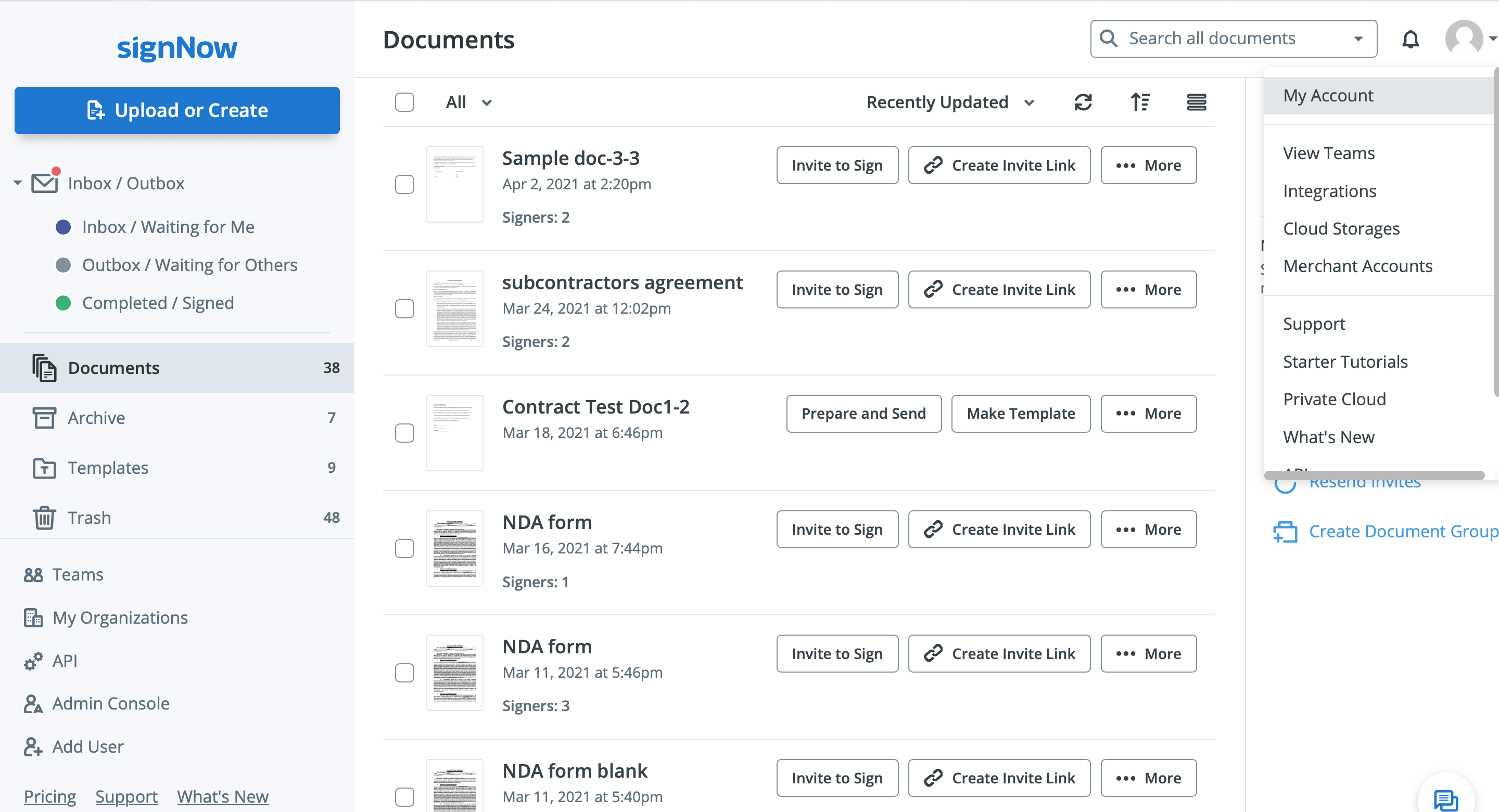
Log in to your airSlate SignNow account as an Admin of your Organization. To open your account settings, click on your profile image (a silhouette icon by default) and select My Account.
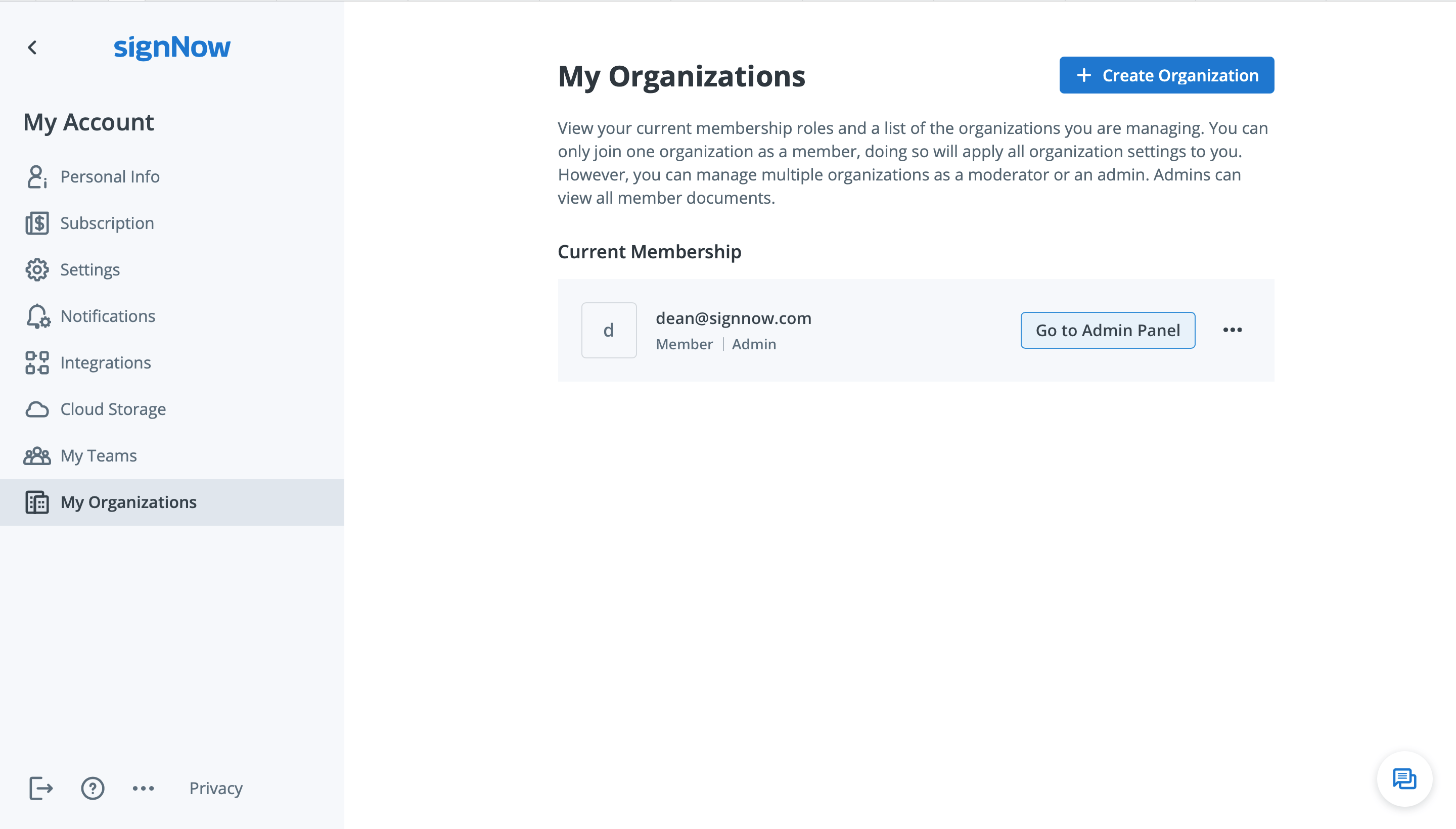
In the account menu, go to My Organizations and click the Go to Admin Panel button. If you don’t yet have an organization in airSlate SignNow, create one by clicking Create Organization.
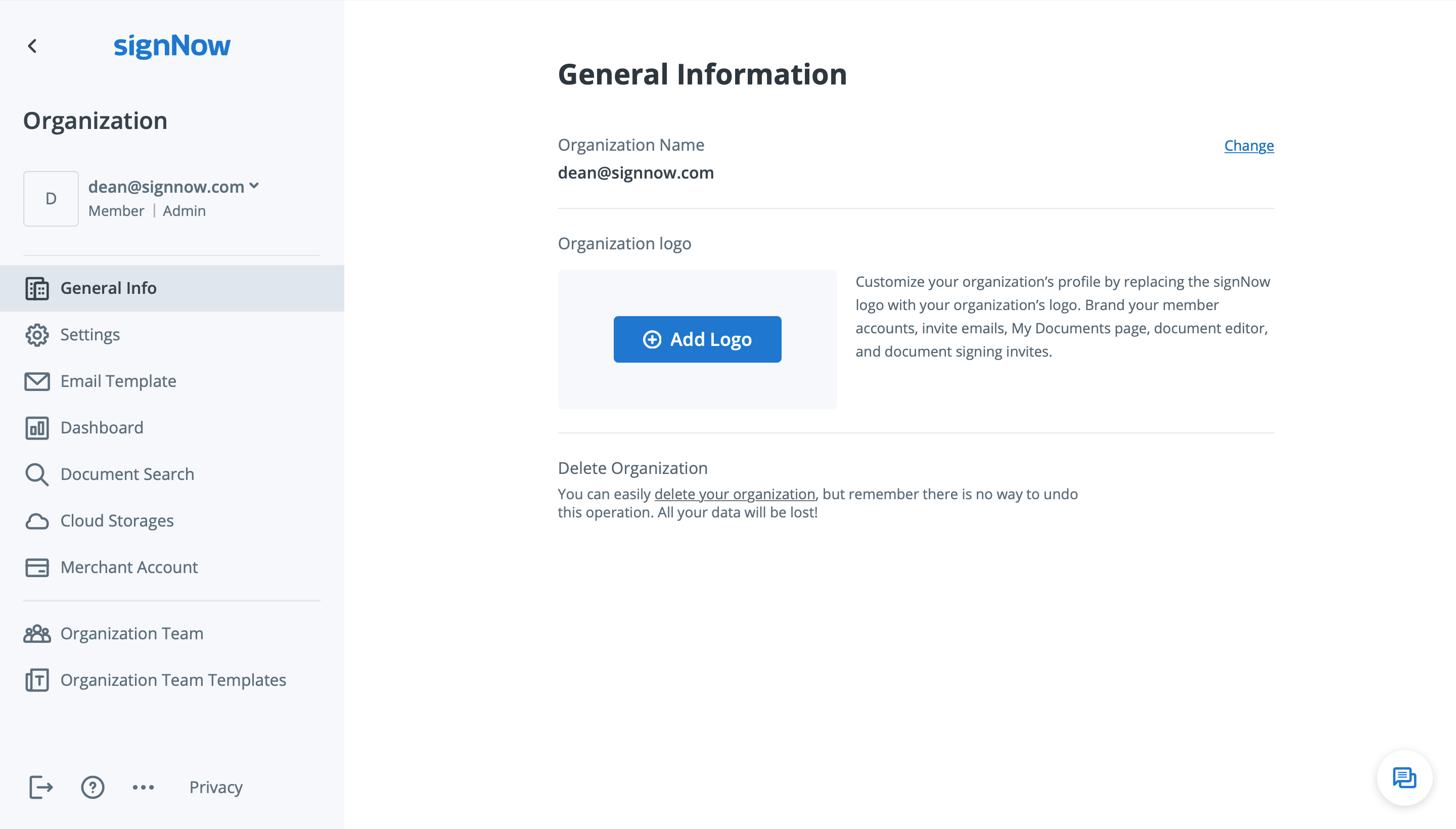
In your admin panel, go to the General Info tab and click Add Logo.
Click the Upload Image button and select the logo stored on your device.
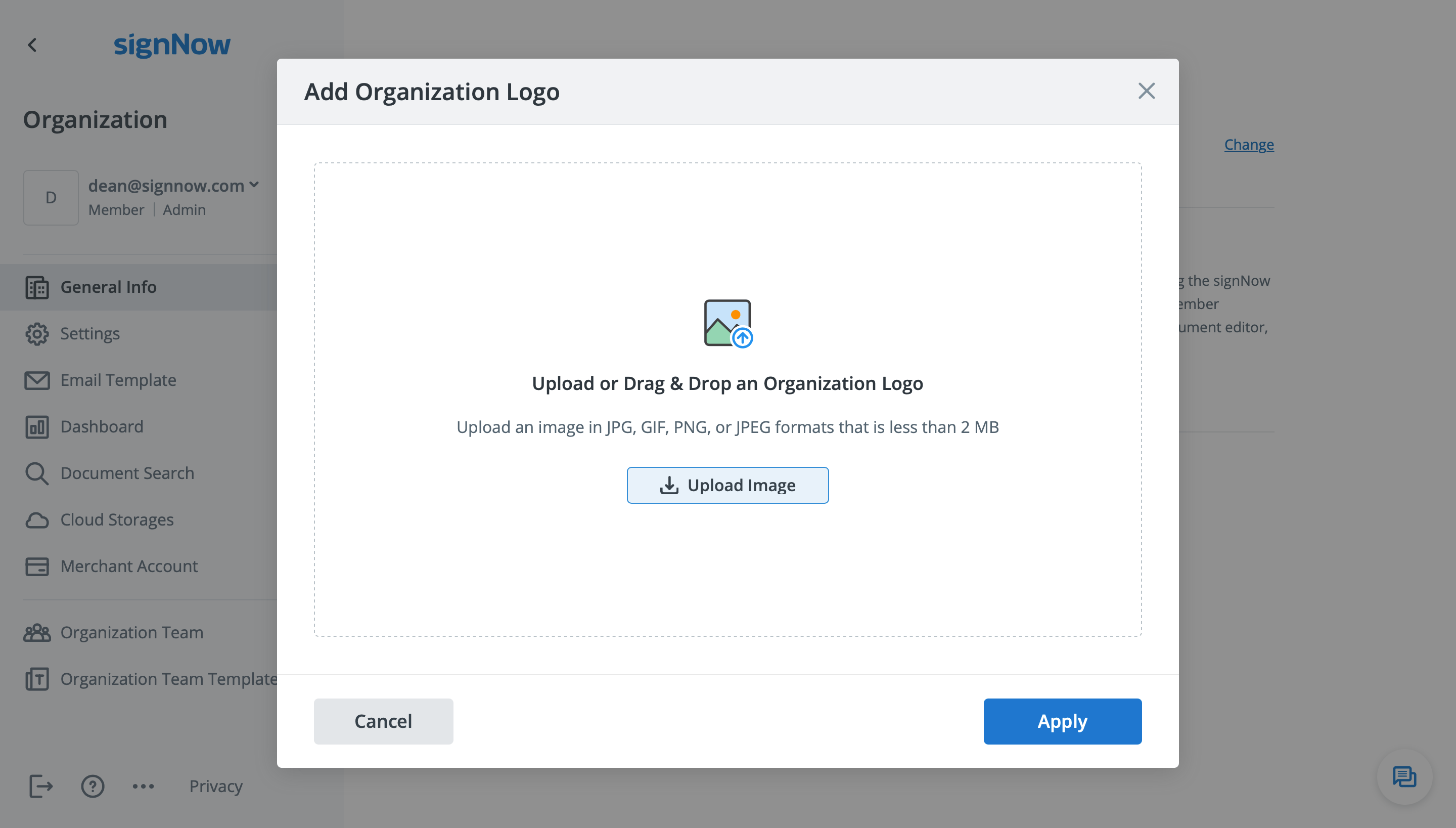
Once your logo is uploaded, a preview window appears where you can see how your logo looks when applied to your emails, signature invites, dashboard, and editor. To continue, click Apply.
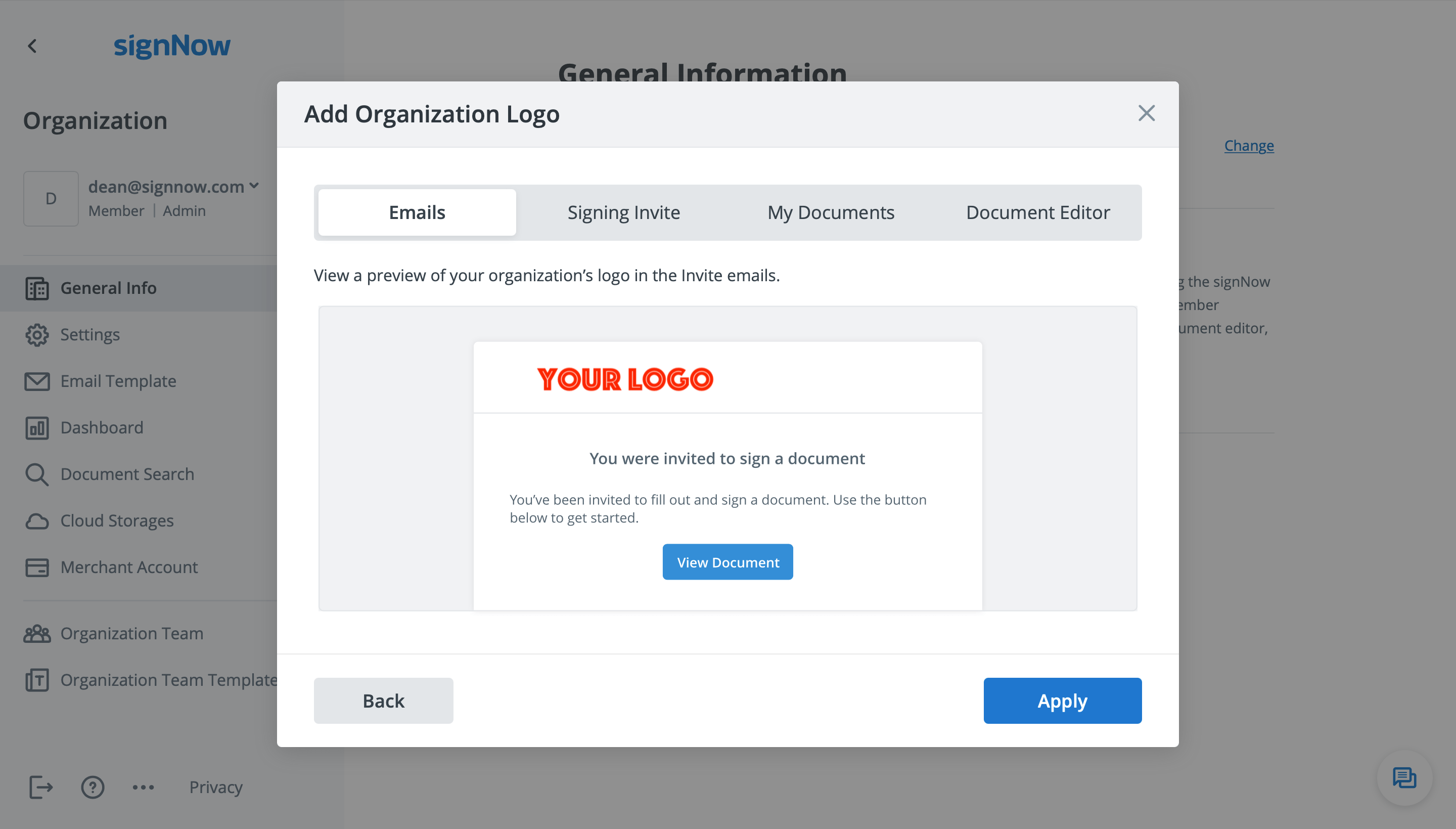
Your custom logo has now been added and will appear in your eSignature invites and notification emails.
Please note:











