Create Business Invoice for Facilities with SignNow

Effortlessly streamline your invoicing process and eSign documents with our user-friendly solution. Save time and reduce costs while enhancing your business operations.

Award-winning eSignature solution

What creating a business invoice for facilities entails

Creating a business invoice for facilities refers to generating, delivering, and tracking billing documents for facility services such as maintenance, janitorial work, repairs, and property management. The workflow typically includes a structured invoice template, line-item charges, tax and discount calculations, client and job identifiers, delivery via email or secure portal, and an auditable signature or acceptance. Modern digital solutions add templates, integrations with accounting or CRM systems, automated reminders, and a full audit trail to reduce disputes and accelerate payment while maintaining compliance with U.S. eSignature laws and recordkeeping requirements.

Why standardized facility invoices improve operations

Standardized invoicing reduces errors, shortens payment cycles, and provides a consistent record for billing, compliance, and reconciliation across multiple facilities and service teams.

Why standardized facility invoices improve operations

Common invoicing challenges in facility management

  • Manual entry across spreadsheets increases mistakes and produces inconsistent line items and totals across invoices.
  • Lost or delayed paper invoices cause late payments and unclear dispute resolution timelines between vendors and site managers.
  • Tracking approvals from multiple stakeholders slows billing and results in fragmented email threads and missing signatures.
  • Integrating invoices with accounting and maintenance systems is often ad hoc, leading to duplicate data entry and reconciliation delays.

Representative user profiles for facilities invoicing

Facilities Manager

A facilities manager oversees multiple properties, coordinates contractors, and needs concise invoices that match service orders and maintenance logs. They rely on standardized templates, mobile signing on-site, and integration with work order systems to confirm billable tasks and approve payments quickly.

Accounts Receivable

An accounts receivable specialist processes incoming invoices, reconciles line items to contracts, and monitors aging. They require searchable records, automated reminders, and audit trails to support collections and financial reporting while ensuring compliance with corporate retention policies.

Who typically uses facility invoicing tools

Facility managers, accounts receivable teams, and service contractors use invoice workflows to standardize billing and record approvals before payment.

  • Facilities management teams who coordinate multi-site service providers and need consistent billing.
  • Accounts receivable staff who require clear audit trails for collections and reconciliation.
  • Third-party contractors and vendors who submit invoices and need fast, verifiable acceptance.

These roles rely on templates, automation, and secure signing to reduce disputes and speed cash collection across sites.

Six features to look for when creating facility invoices

Effective facility invoicing combines automation, templates, secure signing, integrations, and reporting to minimize manual work and improve cash flow across sites.

Template library

Prebuilt, customizable invoice templates ensure consistent line-item formatting, tax handling, and client-specific fields so staff can generate compliant invoices quickly without repeated manual configuration.


Automated calculation

Automatic tax, discount, and subtotal calculations reduce arithmetic errors and speed up invoice preparation while maintaining consistent financial formatting across invoices.

Approval workflows

Configurable multi-step approval processes let supervisors and finance teams sign off in sequence, preventing unauthorized billing and ensuring accountability before invoices are issued.

Audit trail

Comprehensive logs capture views, edits, and signatures with timestamps and IP data to support dispute resolution and regulatory compliance for billing records.

Integrations

Connectors to accounting, CRM, and procurement systems eliminate duplicate entry, synchronize customer and PO data, and automate posting once an invoice is signed.

Mobile readiness

Mobile-friendly interfaces allow technicians and on-site managers to complete, sign, and submit invoices from the field, reducing delays and improving validation with attached media.

be ready to get more

Choose a better solution

Integrations and templates that speed facility invoicing

Connectivity and reusable templates let teams move from service completion to invoice delivery without manual handoffs or data re-entry.

Accounting sync

Two-way integration with accounting systems ensures invoices post directly to the ledger, prevents duplicate entries, and keeps aging reports accurate while preserving invoice metadata for audits.

CRM and work order links

Link invoices to CRM records and work orders so client billing history, contact details, and service authorizations populate automatically, reducing reconciliation time.

Document attachments

Attach photos, signed work orders, and receipts to invoices to provide evidence for billed items and reduce the likelihood of client disputes during review.

Google and cloud storage

Save finalized invoices to cloud folders or Google Drive for centralized retention, easy sharing with accounting, and automated backup according to corporate policies.
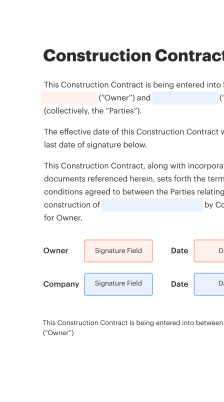
How online invoicing and signing works in practice

A typical online invoicing flow combines template generation, recipient routing, secure signature capture, and archival in a centralized record system.

  • Create invoice: Populate a template with service and pricing data.
  • Route for approval: Assign approvers in sequence or parallel workflows.
  • Capture signature: Obtain electronic signature via web or mobile device.
  • Archive record: Store signed invoice with audit metadata for retrieval.
Collect signatures
24x
faster
Reduce costs by
$30
per document
Save up to
40h
per employee / month

Step-by-step: prepare and send a facility invoice

A concise sequence to generate a complete, signable invoice for facility services, from data entry to signed receipt.

  • 01
    Gather details: Collect client, PO, service dates, and itemized charges.
  • 02
    Use template: Apply a preapproved invoice template with required fields.
  • 03
    Attach proof: Include photos, work orders, or time logs as evidence.
  • 04
    Send and track: Deliver for signature and monitor the audit trail.

Grid checklist for completing a facility invoice

A compact checklist to verify all required elements are present before sending an invoice for signature.

01

Client details:

Confirm billing address and PO number
02

Service description:

Include dates, locations, and work performed
03

Itemized charges:

List labor, parts, and taxes separately
04

Attachments:

Attach photos and signed work orders
05

Approvals:

Route to required approvers in order
06

Signature:

Obtain electronic signature and timestamp
be ready to get more

Why choose airSlate SignNow

  • Free 7-day trial. Choose the plan you need and try it risk-free.
  • Honest pricing for full-featured plans. airSlate SignNow offers subscription plans with no overages or hidden fees at renewal.
  • Enterprise-grade security. airSlate SignNow helps you comply with global security standards.
illustrations signature

Recommended workflow settings for facility invoice automation

Configure workflow defaults to enforce approval rules, reminders, and retention so invoice processing remains consistent across teams and sites.

Workflow Setting and Configuration Values Default values used in common setups
Invoice reminder frequency interval setting Send reminder email 48 hours after invoice issuance for unpaid invoices
Approval chain and escalation policy Two-step approval with manager escalation after five days
Invoice numbering and sequencing convention Auto-generate sequential numbers with site prefix
Document retention and archival rule Retain signed invoices for seven years per policy
Automatic posting to accounting system Post signed invoices to ledger within 24 hours

Device and platform requirements for field invoicing

Ensure mobile, tablet, and desktop compatibility so technicians and finance staff can create and sign invoices from any location with minimal friction.

  • Mobile OS: iOS 13+ or Android 9+ supported
  • Browser support: Latest versions of Chrome, Edge, Safari
  • Offline capability: Temporary offline drafting with sync

Confirm that chosen tools provide responsive design, native mobile apps where needed, and offline drafting with automatic synchronization to avoid data loss between field service and central office.

Key security controls for invoicing documents

Encryption in transit: TLS encryption protects data moving between parties.
Encryption at rest: Stored documents remain encrypted on servers.
Role-based access: Access limited by user roles and permissions.
Multi-factor authentication: Adds an extra verification step for users.
Audit logging: Records actions for traceability and review.
Document tamper-evidence: Versioning shows unauthorized changes.

Practical examples of facility invoice workflows

Two concise case studies show how a structured invoicing process supports facilities operations, approval, and payment collection.

Multi-site maintenance billing

A national maintenance contractor consolidates monthly service entries into a single invoice per client site, matching job codes to PO numbers

  • Uses automated templates with line-item mapping
  • Reduces reconciliation time and errors

Leading to faster payments and clearer audit trails for both vendor and site finance teams.

On-site repairs with mobile approval

A facilities team documents repair labor and parts on a mobile form that becomes an invoice draft, attached to the original work order

  • Captures signatures at point of service
  • Prevents charge disputes and provides proof of completion

Resulting in immediate client acceptance and accelerated invoicing cycles that improve cash flow.

Best practices for secure and accurate facility invoices

Follow consistent controls and documentation to reduce disputes, meet compliance obligations, and accelerate payment cycles for facility services.

Use standardized invoice templates with required fields
Require client identifiers, PO numbers, service dates, and detailed line descriptions on every invoice so reviewers can match charges to contracts and work orders without additional follow-up.
Retain signed invoices with full audit metadata
Store completed documents alongside the audit trail including signer identity, timestamps, and IP data to support legal admissibility and internal reviews when questions arise.
Validate signer identity and intent for high-value invoices
Apply multi-factor authentication or knowledge-based verification for significant charges to reduce fraud risk and strengthen enforceability under ESIGN and UETA frameworks.
Integrate invoicing with accounting and procurement systems
Automate posting and reconciliation to minimize manual entry errors, speed up month-end close, and ensure consistent financial reporting across facilities.

Common issues and troubleshooting for facility invoices

Answers to frequent problems when preparing, sending, or reconciling facility invoices, including signature and integration errors.

Feature availability across leading eSignature providers

A quick comparison of core compliance and capability features relevant to facility invoicing across three established eSignature vendors.

Feature availability across eSignature vendors signNow (Recommended) DocuSign Adobe Acrobat Sign
ESIGN and UETA legal validity
HIPAA compliance and BAA availability Available Available Available
Bulk Send and mass distribution
Advanced API and developer access REST API available REST API available REST API available
be ready to get more

Get legally-binding signatures now!

Retention and timeline checkpoints for facility invoices

Key document retention timelines and operational deadlines to maintain compliance and ensure timely collections for facility billing.

Invoice issuance deadline:

Issue invoices within 30 days of service completion to align with standard payment terms

Payment terms and due date:

Standard 30-day net terms unless contract specifies otherwise

Reminders and escalation timeline:

Send first reminder at 7 days past due, escalate after 30 days

Record retention period:

Retain signed invoices and audit trails for seven years for accounting and tax purposes

Dispute resolution window:

Allow a 60-day review period for disputes before initiating collections

Risks and regulatory penalties to consider

Noncompliant records: Fines or failed audits
Data breaches: Liability and notification costs
Invalid signatures: Contract disputes and delays
Late billing: Cash flow disruption
Retention failures: Regulatory penalties
Misapplied charges: Customer disputes and refunds
walmart logo
exonMobil logo
apple logo
comcast logo
facebook logo
FedEx logo
be ready to get more

Get legally-binding signatures now!