Create Customer Number with SignNow

Get rid of paper and automate digital document processing for higher productivity and countless possibilities. Sign anything from your home, fast and feature-rich. Explore the best way of doing business with airSlate SignNow.

Award-winning eSignature solution

What create customer number means and why it matters

The create customer number feature generates a unique identifier for each customer record and embeds that identifier into documents, templates, and workflows to improve tracking, reconciliation, and auditability. It can be auto-assigned when a new record is created or applied via templates and API calls, ensuring consistent formatting and integration with CRM and billing systems. For teams that handle high volumes of agreements, auto-numbering reduces manual entry errors, speeds processing, and provides a reliable key for search, reporting, and long-term retention across cloud storage.

Why using create customer number adds operational value

A standardized customer number simplifies document linking, reduces reconciliation time, and supports audit trails without changing core processes. It improves data consistency across systems and helps meet internal tracking requirements.

Why using create customer number adds operational value

Common challenges when implementing customer numbering

  • Inconsistent formats between systems can cause duplicate identifiers and reconciliation delays during imports or migrations.
  • Manual assignment leads to human error and collisions when multiple teams create records concurrently.
  • Lack of a central numbering policy complicates integrations with CRM, billing, and archived documents.
  • Insufficient validation allows invalid or malformed numbers that break downstream automation and reporting.

Typical users and administrative roles

Account Manager

Account Managers use create customer number to ensure every signed contract references a consistent customer identifier, enabling efficient follow-ups, renewals, and centralized record searches across CRM and document archives.

IT Administrator

IT Administrators configure numbering rules, API integrations, and permissions so that auto-assigned customer numbers align with existing backend systems and maintain uniqueness across organizational units.

Teams that commonly deploy create customer number workflows

Many departments adopt create customer number to improve document management across signing, billing, and support workflows.

  • Sales operations for quote and contract tracking across CRM records and signed agreements.
  • Finance teams for invoice matching and audit reconciliation with payment systems.
  • Customer support to link support cases with signed agreements and service records.

Standardizing identifiers across teams reduces cross-department friction and speeds retrieval for reporting and compliance purposes.

Core create customer number capabilities to look for

These capabilities determine how flexible and reliable a customer numbering implementation will be across teams, integrations, and automation.

Auto-numbering

Automatically generates sequential or patterned identifiers when records or documents are created to avoid manual entry and collisions.


Custom patterns

Supports prefixes, suffixes, separators, and checksums to match existing organizational numbering standards and external system requirements.

Field validation

Enforces format rules and prevents invalid identifiers from being saved or used in documents, improving data integrity.

API access

Allows programmatic generation and retrieval of customer numbers so external systems can consume and reference identifiers reliably.

Audit trail

Records creation time, source, and user for each identifier to support compliance and forensic review of document histories.

Permission controls

Restricts who can change numbering rules or assign manual IDs to maintain governance and prevent unauthorized overrides.

be ready to get more

Choose a better solution

Integrations that support create customer number

Common integrations sync numbered identifiers across document storage and business systems so that the same customer number appears in contracts, CRM records, and file repositories.

Google Docs

Automatically populate a customer number into document templates stored in Google Drive and maintain the identifier across revisions so editors and signers see the same reference in collaborative drafts.

CRM systems

Push generated customer numbers into CRM records and retrieve the correct identifier when creating new quotes or contracts, ensuring the document references match the customer record used for sales and support.

Dropbox

Store signed documents with embedded customer numbers in Dropbox folders using a consistent file naming convention to enable fast retrieval and automated backups tied to the customer identifier.

Document templates

Template-level fields can insert the customer number automatically during document creation, ensuring every generated agreement includes the correct identifier without manual intervention.
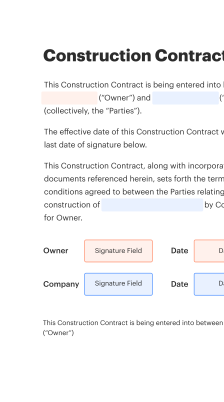
How create customer number is applied in day-to-day workflows

This sequence shows how identifiers are generated at key points: record creation, document generation, signing, and archival for traceability.

  • Record creation: System or user triggers ID generation
  • Document insertion: Identifier placed into template fields
  • Signing process: Signed documents retain ID metadata
  • Archive and search: ID used for retrieval and reporting
Collect signatures
24x
faster
Reduce costs by
$30
per document
Save up to
40h
per employee / month

Quick steps to set up create customer number

Follow these main steps to configure numbering rules and apply them to templates, workflows, or API calls for automated assignment.

  • 01
    Define pattern: Choose prefix, length, and checksum
  • 02
    Create template: Embed identifier field in template
  • 03
    Enable automation: Activate auto-assignment in workflow
  • 04
    Test and monitor: Validate uniqueness and logs
be ready to get more

Why choose airSlate SignNow

  • Free 7-day trial. Choose the plan you need and try it risk-free.
  • Honest pricing for full-featured plans. airSlate SignNow offers subscription plans with no overages or hidden fees at renewal.
  • Enterprise-grade security. airSlate SignNow helps you comply with global security standards.
illustrations signature

Workflow settings to configure create customer number

Configure these workflow settings to control how numbers are generated, validated, and propagated across documents and systems.

Workflow Setting Name and Purpose Default Configuration
Auto-numbering Pattern Prefix-YYYY-###
Number Uniqueness Scope Account-wide
Manual override permission Admins only
API generation endpoint /v1/number/create
Reminder and validation interval Real-time

Supported platforms and browser requirements

The create customer number functionality is accessible via web browsers, native mobile apps, and API endpoints for integration.

  • Web browsers: Chrome, Edge, Safari supported
  • Mobile apps: iOS and Android native apps
  • API clients: RESTful endpoints available

For best results, use recent browser versions and maintain secure network settings; mobile SDKs and API libraries help embed numbering rules into custom applications while preserving platform compatibility and security.

Security controls relevant to create customer number

Data encryption: AES-256 at rest
Transport security: TLS 1.2+ in transit
Access controls: Role-based permissions
Authentication options: Single sign-on supported
Audit logging: Detailed event records
Data separation: Tenant isolation available

Real-world examples of create customer number in action

Two concise case examples show how consistent customer numbering improves workflow, auditability, and integration with downstream systems.

Subscription Billing

A SaaS billing team implements auto-numbering on signup forms to assign a unique customer number to every account

  • Number format includes prefix and sequence
  • Enables automated invoice matching and payment reconciliation

Resulting in faster month-end close and fewer billing disputes due to consistent identifiers across billing and contract records.

Student Records

A university registrar integrates create customer number into enrollment documents to link admissions, financial aid, and course records

  • Uses a campus-specific prefix and checksum
  • Reduces record duplication and simplifies transcript requests

Leading to improved accuracy in student account management and streamlined cross-departmental reporting for audits.

Recommended practices for secure and consistent numbering

Following established standards and safeguards minimizes errors, supports compliance, and ensures identifiers remain useful across systems and time.

Establish a single numbering standard across the organization
Define a clear format that includes required elements such as prefix, numeric length, and optional checksum. Communicate the standard to all teams and document it in a central policy so integrations and manual processes align consistently.
Use automation to assign identifiers and avoid manual entry
Configure auto-numbering within templates and workflows to prevent duplicates and collisions. Automation reduces human error and ensures identifiers are issued according to the established pattern whenever a new record or agreement is created.
Validate identifiers and log assignment events
Implement format checks and store assignment metadata in audit logs. Validation stops malformed numbers from propagating and logs provide traceability for compliance and troubleshooting purposes.
Design integrations to consume and preserve the number
Ensure CRM, billing, and storage integrations accept and display the customer number as a primary key. Preserve the identifier in filenames and metadata to simplify search, reporting, and cross-system reconciliation.

FAQs About create customer number

Answers to common questions about configuration, troubleshooting, and best practices for create customer number implementations.

Feature comparison: create customer number support across vendors

A focused comparison of essential capabilities for integrating customer numbering into signing workflows across popular eSignature providers.

Feature or Criteria Display Name signNow (Recommended) DocuSign Adobe Sign
HIPAA compliance
API access for numbering
Bulk numbering support
Native mobile numbering
be ready to get more

Get legally-binding signatures now!

Risks and penalties from poor numbering practices

Noncompliance fines: Regulatory penalties
Data breaches: Exposure risk
Invalid contracts: Agreement disputes
Audit failures: Record gaps
Operational delays: Processing backlog
Reconciliation errors: Financial mismatches

Pricing and plan considerations for customer numbering

Pricing varies by vendor and plan tier; below are representative plan-level details relevant to create customer number capabilities and API access.

Pricing Plan and Feature signNow (Recommended) DocuSign Adobe Sign PandaDoc HelloSign
Entry-level monthly cost Starts at $8/user/month Starts at $10/user/month Starts at $12.99/user/month Starts at $19/user/month Starts at $15/user/month
Team-level offering cost Business plan around $15/user/month Standard business offers vary Teams plan from $29.99/user/month Business plan from $25/user/month Business plan from $20/user/month
API included in plan Available on business tiers Available on API plans Available for enterprise Available on advanced plans Available on higher tiers
HIPAA-ready options Add-on or enterprise options Enterprise only Enterprise only Enterprise only Enterprise only
Bulk and template features Bulk Send and templates included Bulk send available Template automation available Template and bulk available Template features included

Simplify complex workflows

Create, execute, and manage workflows of any complexity, electronically from virtually anywhere. Scalable eSignature capabilities allow you to share documents with the right people in the correct order and define roles for each recipient. Execute document workflows faster and easier than ever before.

Automate document management

Optimize complex signing processes with airSlate SignNow’s powerful features to enhance your business. Control your automated eSignature workflows to ensure they're running at peak performance with instant notifications and reminders.

Optimize in team collaboration

Bring teams together in a secure, shared environment. Manage documents, use form templates and notifications to create more efficient cross-organization collaboration. Free your employees from having to spend time on repetitive activities so that they can focus on valuable, business-critical tasks.

Integrate into your existing systems

Run your projects with industry-leading integration. Collect Salesforce, Microsoft Teams, and SharePoint all in one business flow. Connect your software to a single system for endless possibilities and more productiveness.

Stay compliant with best-in-class data protection

Feel safe with the knowledge that your data remains secure by the newest in encryption security. airSlate SignNow is GDPR and eIDAS compliant and offers you transparence into your eSigning process with court-admissible audit trails. Set up user access permissions and roles to control who has access to what.


walmart logo
exonMobil logo
apple logo
comcast logo
facebook logo
FedEx logo
be ready to get more

Get legally-binding signatures now!