Create Digisign Placeholder with SignNow

Get rid of paper and automate digital document management for increased efficiency and limitless possibilities. Sign anything from your home, fast and accomplished. Enjoy a greater manner of running your business with airSlate SignNow.

Award-winning eSignature solution

What create digisign placeholder means

Creating a digisign placeholder means adding a reserved signature or data field into a document template that indicates where a signer will later apply an electronic signature, initials, or other required inputs. In practice this lets administrators prepare documents in advance, enforce field types and order, and reuse the same template across workflows. Placeholders help validate input types, trigger required fields, and integrate with routing logic so documents are ready for recipients while preserving an auditable chain of events.

Why use placeholders in eSignature workflows

Placeholders speed preparation and improve accuracy by fixing signature locations, enforcing field validation, and enabling reusable templates across teams and integrations in regulated U.S. environments.

Why use placeholders in eSignature workflows

Common challenges when creating signature placeholders

  • Misaligned fields on mixed-format documents can cause recipients to miss required signature spots and delay approvals.
  • Using generic placeholders without validation allows incorrect data types, increasing rework and manual correction.
  • Overlapping form elements or locked PDF layers may prevent adding placeholders without pre-processing the source file.
  • Insufficient routing rules can place placeholders on the wrong signer, creating signature conflicts and reassignments.

Typical user profiles for placeholder setup

HR Administrator

An HR Administrator prepares onboarding packets and employment agreements using placeholders so new hire documents enforce signature order, date fields, and required initials. They maintain templates, manage recipient roles, and ensure compliance with internal retention policies.

Sales Operations

Sales Operations configures proposal and contract templates with placeholders mapped to CRM data, enabling automated field population, consistent signature placement, and tracking of who signed which version for downstream billing and fulfillment.

Teams and roles that rely on placeholders

Legal, HR, sales, and operations teams commonly use placeholders to standardize documents prior to distribution.

  • Legal teams preparing contracts with required signature blocks for multiple parties.
  • HR managing onboarding paperwork that requires initials, dates, and signatures in set locations.
  • Sales teams sending pricing and order forms that use templates and merge fields.

Placeholders reduce manual edits and support consistent audits, particularly where recurring documents require identical field placement.

Features to look for when creating placeholders

Select tools that provide precise placement, field validation, template management, and auditability to ensure placeholders support accurate, repeatable signing processes.

Precise positioning

Pixel-level placement tools and snap-to guides to avoid misalignment across document formats.

Field validation

Built-in validators for dates, SSNs, email, numeric ranges to reduce data entry errors.

Role mapping

Assign specific signer roles and locking rules so placeholders apply only to intended recipients.

Reusable templates

Template libraries with version control and placeholder presets for consistent reuse across teams.

API support

Programmatic creation and mapping of placeholders for large-scale automation and integrations.

Audit trail

Immutable logs capturing field placements, edits, and the full signing sequence for compliance.

be ready to get more

Choose a better solution

Key integration points for placeholders

Placeholders work best when integrated with common document sources and CRM platforms so fields can be auto-populated and templates triggered from business systems.

Google Docs

Create documents in Google Docs and export or sync templates with placeholders so merge fields map to Google metadata and reduce double-entry between authoring and signing.

CRM connectivity

Integrate with CRMs like Salesforce to auto-fill placeholders with customer data, trigger send events, and capture signature status back to account records for sales operations.

Cloud storage

Connect to Dropbox or Google Drive to source template files and archive completed signed agreements automatically, keeping originals and signed copies synchronized.

API automation

Use REST APIs to create placeholders programmatically, attach signer roles, and orchestrate template sends from business applications without manual intervention.
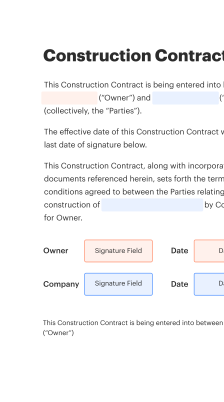
How placeholder-driven signing works

This sequence shows how a prepared template with placeholders moves from admin configuration to completed signed document.

  • Template creation: Admin places placeholders and sets roles.
  • Recipient routing: System sends to signers in defined order.
  • Signing step: Recipients complete fields and apply eSignatures.
  • Finalization: Signed document is sealed, stored, and audited.
Collect signatures
24x
faster
Reduce costs by
$30
per document
Save up to
40h
per employee / month

Quick step-by-step: create digisign placeholder

Follow these four actions to add a placeholder field to a document and prepare it for eSignature routing.

  • 01
    Upload document: Add the source file (PDF, DOCX) to the template area.
  • 02
    Place placeholder: Drag a signature or data field to the correct location.
  • 03
    Set validation: Configure required fields, format checks, and signer roles.
  • 04
    Save template: Assign a template name and enable reuse across workflows.
be ready to get more

Why choose airSlate SignNow

  • Free 7-day trial. Choose the plan you need and try it risk-free.
  • Honest pricing for full-featured plans. airSlate SignNow offers subscription plans with no overages or hidden fees at renewal.
  • Enterprise-grade security. airSlate SignNow helps you comply with global security standards.
illustrations signature

Suggested workflow settings for placeholders

These example settings provide a starting point for configuring automated sends, reminders, and retention when using placeholders in templates.

Workflow Setting Name for Configuration Default configuration values and typical settings
Reminder Frequency and Recurrence Interval 48 hours between reminders, limit three automatic reminders
Signing Order and Routing Sequence Sequential routing with fixed signer order by role
Authentication Method and Verification Level Email plus optional SMS code for higher assurance
Expiration Date and Reminder Policy Set 30-day expiration with notices at 7 and 2 days
Document Retention and Archival Settings Retain signed documents for seven years in encrypted storage

Supported platforms and device considerations

Placeholders should render correctly across desktop and mobile devices; test templates in all target environments before wide deployment.

  • Desktop browsers: Chrome, Safari, Edge supported
  • Mobile devices: iOS and Android apps supported
  • File formats: PDF and DOCX recommended

Ensure templates are validated on tablets and phones, confirm touch-friendly field sizes, and verify that PDFs with complex layers are flattened or preprocessed to allow stable placeholder placement and consistent rendering.

Security controls related to placeholders

Field-level locks: Prevents editing after placement
Role-based access: Restricts who adds placeholders
TLS encryption: Secures data in transit
At-rest encryption: Protects stored documents
Audit logging: Tracks placeholder changes
Access tokens: Secures API operations

How placeholders are used in real workflows

Two concise examples show practical uses of placeholders for recurring documents and regulated industries.

Onboarding packet

A company prepares a single onboarding template with placeholders for signature, initials, and date fields

  • placeholders are mapped to specific role assignments and validation rules
  • this reduces manual corrections and speeds new hire completion

Resulting in faster onboarding and clearer audit trails for HR and compliance.

Healthcare consent

A clinic uses a consent form template with placeholders for patient signature, witness initials, and checkbox confirmations

  • placeholders enforce required responses and capture signing order
  • the template integrates with patient records and stores metadata for compliance

Leading to consistent consent capture and a verifiable audit trail for HIPAA purposes.

Best practices for secure and accurate placeholders

Apply consistent standards and governance when designing placeholders to reduce errors, strengthen security, and maintain compliance with U.S. electronic signature laws.

Standardize template naming and version control
Use clear, consistent template names and a version history to ensure teams apply the correct placeholders. Maintain a single source of truth and retire outdated templates to prevent mis-sends.
Use field validation and type enforcement
Configure placeholder fields with strict validators for dates, phone numbers, and identifiers. Validation prevents invalid entries and reduces manual corrections and processing time.
Restrict edit rights and enable audit logs
Limit who can add or modify placeholders to reduce accidental changes. Keep detailed logs of template edits, placeholder placement, and who authorized changes for audit readiness.
Test templates with sample signers before production
Run test sends that exercise routing, role assignment, and field behavior. Verify that placeholders render on mobile and desktop and that downstream integrations receive populated data correctly.

Common problems and troubleshooting for placeholders

This troubleshooting list covers typical issues encountered when creating or using placeholders and practical remedies for each situation.

Feature availability for placeholder workflows

A brief comparison of essential capabilities for placeholder-driven templates across major eSignature platforms, focused on U.S. compliance and automation features.

Feature or Comparison Criteria List signNow (Recommended) DocuSign Adobe Sign
Reusable templates with placeholders
API-driven placeholder creation
HIPAA BAA availability BAA available BAA available BAA available
Bulk send for templates
be ready to get more

Get legally-binding signatures now!

Risks when placeholders are misused

Invalid signatures: Legal challenges
Data exposure: Breach risk
Noncompliance: Regulatory fines
Operational delays: Slowed approvals
Template errors: Contract disputes
Audit gaps: Evidence issues

Pricing and core capabilities for placeholder support

High-level pricing and capability snapshot across five providers; figures and feature notes reflect common entry plans and typical commercial options.

Pricing and Feature Comparison signNow (Recommended) DocuSign Adobe Sign Dropbox Sign PandaDoc
Starting Price (per user/month) Starts at approximately $8 per user per month billed annually Starts at approximately $10 per user per month Starts around $15 per user per month Starts near $12 per user per month Starts near $19 per user per month
Core eSignature feature set Standard eSign, templates, placeholders, basic audit trail Full eSignature suite, templates, extensive integrations Enterprise-grade eSign, templates, Adobe Document Cloud integration Simple eSign flows, templates, Dropbox integration eSign plus document workflow and quoting tools
API access and SDKs REST API with SDKs and sample code Mature REST API and broad SDK support REST API with enterprise SDKs API available for business plans REST API with document generation SDKs
Bulk send and templates Bulk Send and reusable templates available Bulk Send available on business tiers Bulk/mass send available in higher plans Bulk send available in paid plans Bulk send and template automation included
HIPAA / BAA support BAA available for eligible plans BAA available on enterprise agreements BAA available with enterprise deployment BAA available upon request No BAA offered by default

Simplify complex workflows

Create, execute, and manage workflows of any complexity, electronically from virtually anywhere. Scalable eSignature capabilities allow you to share documents with the right people in the correct order and define roles for each recipient. Execute document workflows faster and easier than ever before.

Automate document management

Optimize complex signing processes with airSlate SignNow’s powerful features to enhance your business. Control your automated eSignature workflows to ensure they're running at peak performance with instant notifications and reminders.

Optimize in team collaboration

Bring teams together in a secure, shared environment. Manage documents, use form templates and notifications to create more efficient cross-organization collaboration. Free your employees from having to spend time on repetitive activities so that they can focus on valuable, business-critical tasks.

Integrate into your existing systems

Run your projects with industry-leading integration. Collect Salesforce, Microsoft Teams, and SharePoint all in one business flow. Connect your software to a single system for endless possibilities and more productiveness.

Stay compliant with best-in-class data security

Feel confident understanding that your information remains secure by the newest in encryption security. airSlate SignNow is GDPR and eIDAS compliant and offers you transparence into your signing process with court-admissible audit trails. Configure user authorization and rights to control who has access to what.


walmart logo
exonMobil logo
apple logo
comcast logo
facebook logo
FedEx logo
be ready to get more

Get legally-binding signatures now!