Create Looker on Default with SignNow

Get rid of paper and automate digital document processing for higher productivity and countless possibilities. Sign any papers from a comfort of your home, fast and feature-rich. Experience a better strategy for doing business with airSlate SignNow.

Award-winning eSignature solution

What create looker on default means and how it behaves

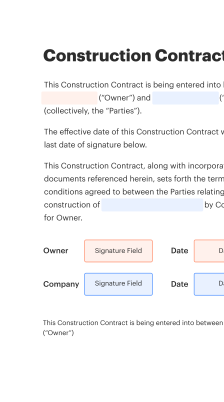
create looker on default is a configuration option that automatically generates a default document preview and signing layout when a new template or envelope is created. In practical terms, enabling this setting standardizes field placement, initial recipient roles, and a starting display for signers and reviewers. The setting is intended to reduce repetitive setup work, speed template creation, and ensure a consistent signing experience across documents. Administrators can customize default field types, visibility, and basic security options before deployment.

Why enable create looker on default in your workflows

Enabling create looker on default streamlines template creation, enforces consistent field placement, and reduces manual setup time while supporting compliance and predictable signer experience.

Why enable create looker on default in your workflows

Common implementation challenges to anticipate

  • Initial configuration may require coordination between legal, IT, and operations to define safe defaults and role mappings.
  • Overly rigid defaults can force frequent manual edits for nonstandard documents, reducing expected time savings.
  • Users may assume defaults cover compliance needs; administrators must still verify settings for HIPAA or FERPA documents.
  • Legacy templates may need migration to align with new default layouts and validation rules before rollout.

Representative user profiles for create looker on default

Contract Manager

A contract manager who issues standard agreements weekly and needs repeatable templates. They use defaults to reduce manual edits, ensure required signature blocks appear in the same locations, and maintain a consistent audit trail for each execution.

HR Director

An HR director who oversees onboarding documents across multiple offices. They apply defaults to ensure FERPA- or HIPAA-sensitive documents include required privacy notices and authentication steps while reducing configuration errors across hundreds of hires.

Teams and roles that benefit most from defaults

create looker on default provides the greatest value for teams that send recurring, similar documents and need consistent signer flows and auditability.

  • Sales operations that send standardized agreements at scale and need predictable signing layouts.
  • HR teams distributing offer letters and onboarding forms that require consistent fields and data capture.
  • Legal and compliance teams that monitor template versions and need clear audit trails for review.

When adopted with governance, defaults reduce errors and administrative overhead while preserving the ability to make case-by-case adjustments for atypical transactions.

be ready to get more

Choose a better solution

Core controls to include in create looker on default

When configuring defaults, focus on a small set of controls that influence security, data capture, and signer experience across all documents.

Field templates

Reusable field groups let administrators place commonly required fields — such as signature, full name, date, and standard checkboxes — consistently across templates while preserving field validation rules and preventing accidental omission in high-volume workflows.

Role mappings

Define default role definitions and access permissions for signers, approvers, and observers so each new document inherits a predictable signer order and permission set, reducing configuration errors and ensuring consistent auditability.

Security defaults

Set baseline authentication requirements, encryption preferences, and document locking behavior so every created item meets your minimum compliance and protection standards without needing per-template configuration.

Retention settings

Specify default storage location, retention periods, and archival policies so executed documents are retained and purged according to organizational and regulatory obligations without manual handling.

How the default creation process operates

This outlines the sequence from template creation to signer completion for default-enabled workflows.

  • Template initialization: Admin creates a template and enables defaults.
  • Default application: System applies layout and role settings automatically.
  • Signer interaction: Recipients see the standardized preview and required fields.
  • Completion and archive: Signed documents are locked and stored with an audit record.
Collect signatures
24x
faster
Reduce costs by
$30
per document
Save up to
40h
per employee / month

Quick setup steps for create looker on default

Follow these basic steps to enable and calibrate defaults for templates and envelopes so the feature aligns with your policies.

  • 01
    Define scope: Identify document types to receive default layouts.
  • 02
    Set roles: Map signer and approver roles for templates.
  • 03
    Configure fields: Place default form fields and validation rules.
  • 04
    Test and deploy: Validate sample workflows and roll out to users.
be ready to get more

Why choose airSlate SignNow

  • Free 7-day trial. Choose the plan you need and try it risk-free.
  • Honest pricing for full-featured plans. airSlate SignNow offers subscription plans with no overages or hidden fees at renewal.
  • Enterprise-grade security. airSlate SignNow helps you comply with global security standards.
illustrations signature

Recommended workflow settings when enabling defaults

These suggested default settings are suitable starting points; adjust values to match your organization’s security posture and operational needs.

Workflow Settings and Default Configuration Header Default configuration value or recommended setting
Reminder Frequency for Signers 48 hours
Default Authentication Method Email plus SMS
Document Retention Location Encrypted cloud storage
Default Signature Type Typed or drawn signature
Audit Trail Capture Level Full event logging

Supported platforms and minimum requirements

create looker on default functions across desktop and mobile platforms but requires compatible browser versions and updated mobile apps for full feature parity.

  • Desktop browsers: Chrome, Edge, Firefox
  • Mobile operating systems: iOS and Android
  • Minimum network needs: Stable HTTPS connection

For best results, keep browser and application versions current, verify JavaScript and TLS support, and test defaults on representative devices to ensure consistent signer experience across platforms.

Security and protection elements to configure with defaults

Access controls: Role-based signer access
Authentication: Email, SMS, or knowledge-based
Encryption: TLS in transit, AES at rest
Document locking: Prevent post-sign edits
Watermarking: Optional visible protection
Session timeout: Auto sign-out period

Practical examples of create looker on default in use

Two concise case examples show how defaults reduce manual work while maintaining compliance and auditability.

Sales Contract Template

A regional sales team standardized contract headers and signature fields during template creation to prevent placement errors

  • default fields include signature, date, and company tax ID
  • this reduced editing time per contract and improved data accuracy

Resulting in faster turnaround and fewer post-execution corrections for renewals.

Onboarding and HR Forms

An HR function applied defaults for offer letters, tax forms, and benefits enrollment to ensure required consent language appears consistently

  • default authentication set to email plus SMS where required
  • confidentiality and HIPAA-sensitive sections were pre-configured for restricted access

Leading to consistent compliance controls and streamlined audit reporting across new hires.

Recommended practices for safe and effective defaults

Use defaults to save time but combine them with governance and periodic review to maintain compliance and flexibility as document requirements evolve.

Review default configurations with legal and compliance annually
Schedule an annual review involving legal, security, and operations to confirm that defaults remain aligned with current ESIGN/UETA guidance and internal policies. Update default authentication, retention, and disclosure templates as regulations or business needs change.
Limit administrative edit rights to a few trained users
Restrict permission to change defaults to a small group of trained administrators to reduce accidental policy drift. Maintain change logs and require approvals for default modifications to preserve governance.
Test defaults in a staging environment before production deployment
Validate defaults against representative documents and signer scenarios in a nonproduction environment. Confirm behavior for edge cases, mobile signing, and integration points to avoid workflow interruptions after rollout.
Maintain template versioning and rollback capabilities
Track template and default changes through versioning so you can audit who changed settings and restore prior configurations if a change causes issues with active workflows or regulatory requirements.

FAQs and troubleshooting for create looker on default

Common questions and solutions for configuration, signer experience, and compliance when using create looker on default.

How signNow compares on default behavior with other providers

A concise feature comparison showing common default behaviors and compliance support across three widely used eSignature platforms.

Feature Comparison Across eSignature Providers signNow (Recommended) DocuSign Adobe Sign
Default template application Automatic Manual templates Manual templates
Role and signer mapping
Built-in retention controls Configurable Limited Configurable
HIPAA support options Available Available Available
be ready to get more

Get legally-binding signatures now!

Regulatory risks to monitor when using defaults

Noncompliant authentication: Fines
Data breach exposure: Liability
Improper retention: Penalties
Missing disclosures: Contract disputes
Insufficient audit trails: Admissibility issues
Incorrect role mapping: Invalid signatures

Pricing and plan differences relevant to defaults

Summary of typical entry-level pricing and how each vendor bundles features useful for defaulted templates and enterprise control.

Plan and Pricing Comparison signNow (Recommended) DocuSign Adobe Sign PandaDoc Dropbox Sign
Entry-level monthly price per user $8/user/month $10/user/month $14.99/user/month $19/user/month $15/user/month
Advanced template and defaults included Yes, templates and team defaults Yes, templates and advanced admin Yes, templates and forms Yes, templates and workflow tools Yes, templates and team controls
API access availability Available on paid plans Available on business plans Available on business plans Available on enterprise plans Available on paid plans
Compliance add-ons (HIPAA, BAA) BAA available upon request HIPAA available enterprise HIPAA available enterprise HIPAA available enterprise HIPAA via Dropbox Sign enterprise
Free tier or trial Free trial and limited free plan Free trial Free trial Free trial Free trial

Simplify complex workflows

Create, execute, and manage workflows of any complexity, electronically from virtually anywhere. Scalable eSignature capabilities allow you to share documents with the right people in the correct order and define roles for each recipient. Execute document workflows faster and easier than ever before.

Automate document management

Optimize complex signing processes with airSlate SignNow’s powerful features to enhance your business. Control your automated eSignature workflows to ensure they're running at peak performance with instant notifications and reminders.

Optimize in team collaboration

Bring teams together in a secure, shared environment. Manage documents, use form templates and notifications to create more efficient cross-organization collaboration. Free your employees from having to spend time on repetitive activities so that they can focus on valuable, business-critical tasks.

Integrate into your existing systems

Run your projects with industry-leading integration. Collect Salesforce, Microsoft Teams, and SharePoint all in one business flow. Connect your software to a single system for endless possibilities and more productiveness.

Stay compliant with best-in-class data protection

Feel safe with the knowledge that your data remains secure by the newest in encryption security. airSlate SignNow is GDPR and eIDAS certified and offers you transparence into your signing experience with court-admissible audit trails. Configure user access permissions and rights to manage who has access to what.


walmart logo
exonMobil logo
apple logo
comcast logo
facebook logo
FedEx logo
be ready to get more

Get legally-binding signatures now!