Propuesta De Desarrollo De Software CRM Para Personal

Experience seamless document management with airSlate SignNow. Empower your staffing solutions with easy eSigning and cost-effective processes.

Award-winning eSignature solution

What a crm software development proposal for staffing includes

A crm software development proposal for staffing is a formal document that outlines scope, deliverables, timelines, technical architecture, integration points, security controls, acceptance criteria, and pricing for building or customizing CRM capabilities tailored to staffing firms. It typically details user personas, data flows for candidate and client records, required integrations with job boards or payroll systems, automated workflows for candidate placement, and compliance commitments. The proposal clarifies responsibilities, milestones, testing plans, and maintenance terms so procurement and IT teams can evaluate technical fit and operational impact.

Why a tailored proposal matters for staffing firms

A focused crm software development proposal for staffing translates staffing-specific processes into measurable project scope, reducing ambiguity and aligning vendor and client expectations across recruiting, client management, and compliance requirements.

Why a tailored proposal matters for staffing firms

Common challenges addressed by a crm software development proposal for staffing

  • Mapping candidate lifecycle and placement workflows across multiple teams without duplicating records or losing auditability.
  • Ensuring integrations to job boards, payroll, and background-check vendors operate reliably and securely at scale.
  • Defining authentication and access policies for internal recruiters, hiring managers, and external clients.
  • Specifying measurable acceptance criteria for matching algorithms, reporting accuracy, and performance under load.

Typical roles involved and their needs

Recruiting Manager

Needs clear requirements for candidate tracking, pipeline stages, interview scheduling, and automated alerts. They rely on the proposal to enumerate workflow logic, reporting fields, and expected system behaviors to ensure deliverables support daily recruiting operations.

IT Lead

Requires details on architecture, APIs, authentication methods, data retention, and compliance obligations. The proposal must specify integration endpoints, expected throughput, error handling, and responsibilities for maintenance and security patching.

Primary users and stakeholders for staffing CRM proposals

Project stakeholders include recruiting managers, IT security, compliance officers, procurement teams, and outsourced development partners who review technical scope and risks.

  • Recruiting and operations teams who define functional requirements and workflows.
  • IT and security teams who validate integrations and data protection controls.
  • Procurement and legal teams who assess contract terms, SLAs, and liability.

The proposal also serves operational teams and executive sponsors as a reference for rollout priorities, resource planning, and post-deployment support obligations.

Core technical features to request in proposals

Specify functional capabilities clearly to avoid ambiguity about what will be delivered and tested during development and handover.

Candidate Portal

A responsive candidate interface for profile updates, document uploads, interview scheduling, and status notifications, integrated with the main CRM and preserving document audit trails for compliance purposes.
Client Portal

Client-facing dashboards to review candidate shortlists, approve placements, sign contracts, and view billing summaries with role-based visibility and secure document access.

Automated Matching

Rule-driven matching engine that scores candidates versus job requirements with configurable thresholds, audit logs of match decisions, and manual override paths for recruiters.

Background Check Integration

Predefined connectors to background-check vendors, with data field mapping, status polling, and secure storage of returned reports under defined retention policies.

Reporting & Analytics

Customizable reports on placements, time-to-fill, source effectiveness, and revenue metrics with export options and scheduled delivery to stakeholders.

Compliance Controls

Features for consent capture, opt-out processing, data export, and audit logs to support regulatory obligations and client-specific contractual clauses.

be ready to get more

Choose a better solution

Integrations and templates to include in the proposal

Proposals should list integration endpoints and reusable document templates that speed deployment and reduce recurring configuration work.

Google Workspace

Specify connector type, fields to sync, and whether two-way updates are required for contacts, calendar invites, and proposal documents used in client outreach and interview scheduling.

Applicant Tracking

Define the ATS integration: which candidate fields are authoritative, how duplicates are reconciled, and expected latency for status updates between systems.

Dropbox/Drive

Detail where signed proposals and offer letters will be stored, the folder structure, retention policy, and access permissions for internal users and external clients.

CRM systems

Clarify record ownership, sync cadence, custom field mapping, and conflict resolution rules between the staffing CRM and enterprise CRM platforms.
How to create and maintain the proposal online

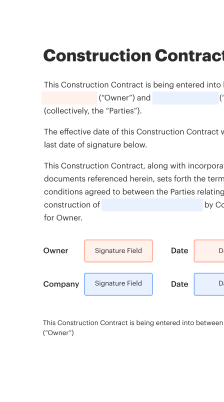
Use a structured template and central document repository so stakeholders can collaborate, review, and sign off on each section of the proposal.

  • Create template: Start from a standardized proposal template.
  • Collaborate: Invite stakeholders to review and comment.
  • Version control: Track edits and preserve previous drafts.
  • Sign-off: Capture approvals and retain final record.
Collect signatures
24x
faster
Reduce costs by
$30
per document
Save up to
40h
per employee / month

Step-by-step: preparing a crm software development proposal for staffing

Follow these core steps to assemble a proposal that clearly assigns scope, success criteria, and operational responsibilities for a staffing CRM engagement.

  • 01
    Define scope: Document features, modules, and exclusions.
  • 02
    Map workflows: Illustrate candidate and client processes.
  • 03
    Specify integrations: List endpoints, protocols, and data fields.
  • 04
    Set acceptance: Agree test cases and success metrics.

Audit trail and transaction record steps

Define how events are captured, stored, and made available for review to meet compliance and dispute-resolution needs.

01

Event capture:

Log all user actions and API calls
02

Timestamping:

Use UTC with millisecond precision
03

Immutability:

Write-once storage for audit records
04

Access controls:

Restrict who can read logs
05

Retention:

Align with legal and client policies
06

Export options:

Provide CSV and secure export APIs
be ready to get more

Why choose airSlate SignNow

  • Free 7-day trial. Choose the plan you need and try it risk-free.
  • Honest pricing for full-featured plans. airSlate SignNow offers subscription plans with no overages or hidden fees at renewal.
  • Enterprise-grade security. airSlate SignNow helps you comply with global security standards.
illustrations signature

Recommended workflow and configuration defaults

Proposals should include default workflow configurations to accelerate onboarding and provide predictable behavior during implementation.

Feature Configuration
Signing Order Sequential
Reminder Frequency 48 hours
Default Retention Period 7 years
Notification Channels Email and SMS
Failure Handling Retry with alert

Supported platforms and device considerations

  • Desktop browsers: Chrome, Edge, Safari supported
  • Mobile platforms: iOS and Android apps available
  • Minimum bandwidth: 2 Mbps recommended

Also list required client-side plugins or browser settings, accessibility requirements, and whether offline capabilities or progressive web app support are needed for remote recruiting environments.

Key security and authentication elements to specify

Encryption: AES-256 at rest and TLS in transit
Authentication: OAuth 2.0 and SAML options
Access Control: Role-based permissions
Audit Logs: Immutable event records
Data Segmentation: Tenant isolation available
Backup Policy: Daily encrypted backups

Staffing use cases that shape proposal requirements

Real-world scenarios help shape technical scope and acceptance tests for staffing-focused CRM projects.

High-volume contingency staffing

A regional staffing firm needed automated candidate intake and rapid matching to open roles using parsed resumes and scoring

  • Bulk resume parsing and rule-based matching
  • Reduced time-to-fill and manual triage

Resulting in measurable placement throughput improvements and clearer SLAs for onboarding and follow-up processes, ensuring consistent performance across multiple locations.

Managed services for enterprise clients

An MSP required role-based portals for clients and recruiters with strict data partitioning

  • Client-specific dashboards and audit controls
  • Centralized billing and SLA reporting

Leading to improved client transparency and simplified compliance evidence, reducing audit preparation time and clarifying responsibilities for data handling.

Best practices for an accurate and secure proposal

Adopt standards and clear conventions to reduce scope drift, protect data, and enable predictable implementations for staffing-specific CRM projects.

Use clear acceptance criteria and test cases
Include explicit user stories, test data sets, and pass/fail conditions so both parties can objectively assess delivered features against the agreed scope within reasonable timelines.
Define data protection and retention
Spell out encryption, retention periods, backups, and deletion processes to satisfy privacy obligations and ensure consistent handling of candidate and client records.
Specify integration SLAs and error handling
Document expected uptime, retry logic, monitoring alerts, and responsibilities for remediation to reduce operational disruptions between integrated systems.
Plan phased rollouts with rollback paths
Recommend incremental deployments, pilot cohorts, and clear rollback criteria to limit user impact and provide time to adjust workflows before full production release.

FAQs About crm software development proposal for staffing

Answers to frequently asked questions clarify common uncertainties about scope, security, integrations, and project delivery for staffing CRM projects.

Digital vs. paper-based signing: capabilities comparison

Compare eSignature vendors and key capabilities that affect staffing proposal workflows, with signNow listed first as a featured option.

Vendor / Capability signNow (Featured) DocuSign Adobe Acrobat Sign
Legal Compliance ESIGN/UETA ESIGN/UETA ESIGN/UETA
Bulk Send
HIPAA Support Available Available Available
Mobile App Availability iOS/Android iOS/Android iOS/Android
be ready to get more

Get legally-binding signatures now!

Timing checkpoints commonly included in proposals

Include clear delivery milestones and review windows to keep development aligned with recruiting cycles and client commitments.

01

Discovery phase

2–4 weeks for requirements and mapping

02

Prototype delivery

2–6 weeks for an initial build

03

User acceptance testing

1–3 weeks for stakeholder validation

04

Production launch

Planned date with rollback window

Typical document and milestone deadlines

Proposals commonly tie document approvals and technical milestones to concrete dates to manage expectations.

Requirements sign-off:

Within two weeks of discovery completion

Design approval:

One week after prototype review

Integration window:

Scheduled with vendor availability

UAT completion:

Three business weeks allocated

Go-live date:

Coordinated with client operations

Risks and potential penalties tied to noncompliance

Regulatory fines: Up to statutory amounts
Breach liability: Civil exposure possible
Contract termination: Vendor or client right
Reputational harm: Loss of client trust
Operational downtime: Revenue disruption risk
Data loss: Recovery costs incurred

Pricing and feature comparison across eSignature vendors

High-level pricing comparisons and included features for common eSignature solutions used in staffing workflows; signNow is listed first and marked as Featured.

Vendor signNow (Featured) DocuSign Adobe Acrobat Sign Dropbox Sign PandaDoc
Starting Monthly Price From $8 per user monthly From $10 per user monthly From $9.99 per user monthly From $15 per user monthly From $19 per user monthly
Free Trial 14-day trial typically available 30-day trial options vary Free trial available Free trial available Free trial available
Advanced Workflows Conditional fields and templates included Advanced workflow tiers exist Workflow features included in plans Workflow via API Workflow in higher tiers
HIPAA Compliance Available with BAAs Available with BAAs Available with enterprise plans Available upon request Available with enterprise plan
Document Storage Included Basic storage included; integrations supported Limited storage included Cloud storage with Acrobat cloud Storage via Dropbox integration Storage included and integrated
walmart logo
exonMobil logo
apple logo
comcast logo
facebook logo
FedEx logo
be ready to get more

Get legally-binding signatures now!