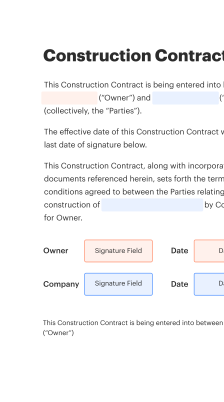
Digital Sign Document with SignNow
What a digital sign document is and how it works
Why using a digital sign document matters for workflows
Digital sign documents reduce turnaround time, lower processing costs, and provide verifiable records that support compliance and audit readiness for typical business transactions.
Common challenges when switching from paper to digital sign documents
- Resistance to change in established teams and unclear internal policies slow adoption and compliance consistency.
- Poorly prepared forms lead to incomplete data capture and require manual follow-up that negates time savings.
- Inadequate authentication choices create legal or security gaps for sensitive agreements, especially in regulated industries.
- Misconfigured retention and backup settings can expose organizations to discovery or compliance failures during audits.
Representative user profiles for digital sign document workflows
HR Manager
An HR Manager uses digital sign documents to send offer letters and onboarding forms, track completion status, and maintain secure records for audits and personnel files. They rely on templates and reminders to ensure new hires complete documentation promptly while preserving privacy controls for sensitive employee data.
Contract Administrator
A Contract Administrator prepares standard agreements, routes them for signatures, and monitors audit trails for compliance. They use role-based access, version control, and retention policies to minimize risk and ensure signed documents are discoverable and admissible when required by legal or regulatory processes.
Who typically uses digital sign documents across organizations
Typical users include legal, HR, sales, and operations teams that need reliable signatures with audit records.
- Legal teams managing contracts and approvals with emphasis on retention and auditability.
- HR departments handling onboarding, offer letters, and confidentiality agreements at scale.
- Sales and procurement teams processing agreements quickly to shorten deal cycles and reduce delays.
Adoption often starts in one department and expands when integration with core systems proves operational value.
Choose a better solution
Core features to look for when creating a digital sign document
Templates
Reusable templates reduce preparation time for recurring documents; templates preserve consistent field placement, default values, and routing logic so teams can send standardized agreements quickly while reducing input errors.
Bulk Send
Bulk Send lets users deliver the same document to many recipients with individualized fields, supporting mass acknowledgements, invoices, and notifications while maintaining audit records for each recipient.
Audit Trail
A secure audit trail records every signing event with timestamps, IP addresses, and authentication method so organizations retain legally defensible evidence of who signed and when.
API Access
APIs enable embedding document creation and signing into existing systems, automating envelope generation, status polling, and retrieval of completed files for seamless back-office workflows.
How the digital sign document process typically flows
-
Prepare document: Upload and add form fields and instructions
-
Authenticate signer: Use email, SMS codes, or SSO
-
Capture signature: Apply electronic or digital signatures
-
Archive record: Store signed PDF and audit trail
Step-by-step: preparing a digital sign document for signature
-
01Upload file: Add your document in PDF or Word format
-
02Add fields: Place signature, date, and data fields
-
03Specify signers: Assign roles and authentication methods
-
04Send and track: Monitor status and retrieve signed copies
Why choose airSlate SignNow
-
Free 7-day trial. Choose the plan you need and try it risk-free.
-
Honest pricing for full-featured plans. airSlate SignNow offers subscription plans with no overages or hidden fees at renewal.
-
Enterprise-grade security. airSlate SignNow helps you comply with global security standards.
Typical workflow settings for digital sign document automation
| Setting Name | Configuration |
|---|---|
| Reminder Frequency | 48 hours |
| Expiry Period | 30 days |
| Default Authentication | Email OTP |
| Signed File Format | Flattened PDF |
| Retention Policy | 7 years |
Industry examples showing practical use of digital sign documents
Healthcare consent forms
A hospital converted paper consent forms to digital sign documents to speed intake and maintain audit logs for each patient encounter.
- Template-driven workflows captured required clinical fields and signatures.
- The change reduced administrative time and improved accuracy in patient records.
Resulting in faster patient throughput and clearer compliance documentation for HIPAA audits.
University enrollment agreements
A university replaced mailed enrollment and FERPA-consent forms with secure digital sign documents to simplify admissions.
- Automated reminders and prefilled fields reduced user error.
- Processing time decreased while record retention improved for student records management.
Leading to more timely enrollments and reliable evidence of consent during regulatory reviews.
Best practices for secure, accurate digital sign documents
FAQs and troubleshooting for digital sign document issues
- Why is my signature not considered legally binding?
Electronic signatures may be challenged if signer intent or authentication cannot be established. Ensure your process captures explicit consent, reliable authentication, and a tamper-evident audit trail. Retain the signed PDF and logs in a secure store to support enforceability under ESIGN and UETA.
- How do I verify a completed digital sign document?
Verify the embedded audit trail showing timestamps, authentication method, and signing events. Check cryptographic seals or document hashes when available; these confirm the file was not altered after signing and support admissibility in disputes.
- What authentication should I require for sensitive agreements?
Require stronger verification for high-risk transactions, such as multi-factor authentication, knowledge-based identity checks, or identity verification services. Align the authentication level with legal and organizational risk tolerances and document retention needs.
- How do I fix incomplete or unsigned documents?
Resend the document with clear instructions and highlight required fields. Use reminders and allow signer corrections where appropriate. Maintain version control to prevent multiple conflicting signed copies in your records.
- Can I store signed documents to meet retention rules?
Yes. Implement retention policies that meet legal and regulatory requirements, back up signed files securely, and restrict access via role-based controls. Ensure retention settings preserve both the signed document and its audit trail.
- Does signNow support regulated-industry requirements?
signNow provides features such as audit logs, encryption, and options for HIPAA compliance to help organizations in regulated sectors. Confirm specific contractual terms and configurations, such as BAAs or additional controls, to meet sector requirements.
Feature comparison for popular eSignature providers for digital sign documents
| eSignature Platform | signNow (Featured) | DocuSign | Adobe Acrobat Sign |
|---|---|---|---|
| Native Mobile App | |||
| Bulk Send | |||
| HIPAA Support | Available | Available | Available |
| API for Developers | REST API | REST API | REST API |
Get legally-binding signatures now!
Legal and operational risks tied to improper digital sign document use
Comparing entry-level capabilities and enterprise support among eSignature vendors
| Platform | signNow (Featured) | DocuSign | Adobe Acrobat Sign | PandaDoc | Dropbox Sign |
|---|---|---|---|---|---|
| Free trial availability | Yes | Yes | Yes | Yes | Yes |
| Per-user subscriptions | Yes | Yes | Yes | Yes | Yes |
| API included | Yes | Yes | Yes | Yes | Yes |
| Enterprise plans | Available | Available | Available | Available | Available |
| HIPAA compliance option | Yes (BAA) | Yes (BAA) | Yes (BAA) | Yes (BAA) | Yes (BAA) |
Simplify complex workflows
Generate, perform, and control workflows of any difficulty, electronically from near any place. Scalable eSignature functionality allow you to exchange contracts with the right users the correct way and determine roles for each receiver. Execute document workflows faster and simpler than ever before.
Automate document management
Enhance complicated signing processes with airSlate SignNow�s powerful functions to boost your operation. Manage your automatic eSignature workflows to ensure they're running at top performance with instant notifications and alerts.
Enhance in team communication
Join teammates together in a protected, shared workplace. Handle paperwork, use form templates and notifications to produce better cross-organization communication. Relieve your staff from having to spend time on repeating activities to enable them to concentrate on valuable, business-crucial duties.
Integrate into your existing network
Work your projects with market-leading integration. Collect Salesforce, Microsoft Teams, and SharePoint in multi functional business stream. Hook up your software to a single unit for endless opportunities and higher efficiency.
Remain compliant with industry-leading data safety
Feel confident understanding that your data remains secure by the most up-to-date in encryption security. airSlate SignNow is GDPR and eIDAS compliant and offers you visibility into your signing experience with court-admissible audit trails. Set up user access permissions and roles to manage who has access to what.