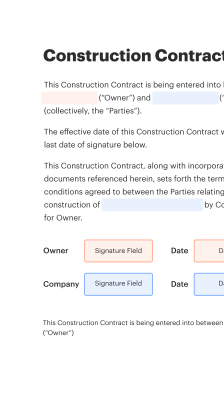
Digital Signature Deed of Trust with SignNow

Get rid of paper and improve digital document management for more efficiency and countless possibilities. Experience the perfect way of running your business with airSlate SignNow.

Award-winning eSignature solution

What a digital signature deed of trust is and why it matters

A digital signature deed of trust is a deed of trust document executed using electronic signatures and associated digital controls that establish lender security interest in collateral. In U.S. transactions this replaces a handwritten signature with an auditable digital process that records signer identity, timestamp, and consent. Properly implemented digital signing preserves the document's legal effect under ESIGN and UETA while accelerating closings, reducing printing and courier delays, and enabling secure remote execution across lenders, title companies, and borrowers.

Advantages of using electronic signing for deeds of trust

Using an electronic workflow for a deed of trust reduces closing time, lowers operational costs, and improves auditability while maintaining compliance with U.S. e-signature law.

Advantages of using electronic signing for deeds of trust

Common challenges when notarizing and signing deeds without a digital workflow

  • Logistical delays from printing, transporting, and coordinating in-person signatures across parties and jurisdictions.
  • Higher operational cost for paper handling, storage, and courier services during multi-party closings.
  • Inconsistent signature verification and limited audit trails make dispute resolution slower and more resource intensive.
  • Difficulty enforcing time-sensitive conditions when signers are in different locations or outside normal business hours.

Representative user roles in a deed of trust signing process

Lender / Servicer

Lenders and servicers prepare the deed of trust, set signing order, and require an auditable record for underwriting and servicing purposes. They need reliable identity verification, retention policies, and integration with loan origination systems to support downstream workflows.

Closing Attorney

Closing attorneys review legal language, coordinate notary requirements, and confirm recording instructions. They rely on secure document storage, redaction tools, and timestamped audit trails to satisfy title exam and post-closing review processes.

Primary users and teams that handle digital deed of trust workflows

Title companies, mortgage lenders, closing attorneys, and loan servicers commonly manage deed of trust signing workflows and approvals.

  • Mortgage lenders and loan operations teams handling origination and securitization paperwork.
  • Title and escrow officers coordinating multi-party signatures and recording requirements.
  • Closing attorneys and settlement agents preparing, reviewing, and notarizing documents.

Efficient digital processes reduce coordination time and provide verifiable records useful for audits, servicing, and regulatory compliance.

Essential features for managing digital deeds of trust securely

When selecting a signing solution for deeds of trust, prioritize features that ensure legal compliance, robust authentication, and streamlined operational workflows.

Audit Trail

Comprehensive, timestamped logs that record each signer action, IP address, and device data to support enforceability and dispute resolution for recorded mortgages.

Identity Verification

Support for knowledge-based checks, ID document upload, and multi-factor authentication to confirm signer identity before allowing execution.

Templates

Reusable deed of trust templates with locked fields and conditional logic to reduce errors, ensure consistent disclosures, and speed repetitive signings.

Bulk Send

Ability to send identical documents to many recipients with individualized data prefilled, useful for portfolio-level servicing notices or standardized lien releases.

Conditional Routing

Rules-based routing that sends documents to specific parties based on loan attributes, required approvals, or post-signing review steps.

eNotary Support

Integrated or third-party electronic notary options where permitted, enabling remote notarization that meets state-specific requirements and recording rules.

be ready to get more

Choose a better solution

Integrations that support completed digital deeds of trust

Connecting signing workflows to commonly used systems reduces rekeying, improves consistency, and keeps title and loan records synchronized across platforms.

Google Docs

Export drafts and import finalized deeds directly between document editors and the signing platform to maintain version control, reduce manual uploads, and allow collaborative pre-signing edits with consistent field mapping.

CRM Systems

Integrate with CRM tools such as Salesforce to automate envelope creation from loan records, prefill borrower data, update status fields in real time, and provide a single source of truth for customer and loan data.

Dropbox

Sync signed deeds and attachments to cloud storage for centralized backup, retention management, and controlled sharing with title parties and recorders while preserving timestamps and document integrity.

APIs

Use REST APIs to embed signing flows into loan origination systems, trigger automated sends, retrieve audit reports programmatically, and maintain secure, auditable exchanges between systems.

How an electronic deed of trust workflow operates

A typical electronic deed of trust workflow automates document distribution, enforces signer order, and records a secure audit trail for each executed copy.

  • Document setup: Template creation and required fields placement.
  • Signer routing: Sequential or parallel routing with notifications.
  • Authentication: Apply verification and identity checks.
  • Archival: Store signed document and immutable audit log.
Collect signatures
24x
faster
Reduce costs by
$30
per document
Save up to
40h
per employee / month

Step-by-step: executing a digital signature deed of trust

Follow these core steps to prepare, execute, and record a digitally signed deed of trust while maintaining an auditable record.

  • 01
    Prepare document: Upload deed, add fields, set signing order.
  • 02
    Verify identities: Enable ID verification and MFA for signers.
  • 03
    Collect signatures: Send envelope and monitor completion status.
  • 04
    Record and store: Submit for recording and archive audit trail.
be ready to get more

Why choose airSlate SignNow

  • Free 7-day trial. Choose the plan you need and try it risk-free.
  • Honest pricing for full-featured plans. airSlate SignNow offers subscription plans with no overages or hidden fees at renewal.
  • Enterprise-grade security. airSlate SignNow helps you comply with global security standards.
illustrations signature

Configuration settings for an automated deed of trust workflow

Typical workflow settings streamline sending, reminders, authentication, and archival for deed of trust documents.

Feature Configuration
Signing Order Sequential routing
Reminder Frequency 48 hours
Identity Verification Level ID check + MFA
Retention Period 10 years
Recording Handoff Automated upload

Platform compatibility for signing deeds of trust on any device

Signers should be able to complete deed of trust transactions using common browsers and mobile devices with consistent security controls.

  • Desktop browsers: Chrome, Edge, Safari
  • Mobile platforms: iOS and Android apps
  • PDF support: PDF/A and standard PDF

Ensure the signing platform supports the latest browser versions and mobile OS releases, provides responsive signing experiences, and preserves document fidelity and field placement across devices for reliable recording and long-term storage.

Security controls used for electronic deeds of trust

Encryption: AES-256 encryption at rest
Transport Security: TLS encryption in transit
Authentication: Multi-factor options supported
Access Controls: Role-based permissions applied
Audit Logs: Immutable activity records
Document Integrity: Tamper-evident hashing

Real-world scenarios for digital deed of trust execution

Two practical examples show how electronic signing streamlines deed of trust workflows across common mortgage and refinance transactions.

Mortgage closing

A lender sends a draft deed of trust to borrower and title company for signatures using an eSignature platform with identity verification.

  • Secure signer authentication and sequential signing order.
  • Faster closing and immediate availability for recording.

Resulting in the deed being ready for electronic submission to the county recorder within hours instead of days, reducing funding delays and lowering logistics costs while preserving a complete audit trail.

Refinance transaction

A homeowner and lender complete a refinance remotely using an electronic workflow that supports notarization and lender attestations.

  • Integrated document templates and conditional fields enforce consistent disclosures.
  • Reduced errors and fewer re-executions.

Leading to shorter turnaround time, fewer clerical mistakes, and clearer chain-of-custody records that simplify post-closing review and loan servicing transfers.

Best practices for secure and accurate digital deeds of trust

Adopt consistent operational controls and documentation practices to reduce risk and ensure a clear chain of custody for each executed deed of trust.

Use standardized templates with locked fields
Create firm-approved deed templates that lock legal clauses and automatically place required signature, initial, and notary fields to prevent unauthorized edits and reduce execution errors across transactions.
Apply adequate signer authentication
Select identity verification measures proportional to risk, combining multi-factor authentication and ID document checks for borrowers and guarantors to mitigate fraud and satisfy lender compliance.
Maintain robust retention and archival policies
Store executed deeds and audit trails in encrypted, access-controlled storage with retention schedules aligned to servicing, regulatory, and state recording requirements to support audits and potential litigation.
Document recording and jurisdiction checks
Verify county recorder requirements and state notarization rules before execution; coordinate with title or recording agents to confirm accepted formats and any additional attestations needed.

FAQs about digital signature deeds of trust

Answers to common legal, technical, and operational questions about executing deeds of trust electronically in the United States.

Side-by-side feature availability for deed signing platforms

Compare essential capabilities that affect enforceability, integration, and operational fit for electronic deeds of trust.

Feature signNow (Recommended) DocuSign
ESIGN & UETA Compliance
Audit Trail Detail Detailed logs Detailed logs
Bulk Send
Native eNotary Third-party Third-party
be ready to get more

Get legally-binding signatures now!

Potential risks when signing deeds of trust incorrectly

Invalid execution: Signature not enforceable
Recording delays: Late filing penalties
Fraud risk: Unauthorized signers
Regulatory exposure: Noncompliant processes
Data breaches: Confidentiality loss
Operational costs: Rework and disputes

Pricing and plan feature comparison for deed of trust signing

A concise pricing comparison highlights starting tiers, API access, and enterprise capabilities across common eSignature providers used in U.S. real estate workflows.

Plan signNow (Recommended) DocuSign Adobe Sign Dropbox Sign PandaDoc
Free tier availability Limited free trial No free tier Trial available Basic free features Trial available
Starting price (per user/mo) $8–$15 $10–$30 $14–$30 $15–$20 $19–$30
Bulk Send availability Included Add-on or higher tier Included Higher tier Included
API access Available Available Available Available Available
Enterprise features Advanced controls & SSO Enterprise-grade admin Integrated Adobe stack Teams & folder controls CRM-focused platform

Simplify complex workflows

Prepare, perform, and manage workflows of any complexity, digitally from almost anywhere. Scalable electronic signature functionality let you exchange contracts with the right users the proper sequence and set up roles for every signee. Stream document workflows faster and easier than ever before.

Automate document management

Enhance complicated signing tasks with airSlate SignNow�s highly effective features to enhance your company. Take control of your automatic signature workflows to guarantee they're operating at maximum efficiency with quick notifications and reminders.

Optimize in team communication

Bring teams together in a safe, shared workplace. Handle documents, use form templates and notifications to create more effective cross-organization interaction. Relieve your workers from having to spend time on repetitive actions so that they can center on valuable, business-essential activities.

Integrate into your existing network

Work your projects with best-in-class integration. Collect Salesforce, Microsoft Teams, and SharePoint all in one business flow. Hook up your applications to a single system for unlimited possibilities and higher productivity.

Stay compliant with best-in-class data security

Feel safe understanding that your information is protected by the most up-to-date in encryption security. airSlate SignNow is GDPR and eIDAS certified and provides you exposure into your signing procedure with court-admissible audit trails. Configure user access permissions and rights to control who has access to what.


walmart logo
exonMobil logo
apple logo
comcast logo
facebook logo
FedEx logo
be ready to get more

Get legally-binding signatures now!