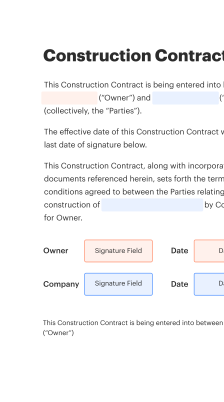
Draft Sign Solicitation Made Easy with SignNow
What draft sign solicitation means in eSignature workflows
Why use a draft sign solicitation in your processes
Draft sign solicitations reduce errors and approvals friction by allowing review and pre-checks before sending, improving accuracy while preserving an audit trail for later compliance.
Common challenges that drafts help address
- Unintended sendings: drafts prevent premature distribution and let teams catch errors before recipients receive requests.
- Version control issues: a saved draft centralizes the active document version and reduces conflicting edits across collaborators.
- Compliance oversights: drafts allow legal or compliance review before a request is issued to external signers.
- Manual coordination delays: preparing a solicitation as a draft reduces back-and-forth and consolidates required fields and recipient order.
Representative user profiles for draft workflows
Contract Manager
A contract manager uses draft sign solicitations to assemble agreements, set signing order, and add conditional fields. They rely on drafts to coordinate internal legal review, attach required exhibits, and ensure signature blocks align with corporate policy before sending to external parties.
HR Administrator
An HR administrator prepares onboarding packages as drafts to combine offer letters, tax forms, and policy acknowledgements. Drafts let HR collect internal approvals, confirm benefit selections, and schedule staggered sends to new hires while maintaining an auditable pre-send history.
Typical teams and roles that use draft sign solicitation
Legal, sales, HR, and procurement teams commonly prepare signature requests as drafts to coordinate approvals and ensure completeness before sending.
- Legal teams: validate clauses, attach redlines, and control signatory order for enforceability.
- Sales and account teams: assemble contracts with pricing and attachments to avoid rework after sending.
- HR and administration: prepare offer letters and onboarding documents for staged approvals and confidentiality checks.
Drafts support collaboration across departments by preserving a reviewable state that can be audited and finalized when all checks pass.
Choose a better solution
Key integrations and template features that support drafts
Google Docs integration
Prepare a draft directly from Google Docs to preserve formatting and collaborative edits, then map signature fields automatically and save the assembled request in the eSignature platform for review.
CRM connectivity
Link drafts to CRM records so contact and deal fields auto-populate, enabling consistent document generation and reducing manual entry before sending the solicitation to clients.
Cloud storage link
Attach files from cloud storage providers while drafting, keeping originals in place and ensuring the solicitation references the correct, versioned document for later auditing.
Document templates
Use templates for recurring forms to predefine fields, recipient roles, and approval steps so drafts are quicker to assemble and less prone to configuration errors.
How draft sign solicitation works online
-
Create draft: Upload document and place signature fields.
-
Configure: Set recipients, deadlines, and authentication.
-
Collaborate: Invite reviewers or apply internal approvals.
-
Finalize: Convert draft to an active solicitation and send.
Step-by-step: finalize a draft sign solicitation
-
01Open draft: Locate the saved draft in the workspace.
-
02Review content: Check attachments and legal clauses for accuracy.
-
03Assign recipients: Set roles and signing order as required.
-
04Send request: Apply reminders and transmit the finalized solicitation.
Why choose airSlate SignNow
-
Free 7-day trial. Choose the plan you need and try it risk-free.
-
Honest pricing for full-featured plans. airSlate SignNow offers subscription plans with no overages or hidden fees at renewal.
-
Enterprise-grade security. airSlate SignNow helps you comply with global security standards.
Typical workflow settings for draft sign solicitation
| Setting Name | Configuration |
|---|---|
| Default draft retention | 90 days |
| Reminder Frequency | 48 hours |
| Approval requirement | Manager sign-off |
| Auto-expire drafts | Disabled by default |
| Draft visibility | Team-only |
Supported devices and browser considerations
Draft sign solicitation workflows are available across modern desktop browsers and mobile apps, though some features are optimized for the web interface.
- Desktop browsers: Chrome, Edge, Firefox
- Mobile platforms: iOS and Android apps
- Offline access: Limited local caching
For consistent drafting and field placement, use an up-to-date browser or the vendor’s mobile app; complex templates and integrations are best managed on desktop before finalizing and sending.
Practical examples of draft sign solicitation in use
Sales contract assembly
A sales rep prepares a contract draft including negotiated terms and pricing for internal review
- Uses role-based approvals and locked fields for pricing
- Reduces version churn and prevents sending incorrect terms
Resulting in fewer contract exceptions and faster closing cycles.
Onboarding and HR approvals
An HR team drafts a new-hire packet with offer letter, tax forms, and benefits selections for manager sign-off
- Applies conditional fields and sequencing for manager then employee signatures
- Ensures all approvals and sensitive fields are validated before release
Leading to consistent records and improved compliance with employment policies.
Best practices for secure and accurate draft sign solicitation
Frequently asked questions about draft sign solicitation
- How do I recover an accidentally deleted draft
Check the platform’s recycle or trash area where deleted drafts may be retained temporarily; if versioning is enabled, restore the last saved version. Contact your administrator if retention settings have removed the draft permanently.
- Can multiple users edit the same draft simultaneously
Concurrent editing policies vary by vendor; some systems allow collaborative editing with locking or check-out mechanisms. Best practice is to assign a single owner to avoid conflicting changes and preserve a clear approval path.
- What authentication should be used for high-risk documents
Use multi-factor authentication or knowledge-based verification for sensitive agreements. For regulated data, combine strong signer authentication with encryption and a business associate agreement where HIPAA applies.
- Why are fields misaligned after importing from another format
File format differences (for example, converting from DOCX to PDF) can shift layout. Reconfirm field placement in the draft and use PDF-native templates to reduce alignment issues before sending.
- How long do drafts remain available before auto-deletion
Retention is controlled by administrative settings; default periods vary by vendor. Verify your organization’s draft retention policy and adjust configuration to meet record-keeping requirements.
- Who can view internal drafts and approval notes
Visibility is driven by role-based access and folder permissions. Ensure permission groups are configured so only authorized staff and approvers can access drafts and any internal notes.
Feature comparison: draft handling and availability
| Criteria | signNow (Recommended) | DocuSign | Adobe Sign |
|---|---|---|---|
| Draft autosave | |||
| Role-based draft permissions | |||
| Template-driven drafts | |||
| HIPAA-compliant configuration | Available | Available | Available |
Get legally-binding signatures now!
Regulatory and operational risks when drafts are mishandled
Comparison of tiers and feature availability across vendors
| Plan Comparison | signNow (Recommended) | DocuSign | Adobe Sign | Dropbox Sign | PandaDoc |
|---|---|---|---|---|---|
| Free eSign option | Yes, basic | Trial only | Yes, with Acrobat Reader | Yes, limited | Yes, limited |
| API access | Included with plans | Included with plans | Included via Acrobat | Included | Included |
| HIPAA support | Available with BA | Available with BA | Available with BA | Not standard | Available with BA |
| Bulk send capability | Included in business plans | Add-on feature | Included | Included | Included |
| Enterprise SSO | Available | Available | Available | Available | Available |
Simplify complex workflows
Create, execute, and manage workflows of any complexity, electronically from virtually anywhere. Scalable eSignature capabilities allow you to share documents with the right people in the correct order and define roles for each recipient. Execute document workflows faster and easier than ever before.
Automate document management
Optimize complex signing processes with airSlate SignNow’s powerful features to enhance your business. Control your automated eSignature workflows to ensure they're running at peak performance with instant notifications and reminders.
Optimize in team collaboration
Bring teams together in a secure, shared environment. Manage documents, use form templates and notifications to create more efficient cross-organization collaboration. Free your employees from having to spend time on repetitive activities so that they can focus on valuable, business-critical tasks.
Integrate into your existing systems
Run your projects with industry-leading integration. Collect Salesforce, Microsoft Teams, and SharePoint all in one business flow. Connect your software to a single system for endless possibilities and more productivity.
Stay compliant with industry-leading data security
Feel safe knowing that your information remains secure by the latest in encryption security. airSlate SignNow is GDPR and eIDAS compliant and offers you awareness into your signing procedure with court-admissible audit trails. Set up user authorization and rights to control who has access to what.