E Sign HTML for Secure Document Signing

Remove paperwork and improve document management for increased performance and limitless opportunities. Enjoy a better way of running your business with airSlate SignNow.

Award-winning eSignature solution

What e sign html means and how it works

e sign html refers to embedding or invoking electronic signature functionality within HTML documents or web pages, allowing users to sign forms inside a browser or app. Implementations vary from simple image-based signature capture to integrated eSignature flows that attach cryptographic evidence, timestamps, and audit trails to the signed document. In U.S. contexts, properly implemented e sign html processes should preserve intent, identity, and record integrity to meet ESIGN and UETA requirements while supporting interoperability with document storage and compliance controls.

Why use e sign html in online workflows

Embedding e sign html streamlines form completion, reduces paper handling, and speeds approvals while retaining verifiable records for compliance and audits.

Why use e sign html in online workflows

Common challenges when implementing e sign html

  • Ensuring the signature capture preserves legal intent and records across browsers and devices without data loss or corruption.
  • Managing identity proofing and multifactor authentication to match organizational compliance needs and industry regulations.
  • Embedding secure timestamping and tamper-evident hashes into HTML workflows to maintain admissible audit trails.
  • Balancing user experience with required security steps to avoid abandonment or signature errors during the process.

Typical user personas for e sign html

Legal Counsel

In-house counsel assesses whether e sign html flows meet ESIGN and UETA evidentiary requirements, reviews identity proofing options, and defines retention and audit policies to reduce legal exposure and support enforceability.

HR Manager

HR managers design embedded signature forms for onboarding and policy acknowledgment, focusing on accessibility, recordkeeping, and integration with HRIS systems to streamline employee lifecycle processes.

Primary users and organizational roles for e sign html

Organizations across regulated and transactional industries embed e sign html into web forms to capture signatures inline and speed approvals for customers and employees.

  • Sales teams using embedded signatures to finalize contracts within CRM-driven web pages.
  • Human resources teams capturing onboarding documents and policy acknowledgements inside employee portals.
  • Healthcare administrators collecting consent forms within clinical portals while maintaining record integrity.

These implementations typically require coordination between IT, compliance, and business owners to align security, legal, and user experience requirements.

Additional features that enhance e sign html workflows

Platforms that extend embedded signing with workflow and integration features reduce manual steps and increase repeatability for common document processes.

Bulk Send

Bulk Send enables sending identical documents to many recipients with individualized signing links and consolidated status reporting to support mass notifications or enrollment processes.


Team Templates

Team Templates allow centralized creation and sharing of preconfigured forms and signature fields, accelerating repeatable processes while maintaining consistency and governance across users.

Conditional Fields

Conditional Fields show or hide input elements based on prior responses, simplifying the signer experience and reducing incorrect or incomplete submissions.

CRM Integration

Direct integrations with CRM platforms sync signer data, automate signature requests, and store signed documents within customer records for streamlined process continuity.

Custom Branding

Custom Branding supports consistent customer-facing presentation by matching fonts, logos, and messaging to the host application for a seamless signing experience.

Advanced Workflows

Advanced Workflows orchestrate sequential or parallel signing steps, reminders, and conditional routing to fit complex approval matrices and business rules.

be ready to get more

Choose a better solution

Core features to look for in e sign html implementations

Choose features that secure the transaction, support compliance, and integrate into existing systems for smooth inline signing experiences.

Embedded SDK

A lightweight SDK or iframe enables the signing experience to run inside the web page without redirecting users, and should support customization, accessibility, and consistent session handling across desktop and mobile browsers.

Audit trail

Comprehensive event logging captures signer actions, timestamps, IP addresses, and document hashes, preserving an unalterable record that supports ESIGN and UETA evidentiary needs for U.S. transactions.

Authentication options

Support for email OTP, SMS OTP, knowledge-based verification, and optional third-party identity proofing allows balancing usability with stronger signer identity assurance for higher-risk documents or regulated industries.

Document security

Tamper-evident sealing, encryption at rest, role-based access, and configurable retention controls ensure signed artifacts remain secure and auditable after capture.
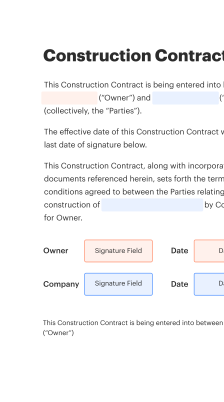
How embedded e sign html flows operate

An embedded e sign html flow typically loads a signing widget in-page, collects signer input, applies cryptographic seals, and returns a signed document and audit trail to the host application.

  • Load widget: Host page loads signing iframe or SDK.
  • Collect input: Signer provides signature and required data.
  • Seal document: Platform applies hash and timestamp.
  • Return artifacts: Signed PDF and audit log returned to host.
Collect signatures
24x
faster
Reduce costs by
$30
per document
Save up to
40h
per employee / month

Quick setup: e sign html basic steps

Follow these fundamental steps to embed an e sign html flow into a web page while preserving legal and security requirements.

  • 01
    Choose provider: Select an eSignature vendor that supports embedding and API access.
  • 02
    Define fields: Map signature, date, and data fields into the HTML form.
  • 03
    Implement auth: Add appropriate user authentication and identity checks.
  • 04
    Store records: Persist signed documents and audit logs in secure storage.

Completing an e sign html signature: user steps

These concise steps describe what a signer typically experiences when completing an embedded HTML signature.

01

Open form:

Access the web page or app with the embedded signing flow.
02

Verify identity:

Complete required authentication or OTP checks.
03

Review content:

Read the document and required disclosures before signing.
04

Apply signature:

Use a drawn, typed, or authenticated signature control.
05

Confirm:

Affirm consent and submit the signed document.
06

Receive receipt:

A signed PDF and audit record are returned to the sender.
be ready to get more

Why choose airSlate SignNow

  • Free 7-day trial. Choose the plan you need and try it risk-free.
  • Honest pricing for full-featured plans. airSlate SignNow offers subscription plans with no overages or hidden fees at renewal.
  • Enterprise-grade security. airSlate SignNow helps you comply with global security standards.
illustrations signature

Typical workflow configuration settings for embedded signing

Key workflow settings determine behavior for reminders, expiry, authentication, and storage when embedding e sign html.

Setting Name Configuration
Reminder Frequency 48 hours
Signature Expiration 30 days
Default Authentication Method Email OTP
Storage Location Secure cloud storage
Webhook Notifications Enabled for events

Supported platforms for e sign html

Embedded e sign html flows should work across modern desktop and mobile browsers as well as webviews inside native apps to reach users where they sign.

  • Desktop browsers: Chrome, Edge, Firefox, Safari
  • Mobile browsers: Mobile Safari, Chrome for Android
  • Native app webviews: iOS and Android webview support

Test signing widgets across targeted browsers, screen sizes, and app webviews and include fallbacks for browsers that restrict third-party cookies or block embedded frames to maintain robust signing availability.

Security controls relevant to e sign html

Encryption in transit: TLS 1.2 or higher
Encryption at rest: AES-256 or equivalent
Access controls: Role-based permissions
Authentication: Multi-factor options supported
Tamper evidence: Document hashing and sealing
Audit logs: Immutable event history

Industry examples of e sign html in practice

Inline e sign html is commonly used to shorten transaction cycles and preserve legally meaningful records across sectors such as real estate and healthcare.

Real Estate Closing

A brokerage embeds e sign html into its client portal to collect buyer and seller signatures on disclosures and purchase agreements

  • Inline signature capture reduces turnaround by removing print-scan steps
  • The portal attaches a time-stamped audit trail and signer IP data for evidence

Resulting in quicker closings and a retained verifiable record that supports title and compliance workflows.

Patient Consent Forms

A clinic uses e sign html inside the patient intake web form to capture consent for treatment and data sharing

  • Identity is verified via knowledge-based questions and SMS OTP
  • Signed records include tamper-evident metadata to meet clinical record requirements

Leading to faster admissions, consistent consent capture, and auditable evidence for HIPAA-aligned recordkeeping.

Best practices for implementing e sign html securely

Apply established controls and process design to keep inline signature capture legally defensible and operationally reliable.

Use clear signer intent and disclosure language
Present explicit statements describing the legal effect of signing, require affirmative consent before capture, and store the text presented to the signer as part of the record to avoid ambiguity in disputes.
Apply appropriate authentication based on risk
For routine low-risk documents, email or SMS OTP may be sufficient; for regulated or high-value transactions, require multi-factor authentication and stronger identity verification methods to match business and legal expectations.
Preserve complete audit metadata with each signature
Capture signer IP, device details, timestamps, document hashes, and the exact version of the document presented so the signed record supports later validation and forensic review if required.
Integrate retention and backup policies with legal requirements
Define retention schedules, export formats, and secure backups aligned with ESIGN, UETA, HIPAA, and organizational records policies to support compliance and defensibility.

FAQs and troubleshooting for e sign html

Common questions and solutions address integration issues, signer errors, and compliance concerns with embedded e sign html workflows.

Feature comparison: embedded e sign html support

A concise comparison of embedded signing capabilities and compliance options among leading eSignature providers.

Capability signNow (Recommended) DocuSign Adobe Acrobat Sign
API access REST API available REST API available REST API available
HIPAA compliance Available with BA Available with BA Available with BA
Bulk Send Bulk Send feature Bulk Send feature Bulk Send feature
Embedded signing SDK and iframe options Click-to-sign embedding Embed via SDK and APIs
be ready to get more

Get legally-binding signatures now!

Retention and document lifecycle checkpoints

Key retention milestones help ensure signed HTML-based documents remain available and compliant throughout their required lifecycle.

Initial capture and storage:

Immediately store signed artifact and audit log.

Short-term retention review:

Verify backups and access controls at 90 days.

Annual compliance audit:

Confirm retention schedule alignment with regulations yearly.

Legal hold readiness:

Implement holds when litigation or investigations begin.

Scheduled disposition:

Securely delete according to retention policy schedule.

Regulatory and operational risks

Noncompliance fines: Civil penalties possible
Rejected evidence: Court admissibility risk
Data breach costs: Notification and remediation
Operational delays: Contract disputes
Privacy violations: FERPA or HIPAA exposure
Loss of trust: Customer relationship damage

Pricing and plan characteristics across vendors

High-level pricing characteristics and enterprise support options vary; compare trial availability, billing models, and compliance add-ons when selecting a solution.

Pricing Aspect signNow (Recommended) DocuSign Adobe Acrobat Sign Dropbox Sign PandaDoc
Free trial availability 14-day trial available on most plans 30-day trial available 7-day trial available Free trial available 14-day trial available
Billing model Per-user subscription with volume discounts Per-user subscription Per-user and enterprise licensing Per-user subscription Per-user and usage tiers
API availability API included on business tiers and up API included for business plans API included with subscription API available on paid plans API available with paid plans
Enterprise support Custom enterprise agreements and SLAs Enterprise plans and SLAs Enterprise licensing and support Enterprise options available Enterprise services available
HIPAA-ready options HIPAA support with BA and controls HIPAA available with plan HIPAA provisions available HIPAA under enterprise agreements HIPAA support with agreements

Make simpler complex workflows

Prepare, deliver, and control workflows of any difficulty, digitally from virtually anywhere. Scalable electronic signature features ensure you can share papers with the right users the correct order and set up roles for each recipient. Complete document workflows faster and simpler than ever before.

Automate document managing

Optimize intricate signing procedures with airSlate SignNow�s powerful features to enhance your company. Take control of your automatic signature workflows to make sure they're running at peak functionality with instant notices and reminders.

Enhance in team communication

Join teammates together in a protected, shared workspace. Handle paperwork, use form templates and notifications to produce more efficient cross-organization communication. Free your employees from having to hang out on repeating actions to enable them to concentrate on valuable, business-essential tasks.

Integrate into your current framework

Manage your assignments with industry-leading integration. Capture Salesforce, Microsoft Teams, and SharePoint in one business flow. Link your software to a single unit for limitless possibilities and more performance.

Remain compliant with industry-leading data protection

Feel safe understanding that your data is protected by the newest in encryption security. airSlate SignNow is GDPR and eIDAS certified and provides you transparence into your signing experience with court-admissible audit trails. Set up user authorization and roles to control who has access to what.


walmart logo
exonMobil logo
apple logo
comcast logo
facebook logo
FedEx logo
be ready to get more

Get legally-binding signatures now!