Easily Create Teams with SignNow

Create one or more teams and invite other airSlate SignNow users to join. Working in teams allows you to share your documents faster and collaborate on them, saving you time and avoiding confusion.

Award-winning eSignature solution

What easily create teams means in practice

The ability to easily create teams lets organizations define groups of users, assign signing or administrative roles, and apply shared settings to workflows and templates. In signNow, team creation centralizes user management for collaborative document processes, enabling consistent role assignment, permission control, and access to shared templates. Teams reduce repetitive configuration for recurring transactions, streamline routing and Bulk Send workflows, and provide a clear audit trail for signatures and approvals across members while remaining compatible with U.S. legal standards for electronic records and signatures.

Why structured teams improve signature workflows

Creating teams simplifies permission management, reduces setup time for repeated processes, and supports consistent routing and compliance across user groups.

Why structured teams improve signature workflows

Common challenges when creating teams

  • Inconsistent role definitions across departments lead to incorrect permissions and delayed approvals.
  • Manual user provisioning becomes time-consuming as headcount grows and onboarding increases.
  • Lack of directory sync forces repeated updates and increases risk of stale access rights.
  • Complex reporting across multiple teams makes audit preparation and compliance reviews slower.

Representative user roles for team workflows

Team Lead

A Team Lead coordinates members, assigns roles within the team, and maintains shared templates. They verify routing order for signatures and ensure documents are assigned to correct signers for consistent processing across recurring workflows.

IT Administrator

An IT Administrator configures SSO, directory sync, and permission policies. They apply role-based access controls, enforce authentication methods, and audit team membership to maintain security and compliance.

Who typically uses team management

Organizations of varied sizes use team structures to centralize permissions, simplify templates, and standardize signature workflows across departments.

  • Human resources teams that route offer letters and onboarding documents efficiently.
  • Sales operations groups managing contracts, bulk proposal sends, and renewal workflows.
  • IT and security teams that control access, SSO, and directory synchronization settings.

Teams support cross-functional use by reducing repetitive setup and improving visibility into approvals and signature history for compliance.

Advanced team management capabilities

For larger deployments, advanced features like SSO, delegated administration, and audit tools improve scalability and governance for teams.

SSO Integration

Enable SAML-based single sign-on so team members authenticate via corporate identity providers, simplifying access while centralizing authentication policies and session controls.


Directory Synchronization

Automate import and update of users from Active Directory or other identity stores to keep team membership aligned with HR or IT systems.

Delegated Administration

Allow designated team admins to manage members and templates within their teams without granting full account-level privileges, supporting segmented governance.

Audit Trail

Maintain detailed logs of team actions, document events, and signature metadata to support compliance audits and legal defensibility.

Notifications

Configure team-level notifications for pending signatures, expirations, and status updates to keep workflows moving and stakeholders informed.

Delegation and Subteams

Create subteams or delegation paths for temporary coverage and role handoffs to maintain continuity when members are absent.

be ready to get more

Choose a better solution

Core features that support team creation

These features make team management efficient: shared templates, role assignment, directory sync, and bulk capabilities reduce administrative work and support consistent, auditable workflows.

Team Templates

Shared templates let teams reuse approved documents with predefined fields, routing order, and role assignments, reducing manual setup and ensuring consistent document structure across recurring processes.

Role Assignment

Define granular roles such as signer, approver, and administrator at the team level so members receive appropriate permissions and workflows enforce separation of duties.

Directory Sync

Synchronize team membership with corporate directories to automate provisioning and deprovisioning, keeping access current and minimizing manual account maintenance.

Bulk Send

Use Bulk Send with teams to distribute the same document to large recipient lists while tracking each instance and preserving team-level permissions and audit logs.

How team-based signing works end-to-end

Team-based workflows centralize sender permissions, template access, and routing so documents follow a consistent path and members share resources.

  • Initiate: Sender selects a team and template.
  • Route: System applies team routing and roles.
  • Authenticate: Recipients use assigned authentication methods.
  • Record: Audit trail and team activity are logged.
Collect signatures
24x
faster
Reduce costs by
$30
per document
Save up to
40h
per employee / month

Quick steps to create a team

Follow these concise steps to set up a team, assign roles, and apply shared templates for repeatable signing workflows.

  • 01
    Create team: Choose a name and description for the team.
  • 02
    Add members: Invite users by email or sync from directory.
  • 03
    Assign roles: Select signer, approver, or admin privileges.
  • 04
    Apply templates: Attach shared templates and routing rules to the team.
be ready to get more

Why choose airSlate SignNow

  • Free 7-day trial. Choose the plan you need and try it risk-free.
  • Honest pricing for full-featured plans. airSlate SignNow offers subscription plans with no overages or hidden fees at renewal.
  • Enterprise-grade security. airSlate SignNow helps you comply with global security standards.
illustrations signature

Recommended workflow and team settings

These configuration settings help teams operate predictably; review them during initial setup and when scaling to more users.

Feature Configuration
Default routing order Sequential
Reminder Frequency 48 hours
Membership sync schedule Daily
Document retention policy 7 years
MFA requirement Optional

Supported platforms and device considerations

Team management and signing functions are available on modern web browsers, iOS, and Android apps for broad access across devices.

  • Web browsers: Chrome, Edge, Safari
  • Mobile apps: iOS and Android
  • Desktop support: Windows and macOS

For mobile use, app updates provide the best compatibility; ensure users run supported OS versions and the latest app release to access team features and maintain security patches.

Security and authentication elements to consider

Encryption in transit: TLS 1.2 or higher
Encryption at rest: AES-256 key protection
Single sign-on: SAML 2.0 support
Multi-factor authentication: Optional MFA enrollment
Access logging: Comprehensive access logs
Role-based access: Granular permission sets

Industry examples of team use

Teams are useful across industries where grouped access and consistent routing reduce administrative overhead and support regulatory needs.

Healthcare onboarding

A regional clinic organized clinicians and administrative staff into role-based teams to centralize new-hire paperwork and credentialing

  • Reduced duplicate configuration across clinics
  • Faster onboarding and consistent permissions for PHI handling

Resulting in streamlined compliance with HIPAA access controls and clearer audit records for inspections

Real estate closings

A broker firm created transaction teams for agents, legal counsel, and closing coordinators to share templates and routing rules

  • Standardized signatures and role order
  • Shorter closing cycles with consistent document versions

Leading to fewer errors, clearer audit trails, and faster escrow processing

Best practices for secure and accurate team setup

Adopt consistent naming, role definitions, and lifecycle policies to maintain security, clarity, and compliance when managing teams.

Use standardized naming and descriptions
Establish a naming convention that includes department, function, and purpose to make teams discoverable and reduce duplicate or overlapping groups across the account.
Define minimal required privileges
Assign the least privilege necessary for each role to reduce risk; separate signing and administrative duties to avoid conflicts of interest.
Automate provisioning where possible
Integrate with directory services or SSO to synchronize team membership and revoke access promptly when employees exit or change roles.
Document retention and lifecycle rules
Apply retention schedules and archival processes at the team level to ensure records meet regulatory and organizational policies for storage and deletion.

FAQs about easily create teams

Answers to frequent questions about creating, managing, and troubleshooting teams to reduce delays and ensure the setup meets security and operational needs.

Feature comparison for team creation

Compare team creation and management features across leading eSignature platforms to inform platform selection and compatibility with enterprise needs.

Feature signNow (Recommended) DocuSign Adobe Sign
Team creation UI
Bulk add members limit 500 users 200 users 300 users
SSO support
Directory sync available
be ready to get more

Get legally-binding signatures now!

Risks and compliance implications

Unauthorized access: Data exposure
Misassigned roles: Improper approvals
Insufficient logging: Audit gaps
Noncompliance with ESIGN: Legal challenges
Data retention errors: Regulatory fines
Weak authentication: Account compromise

Pricing and plan differences for teams

Overview of entry-level costs and team-oriented plan distinctions across providers; actual prices may vary with promotions or enterprise agreements.

Plan / Feature signNow (Featured) DocuSign Adobe Sign PandaDoc HelloSign
Starting price per user $8 per user/month $10 per user/month $9.99 per user/month $19 per user/month $15 per user/month
Free tier available No free tier Trial only Trial only Trial only Free tier available
Enterprise team features Advanced team controls Advanced controls Enterprise controls Team workspace Team management
SSO and directory sync Included enterprise Add-on Included enterprise Add-on Add-on
Support level Email and phone Email and phone Email and phone Email only Email and chat

How to create teams with airSlate SignNow

Boost the efficiency and productivity of your eSignature workflows by letting your teammates share documents and templates. Create a shared folder for your team members so that they don’t have to send files back and forth each time something needs signing.

Gather your team

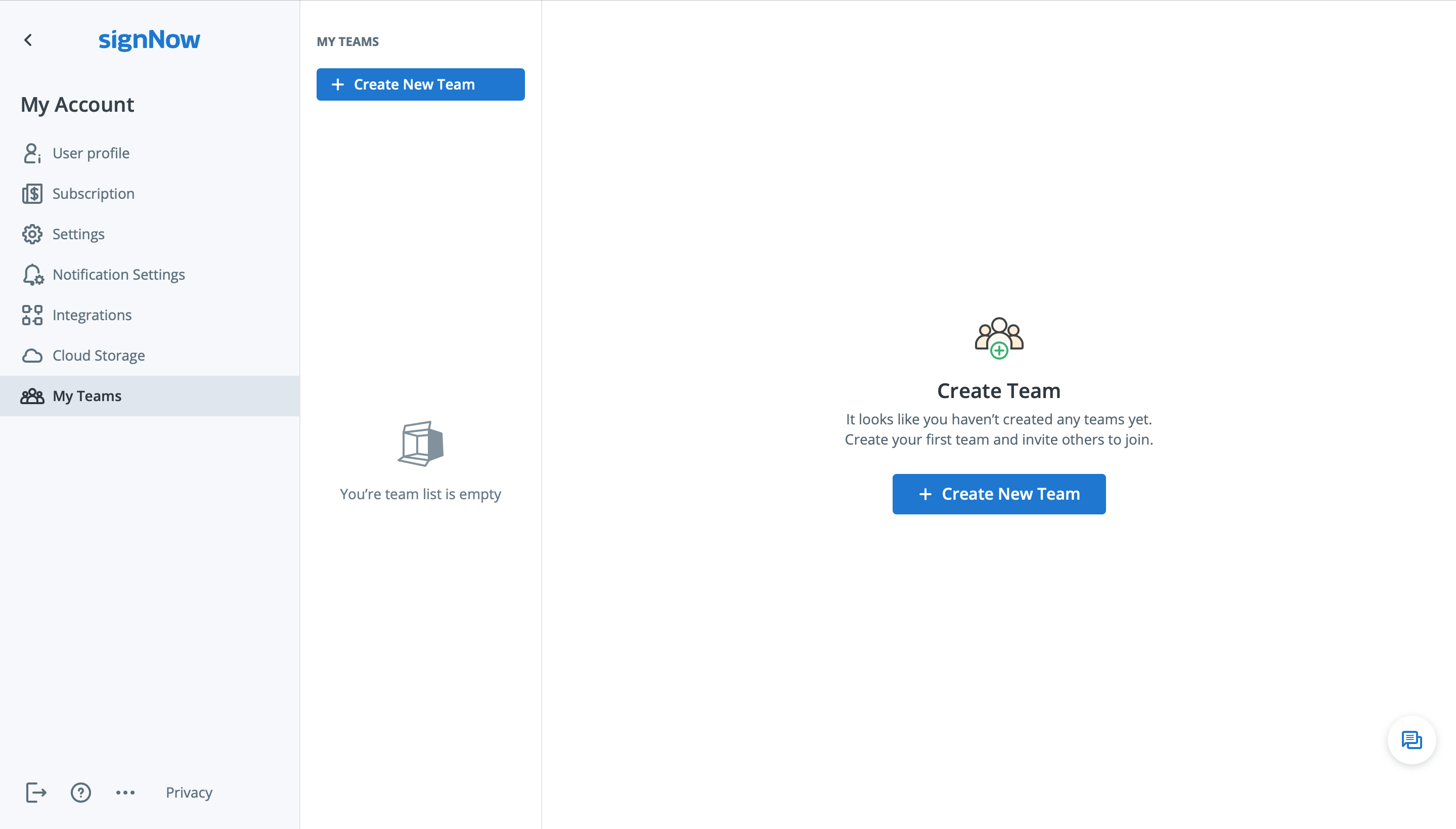
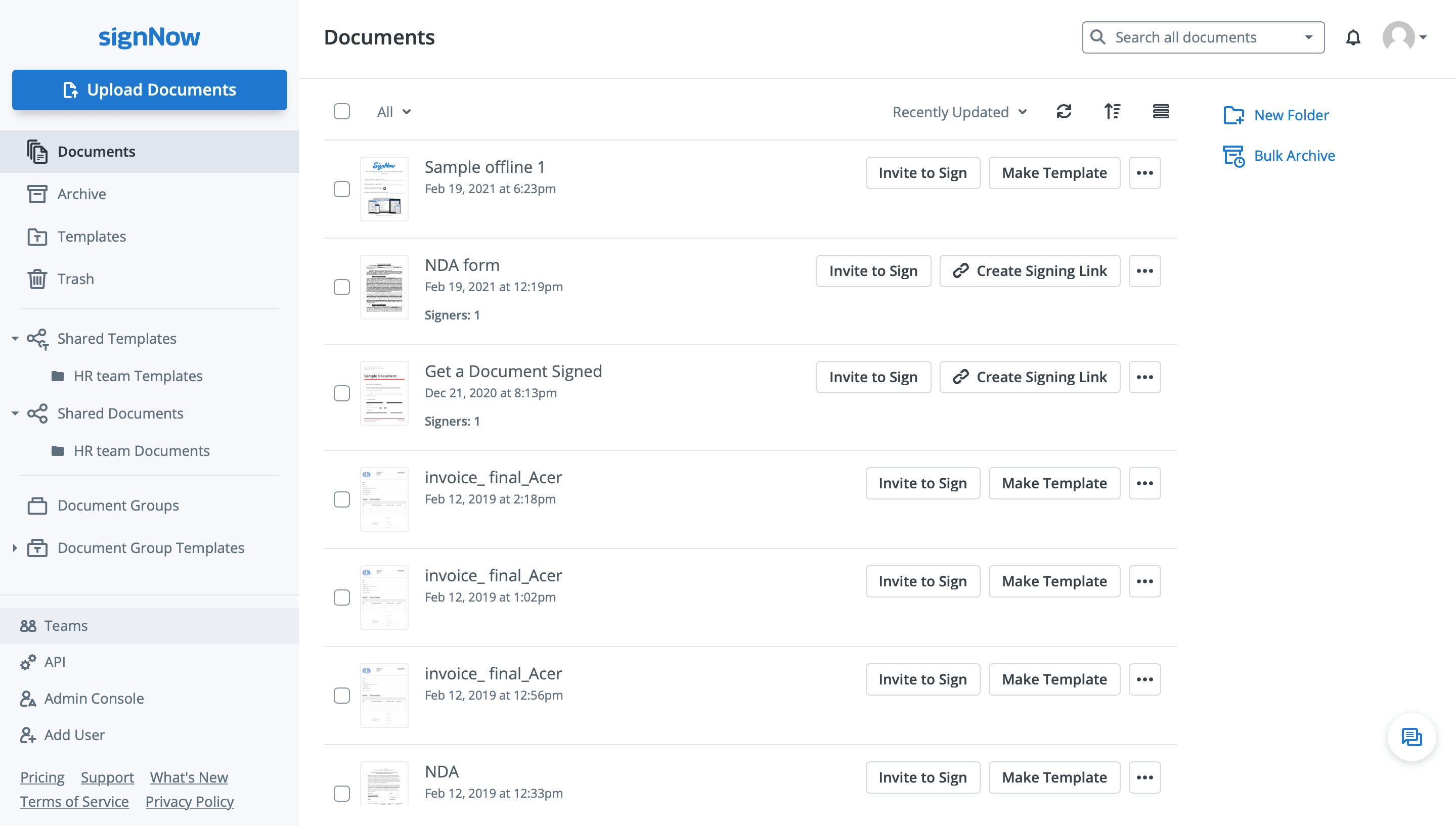
Select Teams towards the bottom of the left-hand sidebar of the airSlate SignNow web app.
fill-guide-illustration

Click the Create New Team button.

fill-guide-illustration

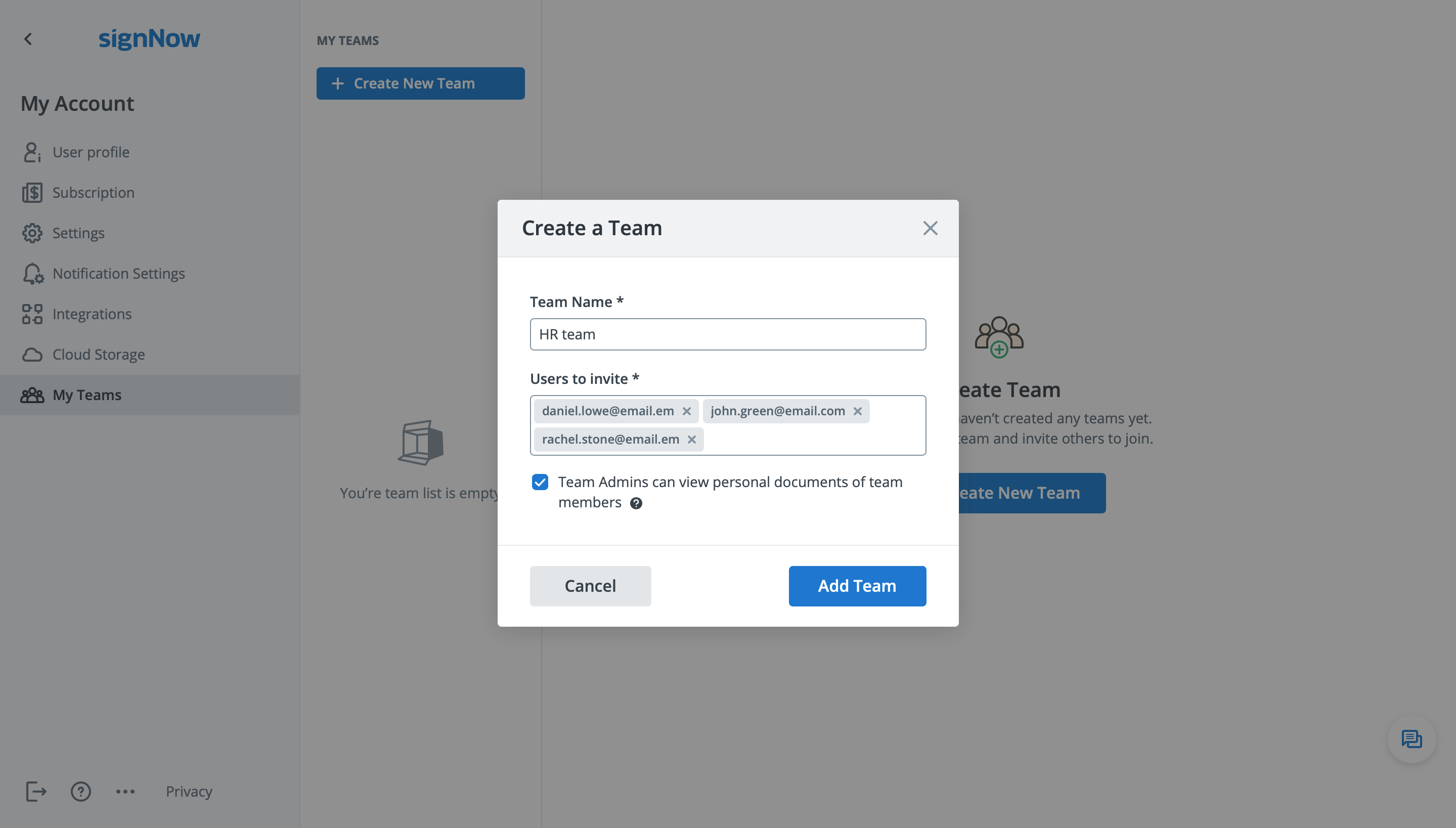
Fill in the Team Name field and add the email addresses of your team members to the Users to Invite box. Then, click Add Team.

Note: If you want to allow your team admins to access all of your teammates’ documents (not only shared ones), check the Team Admins can view personal documents of team members box.
fill-guide-illustration

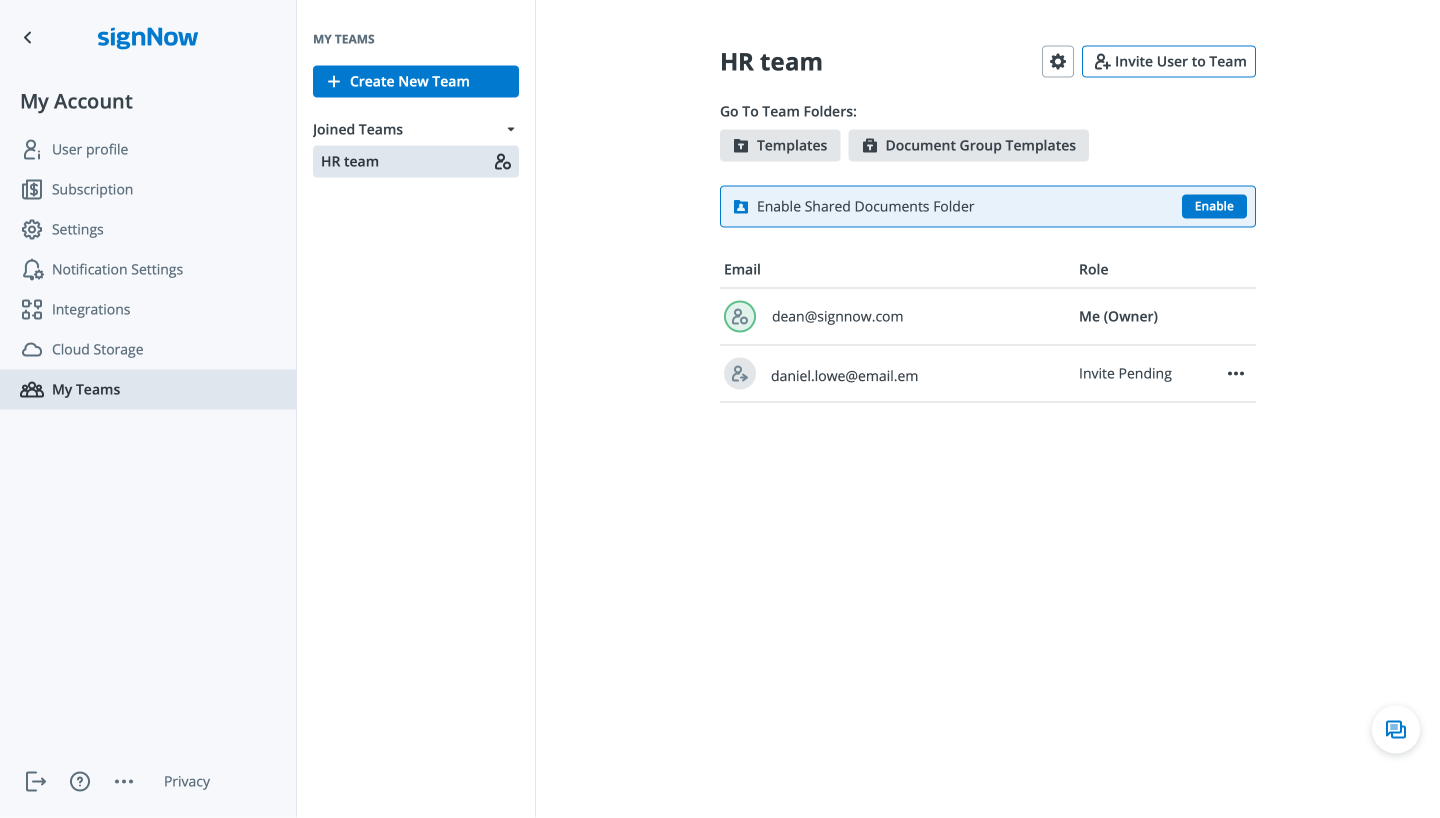
The added members will receive an email invitation to join your team. Once they accept it, your team is ready. The status of your teammates is displayed next to their email addresses.

Create a shared folder for your team

Find the Enable Shared Documents Folder option above your teammate list and click the Enable button.
fill-guide-illustration

Share documents with your team

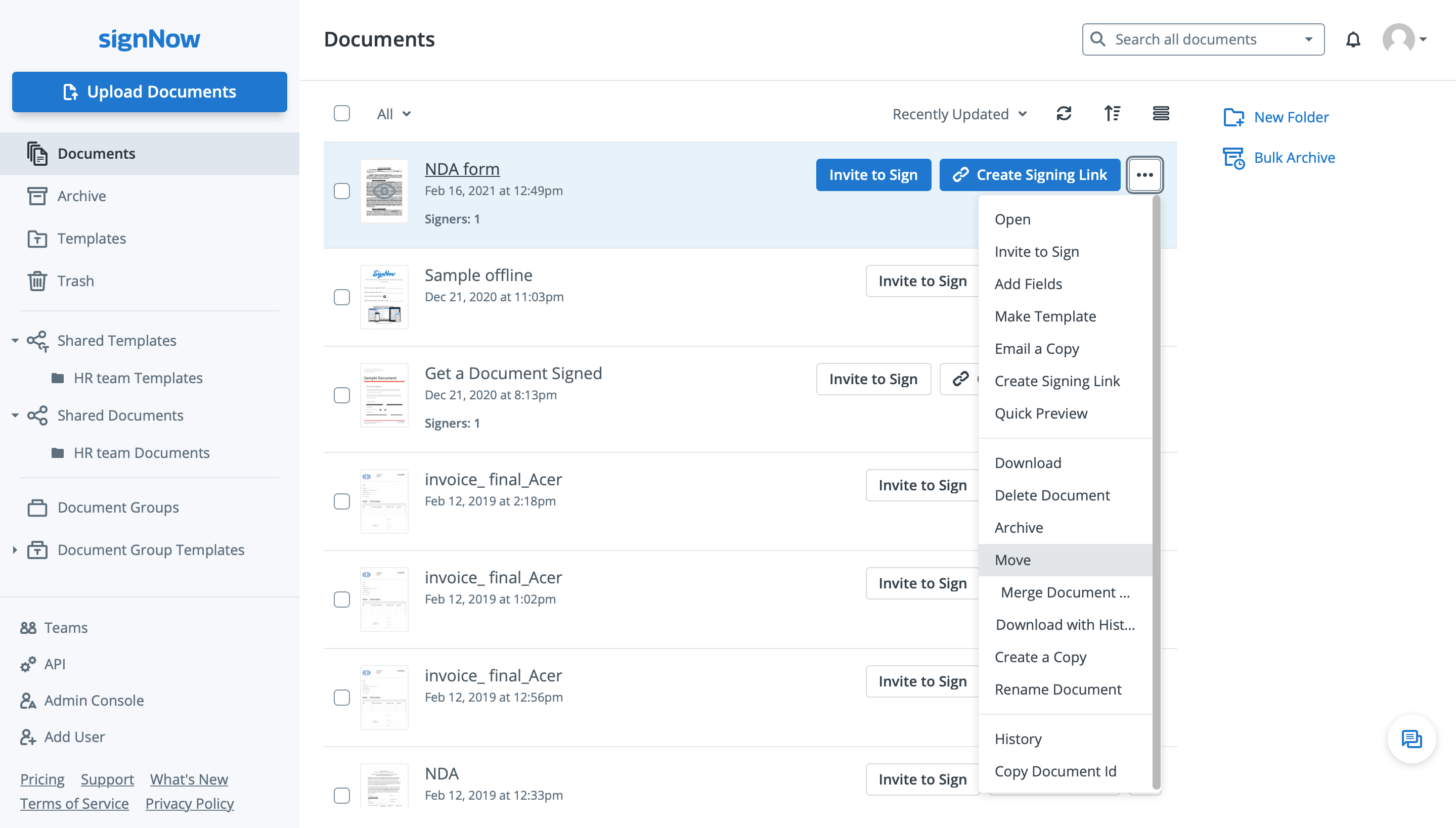
Move any document stored in your airSlate SignNow account to the Shared Documents folder. Click the More button next to the document you want to share and then select Move from the dropdown.
fill-guide-illustration

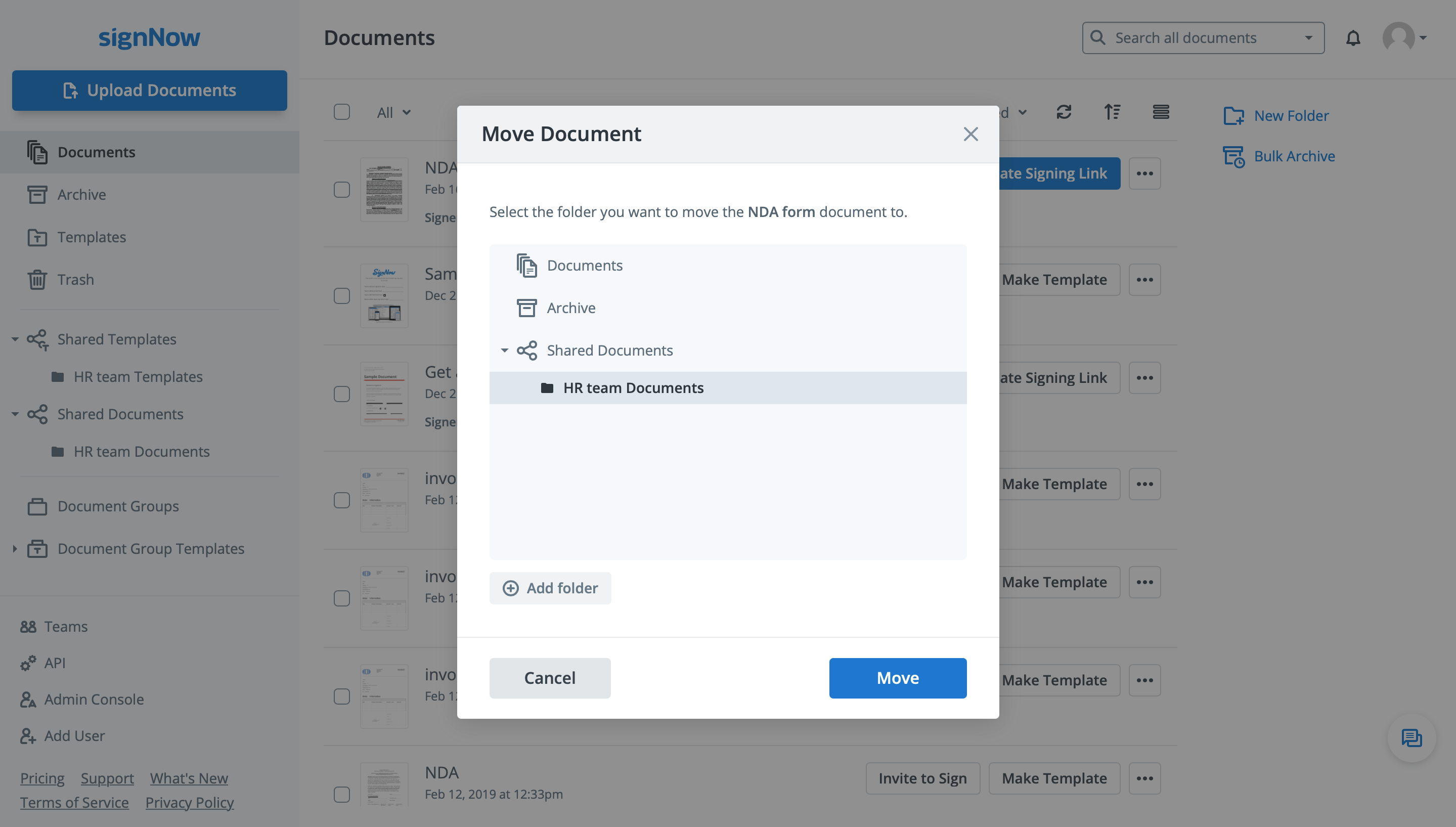
Choose your shared team folder in the new dialog box and click the Move button.
fill-guide-illustration

Your document is now in the shared folder and is available to all your team members. They can eSign or send it for signing, add fields and annotations, and so on.

Share templates with your team

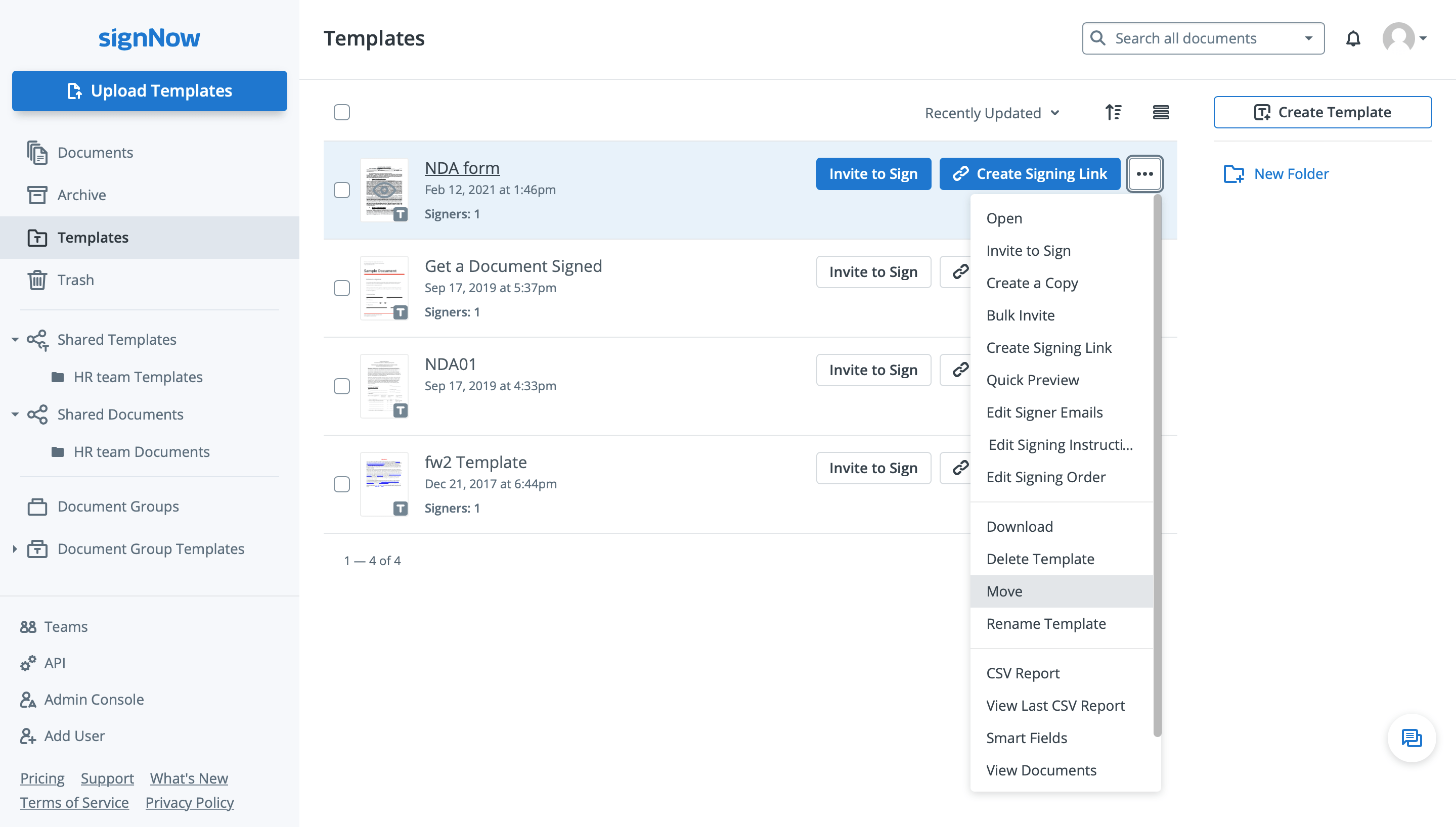
Use a similar workflow to move templates to your shared folder so that your teammates can access them whenever they need.

fill-guide-illustration
walmart logo
exonMobil logo
apple logo
comcast logo
facebook logo
FedEx logo
be ready to get more

Get legally-binding signatures now!