Edit Custom Text with SignNow's eSignature Solution

Get rid of paper and optimize document management for more productivity and countless opportunities. eSign any papers from a comfort of your home, fast and feature-rich. Enjoy a greater strategy for running your business with airSlate SignNow.

Award-winning eSignature solution

What edit custom text does and why it matters

Edit custom text is a document-level capability that lets senders and authorized collaborators change placeholder or static text fields in a document before finalizing an envelope. In practical terms, it allows users to correct typographical errors, localize language, insert case-specific values, or adapt contractual clauses without regenerating the source file. When applied within a compliant eSignature workflow, edit custom text preserves the signature sequence while ensuring the final record matches the parties' intent. Proper use reduces rework, speeds execution, and maintains an auditable trail of who changed what and when.

When edit custom text is most beneficial

Edit custom text is useful when minor, permitted adjustments are required after document assembly but before signatures, preventing full document re-creation and delays.

When edit custom text is most beneficial

Common challenges addressed by edit custom text

  • Accidental typos detected late in the signing cycle that would otherwise require a new version and re-sending.
  • Localized details such as address formatting or jurisdictional clauses that vary by recipient and must be adjusted in place.
  • Last-minute numeric updates like dates or monetary amounts that are too small to justify creating a new template.
  • Coordinating edits among multiple signers while keeping a clear record of modifications and approvals.

Typical users and roles

Corporate Counsel

In-house counsel use edit custom text to make narrow, permitted adjustments to form agreements, ensuring terms reflect negotiated items without recreating the document. They rely on the system's audit trail to record edits and to preserve evidentiary integrity for future disputes or compliance reviews.

HR Administrator

HR administrators employ edit custom text to insert employee-specific data into offer letters or benefits forms, reducing manual PDF edits and avoiding multiple document versions while keeping a clear edit history for personnel files and audits.

Who typically uses edit custom text in workflows

Organizations across legal, HR, sales, and operations use edit custom text to finalize documents quickly while maintaining accountability.

  • Legal teams making permitted clause adjustments before execution.
  • HR staff updating onboarding forms with employee-specific details.
  • Sales reps personalizing proposals with negotiated figures.

The feature serves small edits rather than substantive rewrites, and should be paired with clear internal policies to determine who may make changes and at what stage.

Key tools that support edit custom text

Several interface and policy controls help ensure edits remain intentional, auditable, and compliant when using edit custom text in document workflows.

Field-level permissions

Assign edit rights to specific roles and fields so only authorized users can change designated text, minimizing risk of unauthorized alterations.


Edit approval workflow

Require an approval step after edits so a secondary reviewer can confirm changes before the document proceeds to signature, adding an extra compliance checkpoint.

Versioning

Automatically retain prior document versions when edits are made so administrators can review historical content and restore earlier states if needed for audits.

Immutable audit trail

Each edit is time-stamped and associated with a user identity, preserving evidence of the change and supporting legal admissibility under ESIGN and UETA.

Template locking controls

Lock core template sections while permitting edits in designated fields, enabling reuse of standardized documents while allowing necessary customizations.

Granular retention policies

Apply retention rules that preserve final executed versions and associated edit metadata for the period required by internal policy or regulation.

be ready to get more

Choose a better solution

Integrations that enhance edit custom text workflows

Linking edit custom text to common apps helps populate fields, maintain consistency, and keep records synchronized across systems.

Google Workspace

Populate editable fields from Google Docs content or Sheets rows so changes reflect source data, reducing manual entry and ensuring current information is used during the signing process.

CRM systems

Integrate with CRMs to pull customer-specific values into editable fields, enabling sales and account teams to tailor documents quickly while retaining centralized client records.

Cloud storage

Link documents with Dropbox or Drive so edited documents and final executed copies are saved back to a canonical folder for records management and easy retrieval.

Identity providers

Use SSO and directory integrations to enforce role-based edit permissions, aligning who can apply text edits with corporate access controls and audit requirements.
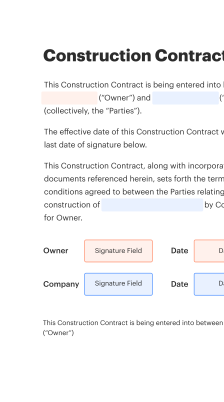
How edit custom text integrates into the eSignature flow

This sequence explains how a permitted text change is introduced, captured, and finalized within a signing session.

  • Prepare envelope: Upload document and set editable fields.
  • Authorize editor: Assign role with edit permissions.
  • Edit before signing: Authorized user modifies text in place.
  • Record and lock: System logs edit, then proceeds to signing.
Collect signatures
24x
faster
Reduce costs by
$30
per document
Save up to
40h
per employee / month

Quick steps to edit custom text before signing

Follow these four concise steps to apply and record permitted text edits in a document prior to final signature.

  • 01
    Open document: Load the envelope or template in the editor.
  • 02
    Select field: Choose the specific text field to be edited.
  • 03
    Apply edit: Make the permitted change and save the update.
  • 04
    Confirm and record: Validate the change and check the audit log entry.

How audit trails capture edit custom text events

Audit records must show who changed text, what was changed, and when the change occurred to preserve evidentiary quality.

01

Event recorded:

User identity tied to edit
02

Timestamp:

ISO-format time recorded
03

Field before value:

Original text snapshot stored
04

Field after value:

New text snapshot stored
05

Change reason:

Optional note captured
06

Associated document hash:

Integrity verification recorded
be ready to get more

Why choose airSlate SignNow

  • Free 7-day trial. Choose the plan you need and try it risk-free.
  • Honest pricing for full-featured plans. airSlate SignNow offers subscription plans with no overages or hidden fees at renewal.
  • Enterprise-grade security. airSlate SignNow helps you comply with global security standards.
illustrations signature

Configuration settings to enable controlled edit custom text

These recommended workflow settings help balance flexibility and control when allowing text edits in signing processes.

Primary Workflow Setting Name Header Default configuration values used by this workflow
Automatic Reminder Frequency in Days 48 hours between reminders
Edit Approval Required for Changes Enabled for sensitive fields
Maximum Edit Window Before Signing 48 hours prior to signature
Who May Edit Fields by Role Designated editors only
Audit Retention Period for Edit Logs Seven years standard

Supported devices and platform considerations

Edit custom text is available on modern web browsers and supported mobile apps, but usability varies by device and input method.

  • Windows and macOS: Full editor capabilities
  • iOS and Android apps: Most edits supported
  • Browser requirements: Chrome, Edge, Safari recent versions

For consistent behavior when editing text, use up-to-date browsers or the signNow mobile app, and validate that your organization's device policies permit secure local caching of documents during editing sessions.

Security controls that apply to edit custom text

Encryption at rest: AES-256 encryption
Encryption in transit: TLS 1.2+ transport
Access logging: Detailed event logs
Role-based access: Granular permissions
Two-factor authentication: Optional for accounts
Document locking: Post-signature immutability

Industry examples using edit custom text

These short case narratives show how edit custom text resolves common document needs in regulated and transactional contexts.

Case Study 1

A mid-size healthcare provider needed to correct patient contact details in consent forms without reissuing every document

  • Adjustments were limited to non-clinical fields
  • This avoided delays in care coordination

Resulting in preserved timelines and an auditable change history for HIPAA compliance review.

Case Study 2

A regional real estate firm adjusted closing dates and escrow figures in standard contracts during final review

  • Edits were restricted to numeric and date fields
  • This reduced last-minute reprints and courier exchanges

Leading to faster closings while maintaining a clear record of who applied each modification.

Best practices for secure, auditable edit custom text usage

Adopt these practices to maintain control and evidentiary value while using edit custom text across teams and systems.

Define a formal edit authorization policy
Document who may make edits, what fields are editable, and which stages permit changes. Combine written policy with technical enforcement such as role-based permissions and approval workflows to ensure edits are controlled and consistent across the organization.
Limit editable areas to non-substantive content
Reserve edit permissions for numeric, date, and contact fields rather than core contractual clauses. When clause-level changes are needed, require a formal amendment process or a new document version to reduce ambiguity and legal risk.
Retain comprehensive audit records
Ensure the system captures before-and-after values, user identity, timestamps, and document integrity checks. Store these records alongside the final executed document to support compliance audits, legal inquiries, and internal reviews.
Train users on permissible edits and workflows
Provide role-specific training that explains when edits are allowed, how to document reasons for changes, and how to use approval workflows. Regular training reduces errors and strengthens adherence to internal controls and regulatory obligations.

FAQs About edit custom text

Frequently asked questions and solutions for common issues encountered when permitting or performing text edits in electronic signing workflows.

Edit custom text: feature availability across vendors

A concise comparison of edit custom text support and related controls among major eSignature providers commonly used in the United States.

Criteria signNow (Recommended) DocuSign Adobe Sign
Field-level editable controls
Edit approval workflow Optional workflow add-on Workflow via Adobe Experience
Audit trail detail High detail High detail High detail
Template locking features
be ready to get more

Get legally-binding signatures now!

Risks and compliance considerations

Unauthorized edits: May invalidate intent
Insufficient audit: Weakens evidentiary value
Regulated data exposure: HIPAA/FERPA concerns
Contract disputes: Ambiguous changes risk litigation
Policy noncompliance: Internal control failures
Retention gaps: Loss of historical versions

Plan-level considerations for edit custom text

Plan and feature availability vary; the row entries below summarize common plan names and where edit controls are typically included across vendors.

Plan names and tiers signNow Business DocuSign Standard Adobe Sign Business PandaDoc Essentials Dropbox Sign (HelloSign) Essentials
Free or trial availability Free trial available Free trial available Free trial available Free eSign plan available Limited free plan available
Entry-level plan includes basic edit controls Yes, at Business tier Yes, Standard includes basic controls Yes, Business includes basic controls Yes, Essentials includes basic features Yes, Essentials includes basic editing
Advanced workflow and approvals Included in higher tiers Available in Business Pro Included in enterprise packages Available in Business plan Available in paid tiers
API access for programmatic edits Available with API plan Available with API subscription Available with API access Available with API plan Available with API plan
Enterprise features (SSO, SAML, SSO provisioning) Offered in enterprise Offered in enterprise Offered in enterprise Offered in enterprise Offered in enterprise

Simplify complex workflows

Create, execute, and manage workflows of any complexity, electronically from virtually anywhere. Scalable eSignature capabilities allow you to share documents with the right people in the correct order and define roles for each recipient. Execute document workflows faster and easier than ever before.

Automate document management

Optimize complex signing processes with airSlate SignNow’s powerful features to enhance your business. Control your automated eSignature workflows to ensure they're running at peak performance with instant notifications and reminders.

Optimize in team collaboration

Bring teams together in a secure, shared environment. Manage documents, use form templates and notifications to create more efficient cross-organization collaboration. Free your employees from having to spend time on repetitive activities so that they can focus on valuable, business-critical tasks.

Integrate into your existing systems

Run your projects with industry-leading integration. Collect Salesforce, Microsoft Teams, and SharePoint all in one business flow. Connect your software to a single system for endless possibilities and more productiveness.

Stay compliant with market-leading data security

Feel safe knowing that your data remains secure by the most up-to-date in encryption security. airSlate SignNow is GDPR and eIDAS certified and offers you transparence into your eSigning procedure with court-admissible audit trails. Configure user authorization and rights to regulate who has access to what.


walmart logo
exonMobil logo
apple logo
comcast logo
facebook logo
FedEx logo
be ready to get more

Get legally-binding signatures now!