Electrical Invoice Example for Banking

Transform your invoicing process with airSlate SignNow, making document sending and eSigning effortless and affordable for businesses.

Award-winning eSignature solution

What an electrical invoice example for banking means in practice

An electrical invoice example for banking describes a standardized digital invoice used by banks and related services to document charges for electrical work, metering adjustments, or utility reconciliations. It typically includes invoice metadata, account identifiers, line-item charges, tax details, and authorization fields for signers. In regulated banking contexts, these invoices are routed, authenticated, and retained according to financial controls and recordkeeping standards. Clear templates reduce processing time, support auditability, and facilitate secure eSignature workflows for internal approvals and external vendor settlement.

Why use a structured electrical invoice for banking

A standardized electrical invoice template ensures consistent data capture, simplifies approvals, and supports compliance with financial controls and record retention policies.

Why use a structured electrical invoice for banking

Common processing challenges

  • Incomplete account data causing reconciliation delays and manual follow-ups.
  • Lack of approved routing causing signature bottlenecks across departments.
  • Inconsistent formatting that complicates automated data extraction and filing.
  • Weak authentication increasing risk of disputed or invalid authorizations.

Representative roles and responsibilities

Facilities Manager

Manages vendor relationships and verifies that electrical work meets contract terms; prepares and forwards invoices for internal approval and tracks completion status until payment is issued.

Accounts Payable

Receives approved invoices, reconciles charges with budgets and purchase orders, initiates payments, and ensures records are retained according to bank retention policies and regulatory requirements.

Typical users and stakeholders

Banking operations teams, facilities managers, treasury staff, and third-party vendor administrators are primary users who interact with electrical invoice workflows.

  • Facilities managers who verify service completion and approve costs for payment.
  • Treasury and accounts payable teams who validate charges and schedule disbursements.
  • External electrical contractors submitting itemized invoices for bank review.

These stakeholders collaborate across validation, approval, and retention stages to ensure invoices are processed securely and recorded for audits.

Additional capabilities to improve efficiency and compliance

Beyond core features, these capabilities help banks automate, secure, and integrate electrical invoice processing across systems and teams.

Bulk Send

Send the same invoice template to multiple approvers or branches simultaneously, reducing repetitive tasks when identical approvals are required across locations.


API access

Programmatic APIs enable automatic invoice creation, submission, and status polling from ERP and procurement systems to minimize manual entry and synchronization errors.

Field-level validation

Validation rules check numeric ranges, required formats, and cross-field dependencies to prevent invalid invoices from entering approval queues.

Conditional routing

Routing logic can change approvers based on invoice amount, department, or vendor, enforcing policy without manual intervention for common exceptions.

Third-party integrations

Connectors for document storage and CRMs enable automatic archiving, vendor record updates, and linkage to contracts to facilitate reconciliations.

Secure attachments

Attach supporting documents like work orders or photos with encryption and controlled access to substantiate charges during reviews.

be ready to get more

Choose a better solution

Core features useful for electrical invoice workflows

Key features support data accuracy, secure approvals, and integration with bank systems to streamline invoice handling and recordkeeping.

Template fields

Custom invoice templates enforce required fields such as account numbers, meter IDs, tax calculations, and PO references; validation prevents submission until mandatory data is complete and consistent with internal coding standards.

Signer routing

Configurable routing sequences allow banks to require approvals from facilities, procurement, and treasury in a defined order or enable parallel approvals where policy permits, reducing cycle times while preserving control.

Audit trail

Immutable event logs capture timestamps, IP addresses, and signer identity details for each action, producing an evidentiary record suitable for internal review and external audits.

Document retention

Retention settings map invoices to bank retention schedules, support export for regulatory requests, and automate disposition according to policy to reduce manual record management overhead.
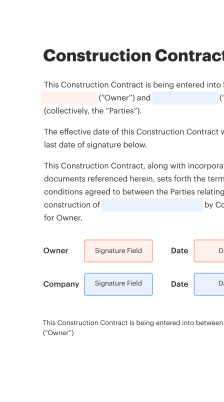
How a signed electrical invoice moves through a bank

This overview outlines the standard lifecycle from submission through approval to archival for electrical invoices used by banks.

  • Submission: Vendor uploads invoice or submits via portal.
  • Validation: System checks fields and compares to POs.
  • Approval: Designated approvers sign in sequence or parallel.
  • Archival: Signed document is stored with an audit record.
Collect signatures
24x
faster
Reduce costs by
$30
per document
Save up to
40h
per employee / month

Quick setup steps to implement an electrical invoice template

Follow these concise steps to create a usable electrical invoice workflow for banking approvals and recordkeeping.

  • 01
    Define fields: List required invoice fields and identifiers.
  • 02
    Create template: Build a template with mandatory validation rules.
  • 03
    Configure routing: Set approvers and sequential or parallel signing.
  • 04
    Enable retention: Set storage and retention policies for audits.
be ready to get more

Why choose airSlate SignNow

  • Free 7-day trial. Choose the plan you need and try it risk-free.
  • Honest pricing for full-featured plans. airSlate SignNow offers subscription plans with no overages or hidden fees at renewal.
  • Enterprise-grade security. airSlate SignNow helps you comply with global security standards.
illustrations signature

Recommended workflow configuration settings

These settings reflect typical configurations banks apply when automating invoice approvals and retention for electrical invoices.

Workflow automation default configuration overview Default configuration values for workflow fields
Signature order and routing rules enforced Sequential by role, editable, default on
Reminder frequency and escalation policy 48 hours reminders, escalate after 7 days
Required document attachments and formats PDF preferred; images accepted, max 25MB
Retention period and archival location Seven years, encrypted cloud archive
Authentication and verification methods Email plus optional MFA for signers

Platform and device support for invoice signing

Ensure chosen eSignature and workflow tools support common desktop and mobile platforms used by bank staff and external vendors.

  • Desktop support: Windows and macOS
  • Mobile support: iOS and Android
  • Browser compatibility: Chrome, Edge, Safari

Confirm device and browser compatibility during piloting, and verify mobile signing workflows and attachment uploads perform reliably for on-site vendors and remote approvers.

Security controls typically applied

Encryption at rest: AES-256 encryption
Transport security: TLS 1.2+ connections
Audit logging: Comprehensive event logs
Access controls: Role-based permissions
Multi-factor authentication: Optional or required MFA
Compliance attestations: SOC 2 and ISO reports

Banking use cases for electrical invoice examples

Two representative case studies show how structured electrical invoices improve approvals, reconciliation, and audit readiness in banking environments.

Branch retrofit invoice

A regional bank submitted structured electrical invoices for branch lighting upgrades with standardized account codes and line items

  • Automated validation against purchase orders and budget codes
  • Reduced manual reconciliation and faster payment cycles

Resulting in clearer audit trails and 30 to 50 percent fewer query escalations during monthly reconciliations.

Data center metering adjustments

A bank's data center operations used electrical invoices to record metering correction charges with meter identifiers and timestamps

  • Integration with facilities CMMS to attach work orders
  • Enabled precise chargeback to cost centers and quicker dispute resolution

Resulting in accurate departmental billing and reduced month-end adjustments, improving financial reporting accuracy.

Best practices for secure and accurate electrical invoices

Adopting consistent practices reduces risk, accelerates approvals, and improves audit readiness for bank invoice workflows.

Standardize invoice templates and fields
Use a consistent template that enforces required fields and validation rules to reduce manual corrections. Standardization improves downstream processing, enables reliable automated matching with purchase orders, and simplifies archival and retrieval during audits.
Enforce multi-step approvals for high-value items
Configure conditional routing so high-dollar invoices require additional approvers or manager sign-off. This preserves segregation of duties, reduces fraud risk, and ensures that large expenditures receive appropriate oversight before payment.
Maintain complete, auditable logs
Ensure every action—uploads, edits, approvals, and downloads—is recorded with timestamp, actor identity, and IP address when possible. Complete logs are essential for internal controls and responding to regulatory inquiries or legal disputes.
Integrate with financial systems for reconciliation
Link invoice workflows to ERP or accounting systems via API or connectors to automate posting and reconciliation. Integration minimizes manual data entry, reduces errors, and shortens time-to-payment while preserving consistent ledgers.

FAQs about electrical invoice example for banking

Answers to common questions about preparing, signing, and managing electrical invoices within a bank's digital workflow.

Feature availability: signNow versus other eSignature vendors

A concise availability and capability comparison across representative eSignature providers for banking invoice workflows.

Comparison criteria header label overview signNow (Recommended) DocuSign Adobe Sign
Signature validity under US law ESIGN/UETA
Bulk Send capability for many recipients
API access and developer tools Available Available Available
Advanced authentication options Email+MFA SMS and KBA Phone and KBA
be ready to get more

Get legally-binding signatures now!

Risks and potential penalties

Regulatory fines: Significant monetary penalties
Data breach exposure: Customer data loss
Contract disputes: Payment delays
Reputational harm: Public trust impact
Invalid signatures: Transaction challenges
Non-compliance costs: Remediation expenses

Pricing and plan characteristics across vendors

High-level plan and feature summaries to compare common commercial offerings and typical capabilities relevant to banking invoice processing.

Pricing and Plan Overview signNow (Featured) DocuSign Adobe Sign Dropbox Sign PandaDoc
Free trial or free tier availability Free trial available for evaluation Free trial available Free trial available Free trial available Free trial available
Entry-level paid plans and billing model Monthly and annual billing; per-user plans offered Multiple tiers, per-user pricing Subscription tiers, per-user pricing Per-user subscription with business tier Per-user subscription with business tier
API access in paid tiers API available on business tiers and above API available on developer plans and up API available with enterprise plans API available on higher tiers API available on enterprise tiers
Bulk send and template support Bulk Send and templates included on business plans Bulk send offered on select plans Template workflows available Templates and bulk features on advanced plans Templates and automation on paid plans
Enterprise features and compliance offerings Advanced admin controls and third-party audits available Enterprise-grade security and compliance options Enterprise security and identity integrations Enterprise controls and eDiscovery features Advanced analytics and enterprise integrations
walmart logo
exonMobil logo
apple logo
comcast logo
facebook logo
FedEx logo
be ready to get more

Get legally-binding signatures now!