Electronic Bill Format for Manufacturing

Experience seamless eSigning and document management with airSlate SignNow's user-friendly, affordable solution that elevates your business efficiency.

Award-winning eSignature solution

What an electronic bill format for manufacturing is and why it matters

An electronic bill format for manufacturing is a structured digital invoice designed to capture production-specific details such as part numbers, batch identifiers, material costs, labor hours, and routing information in a machine-readable layout. It replaces paper billing packets and manual entry with standardized fields, enabling faster validation, automated matching to purchase orders, and clearer audit trails. For manufacturing operations, an effective electronic bill format supports inventory reconciliation, cost allocation, and compliance documentation while reducing errors and cycle time between shipping, invoicing, and payment processing.

Why standardized electronic billing helps manufacturing workflows

Standardized electronic bills reduce manual reconciliation, accelerate payment cycles, and improve traceability for materials and labor across production lines.

Why standardized electronic billing helps manufacturing workflows

Common implementation challenges

  • Inconsistent field definitions between suppliers causing parsing errors and manual adjustments.
  • Integrating legacy ERP systems with modern electronic bill formats requires mapping and middleware.
  • Ensuring every bill includes required compliance fields increases validation and rejection rates.
  • Managing versioning and template updates across multiple plants and trading partners can be slow.

Typical user roles

Accounts Payable Manager

Manages invoice intake and approval workflows, enforces validation rules for bill line items, and oversees exceptions. Relies on structured electronic bills to reduce manual entry, speed three-way matching against purchase orders and receipts, and maintain audit-ready records for month-end close and vendor inquiries.

Supply Chain Analyst

Analyzes bill data to reconcile material usage, track supplier performance, and identify cost variances. Uses electronic bill fields such as lot numbers and work order IDs to link invoices to production records and improve forecasting accuracy across manufacturing sites.

Teams and roles that typically use electronic bill formats

Manufacturing finance, procurement, and operations teams use electronic bill formats to streamline invoicing and tie charges back to work orders and inventory.

  • Accounts payable teams for invoice validation and payment authorization.
  • Procurement and supply chain for supplier reconciliation and contract compliance.
  • Plant operations and warehouse staff for matching receipts to production runs.

Cross-functional use ensures billing accuracy, reduces disputes, and creates a single source of truth for production costs and supplier settlements.

Additional tools that improve billing accuracy and speed

Beyond core capabilities, effective implementations include automation, reporting, secure signing, and supplier collaboration features to lower disputes and accelerate cash management.

Supplier portal

A self-service portal where suppliers upload invoices, review validation errors, and resubmit corrected files to reduce email and manual handling.


Bulk processing

Batch import and processing of large invoice files to handle high-volume suppliers without manual intervention and to maintain throughput during peak periods.

Exception workflows

Configurable routing for mismatches that assigns tasks to approvers, tracks resolution steps, and captures comments for audit purposes.

Reporting and analytics

Dashboards and exports for exception rates, days payable outstanding, and supplier performance to identify bottlenecks and improvement opportunities.

Secure electronic signatures

Integrated eSignature support for approvals and attestations, providing signer identity, timestamping, and audit records for compliance.

Integration APIs

RESTful APIs for pushing and pulling invoice, purchase order, and receipt data to ERP and WMS systems for synchronised processing.

be ready to get more

Choose a better solution

Core features to support manufacturing electronic bills

Look for features that enable structured data capture, automated matching, template versioning, and integration with ERP and warehouse systems.

Structured fields

Customizable invoice schemas that include part numbers, batch/lot IDs, work order references, unit costs, freight details, and tax breakdowns to ensure each bill maps to ERP line items and inventory records precisely.

Template management

Version control and centrally managed templates allow consistent formatting across suppliers and plants, reduce onboarding time, and ensure changes propagate without breaking automated validations or integrations.

Automated matching

Rules-based three-way matching that flags discrepancies by tolerances, routes exceptions for approval, and supports auto-approval for matched invoices to speed processing.

ERP integration

Pre-built connectors and APIs to push validated invoice data into ERP modules for payables, inventory adjustments, and cost accounting with minimal manual intervention.
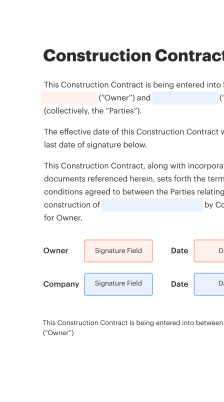
How the electronic bill format flows through a manufacturing system

An electronic bill moves from supplier creation through automated validation, matching, and posting in financial and production systems.

  • Supplier upload: Supplier submits structured invoice file.
  • Validation: System checks required fields and formats.
  • Three-way match: Invoice is matched to PO and receipts.
  • Posting: Approved invoices post to ERP for payment.
Collect signatures
24x
faster
Reduce costs by
$30
per document
Save up to
40h
per employee / month

Quick setup steps to adopt an electronic bill format

Follow a phased approach: define fields, map to systems, pilot with select suppliers, validate, then scale across plants.

  • 01
    Define fields: List mandatory and optional invoice fields.
  • 02
    Map systems: Align ERP and billing templates to new fields.
  • 03
    Pilot suppliers: Test format with a small supplier group.
  • 04
    Scale rollout: Deploy to all vendors and monitor exceptions.
be ready to get more

Why choose airSlate SignNow

  • Free 7-day trial. Choose the plan you need and try it risk-free.
  • Honest pricing for full-featured plans. airSlate SignNow offers subscription plans with no overages or hidden fees at renewal.
  • Enterprise-grade security. airSlate SignNow helps you comply with global security standards.
illustrations signature

Recommended workflow configuration for electronic bill processing

A common workflow enforces validation, matching, exception handling, and posting stages while minimizing manual touchpoints.

Setting Name and Configuration Header Default Configuration
Validation rules and tolerances 2% price tolerance
Three-way match enforcement Enabled for PO invoices
Exception routing Finance then operations
Approval thresholds >$5,000 requires manager
Reminder frequency 48 hours

Device and platform considerations

Electronic bill creation and signing should work across web, mobile, and tablet with consistent field validation and secure connections.

  • Desktop browsers: Modern Chrome, Edge, Safari
  • Mobile OS: iOS and Android supported
  • Connectivity needs: Stable TLS-secured network

Ensure mobile UI preserves required fields for complex invoices and that offline capture or cached signing is available where network reliability is an issue.

Security controls for electronic billing

Encryption in transit: TLS 1.2+ required
Encryption at rest: AES-256 recommended
Access controls: Role-based permissions
Authentication options: SAML and MFA
Audit logging: Immutable trails
Data segregation: Tenant isolation

Manufacturing scenarios that benefit from electronic bills

Real-world examples show how digitized bill formats reduce errors and speed approvals across assembly and process manufacturing operations.

High-volume contract manufacturing

A contract manufacturer with dozens of suppliers standardized invoice fields across partners to automate three-way matching and reduce manual exceptions by 70%

  • standardized SKU and lot fields
  • faster invoice approvals and fewer disputes

Resulting in improved cash forecasting and a shorter AP cycle that reduced month-end backlog and supplier hold times.

Discrete parts supplier

A parts supplier adopted an electronic bill format including work order IDs and serial numbers to automatically reconcile shipped items with customer orders

  • inclusion of serial and batch data
  • immediate traceability for warranty and returns

Leading to faster claims resolution, reduced return processing time, and clearer cost allocation for production batches.

Best practices for accurate and secure electronic billing

Follow consistent templates, apply validation rules, centralize template management, and enforce secure signing and retention policies to reduce errors and disputes.

Standardize invoice schemas across suppliers
Define a single canonical invoice schema that captures manufacturing-specific fields and publish clear mapping guides for suppliers. Maintain version controls, communicate changes in advance, and provide sample files to reduce parsing errors and ensure consistent field interpretation across systems and plants.
Automate matching and exception handling
Use automated three-way matching with configurable tolerances and rule-based exception routing to reduce manual review. Capture reasons for adjustments and approvals to create an audit trail and improve root-cause analysis when discrepancies recur.
Secure signer identity and maintain audit logs
Apply strong authentication, record signer attributes and timestamps, and store tamper-evident audit logs. Regularly review access permissions and retention settings in line with compliance obligations to ensure traceability and defensible records.
Test integrations and maintain monitoring
Validate end-to-end flows in a sandbox environment before production, monitor error rates and exception volumes, and implement alerting for spikes in failed invoices to address upstream data issues quickly.

FAQs About electronic bill format for manufacturing

Common questions address format validation, integration issues, legal validity, and steps to resolve failed matches or signature problems.

How signNow compares with leading eSignature providers for manufacturing billing

Comparison focuses on authentication, audit trails, API availability, mobile support, and U.S. legal compliance relevant to manufacturing billing workflows.

Authentication and Compliance Feature Comparison signNow (Recommended) DocuSign Adobe Sign
Support for ESIGN and UETA in U.S.
Audit trail completeness Comprehensive Comprehensive Comprehensive
API access and developer tools REST API REST API REST API
Mobile signing and offline support
be ready to get more

Get legally-binding signatures now!

Operational and compliance risks

Payment delays: Cashflow impact
Reconciliation errors: Inventory misstatements
Regulatory fines: Compliance exposure
Data breaches: Confidentiality loss
Audit failures: Record gaps
Supplier disputes: Operational friction

Pricing and plan differences for manufacturing eSignature needs

Pricing and included features vary by vendor; consider per-user costs, API access, and document volume when choosing an eSignature provider for billing.

Plan and vendor columns signNow (Featured) DocuSign Adobe Sign HelloSign PandaDoc
Starting monthly price per user $8/user $10-40/user $14-24/user $15/user $19/user
API access included Yes (API key) Paid add-on Paid add-on Yes Yes
Document volume limits High volume friendly Tiered limits Tiered limits Moderate Moderate
Storage and retention Included unlimited Limited Included Limited Included
Audit & compliance features Full audit trail Full audit trail Full audit trail Basic trail Full audit trail
walmart logo
exonMobil logo
apple logo
comcast logo
facebook logo
FedEx logo
be ready to get more

Get legally-binding signatures now!