Electronic Signature Agreement with SignNow

Get rid of paper and improve document management for higher productivity and unlimited possibilities. Enjoy the best way of running your business with airSlate SignNow.

Award-winning eSignature solution

What an electronic signature agreement covers

An electronic signature agreement establishes the terms, parties, and legal intent for signing documents electronically rather than on paper. It typically defines accepted signing methods, authentication requirements, storage and retention practices, and responsibilities for each signer. In the United States, such agreements operate within ESIGN and UETA frameworks, which validate electronic signatures when parties consent and records are retained. Operationally, an electronic signature agreement also sets expectations for audit trails, access controls, and dispute resolution so organizations can rely on signed documents for transactions, compliance, and recordkeeping.

Why use an electronic signature agreement

Electronic signature agreements reduce turnaround times, simplify signer interactions across locations, and provide auditable records while aligning with U.S. legal standards such as ESIGN and UETA.

Why use an electronic signature agreement

Common implementation challenges

  • Ensuring signer identity while avoiding friction can require multiple authentication factors and careful policy design.
  • Integrating signature workflows with legacy systems may need API development and mapping of document fields.
  • Consistent document formatting and field placement are essential to prevent incomplete or invalid signatures during automated processing.
  • Defining retention policies and secure backups is necessary to meet legal holds and regulatory recordkeeping expectations.

Representative user roles for electronic signature agreements

Legal Counsel

Legal counsel reviews agreement language, confirms ESIGN and UETA compliance, and defines signing rules and retention schedules. They establish authentication standards and dispute procedures to preserve enforceability in contract disputes.

Operations Manager

Operations managers design routing, approval order, and template libraries to streamline recurring agreements. They monitor usage metrics, enforce template controls, and coordinate with IT for integrations and access provisioning.

Teams that commonly manage electronic signature agreements

Legal, sales, HR, procurement, and operations teams regularly manage electronic signature agreements as part of routine transactions and internal approvals.

  • Legal teams for enforceability checks and template governance.
  • Sales and account teams for rapid contract turnaround and signature collection.
  • HR and procurement for offer letters, NDAs, and vendor agreements.

Cross-functional coordination between legal and IT helps maintain compliance, consistent templates, and secure access while enabling business users to send and track agreements.

Advanced features to consider for enterprise needs

Enterprises typically require additional capabilities such as advanced routing, branding, compliance controls, developer APIs, bulk operations, and analytics.

Advanced Routing

Conditional routing and parallel signing allow complex multi-party transactions to proceed without manual intervention based on field data or prior approvals.


Branding

Customizable email and signing pages preserve corporate appearance and provide consistent recipient experience across contract types and departments.

Compliance Controls

Features like field locking, clause versioning, and legal approval gates help organizations meet internal governance and external regulatory requirements.

Developer API

A REST API with webhook events allows programmatic sending, status tracking, and retrieval of signed documents for system-to-system automation.

Bulk Send

Send a single template to many recipients at scale, with individualized documents generated and tracked per recipient to reduce repetitive work.

Reporting

Usage analytics and audit reports provide visibility into signing times, completion rates, and bottlenecks for continuous process improvement.

be ready to get more

Choose a better solution

Core tools that support effective electronic signature agreements

Select features that support legal validity, security, and efficient workflows, including templates, authentication, audit records, and integrations with systems of record.

Templates

Reusable templates speed creation of standardized electronic signature agreements and reduce errors by enforcing consistent clause placement and required fields across repeat transactions.

Authentication

Multiple signer authentication options—email verification, SMS one-time passcodes, and SSO—help balance signer convenience with the level of identity assurance required by the agreement.

Audit trail

A detailed audit trail captures signer actions, timestamps, IP addresses, and authentication events to support enforceability and provide an evidentiary record in disputes.

Integrations

Prebuilt connectors and APIs let you route executed agreements to CRM, document storage, and ERP systems to automate lifecycle processes and improve recordkeeping accuracy.
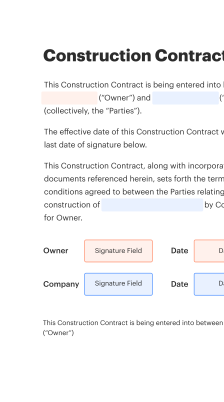
How electronic signature agreements flow in practice

An organized signing flow improves completion rates: send, authenticate, collect signatures, and archive with an audit trail for compliance.

  • Send: Initiator uploads document and selects recipients.
  • Authenticate: System verifies signer identity as configured.
  • Sign: Recipients apply signatures and complete required fields.
  • Archive: Final document and audit trail are stored securely.
Collect signatures
24x
faster
Reduce costs by
$30
per document
Save up to
40h
per employee / month

Quick steps to create an electronic signature agreement

Prepare the document, define signers and order, apply signature fields, and enable appropriate authentication before sending for signature.

  • 01
    Prepare document: Use a finalized PDF or template with defined fields.
  • 02
    Add recipients: Specify signers and their signing order if required.
  • 03
    Place fields: Insert signature, date, and data fields where needed.
  • 04
    Set authentication: Choose email, SMS OTP, or SSO for signer verification.

Detailed signing workflow checklist

Use this checklist to verify each step when preparing and executing an electronic signature agreement to reduce errors and improve completion rates.

01

Finalize content:

Confirm legal text and variable fields are complete.
02

Choose template:

Select or create a template to standardize terms.
03

Assign roles:

Map signers and approvers to roles in the document.
04

Set authentication:

Configure required verification for each signer.
05

Preview:

Validate field placement and completion paths.
06

Send and monitor:

Distribute and track signatures until completion.
be ready to get more

Why choose airSlate SignNow

  • Free 7-day trial. Choose the plan you need and try it risk-free.
  • Honest pricing for full-featured plans. airSlate SignNow offers subscription plans with no overages or hidden fees at renewal.
  • Enterprise-grade security. airSlate SignNow helps you comply with global security standards.
illustrations signature

Typical workflow settings for electronic signature agreements

Below are common configuration settings to define when implementing an electronic signature agreement workflow; adjust values to match organizational policy and transaction risk.

Setting Name Configuration
Default Reminder Frequency for Pending Documents 48 hours then daily reminders
Default Signature Order and Routing Rules Sequential by recipient list
Document Retention and Archive Policy Setting Retain 7 years, archive cold storage
Authentication Method per Risk Level Email for low, SMS for medium
Notification and Expiration Settings Auto-expire after 30 days

Platform compatibility for electronic signature agreements

Ensure your signing platform supports common desktop and mobile environments, modern browsers, and integrations with document storage and business systems.

  • Desktop browsers: Chrome, Edge, Safari, Firefox
  • Mobile devices: iOS and Android support
  • Integrations: Connectors for CRM and cloud storage

Confirm browser versions, enable JavaScript and cookies for best experience, and review mobile behaviors for in-app versus browser-based signing to ensure consistent signer workflows across devices and environments.

Security and authentication features to expect

Encryption: AES-256 at rest
Transport protection: TLS 1.2+ in transit
Multi-factor: Email plus SMS or SSO
Access controls: Role-based permissions
Audit logging: Comprehensive event records
Data isolation: Tenant-level separation

Industry examples of electronic signature agreements

Two practical examples show how electronic signature agreements are used across industries, focusing on workflow, controls, and outcomes.

Case Study: Healthcare Consent Forms

A community clinic converted patient consent forms to electronic signature agreements to support remote intake and faster processing.

  • Authentication combined name, DOB, and SMS OTP for signer verification.
  • The clinic reduced patient wait time and manual filing overhead.

Resulting in faster appointments, clearer audit trails, and improved HIPAA-aligned recordkeeping practices.

Case Study: Vendor Onboarding

A mid-sized distributor standardized procurement contracts as electronic signature agreements to accelerate vendor onboarding and centralize contract management.

  • Templates enforced standard terms and required approved legal clauses.
  • Procurement shortened onboarding cycles and improved compliance oversight.

Resulting in reduced manual review, consistent terms across suppliers, and reliable retention for audits.

Best practices for secure and accurate electronic signature agreements

Follow operational and legal best practices to ensure validity, reduce risk, and make signing straightforward for external parties and internal users.

Define roles and approval workflows clearly
Document the exact signer order and approval gates before creating the agreement to prevent routing errors and ensure required approvals are captured reliably.
Use standardized templates with locked clauses
Maintain centrally managed templates with locked legal clauses and editable fields to reduce variation, speed processing, and make compliance reviews predictable.
Implement appropriate signer authentication
Match authentication strength to transaction risk—use SMS OTP or ID verification for high-value agreements and email verification for routine low-risk transactions.
Retain full audit trails and backups
Ensure executed agreements include immutable audit logs, signed document copies, and offsite backups to meet litigation readiness and regulatory retention requirements.

FAQs and troubleshooting for electronic signature agreements

Below are common questions and practical answers to help troubleshoot execution problems and maintain compliant electronic signature agreements.

Feature availability across popular eSignature providers

Compare common capabilities to assess which solution aligns with your security, compliance, and integration requirements.

Criteria signNow (Recommended) DocuSign Adobe Sign
ESIGN & UETA validity
Audit trail detail Comprehensive Comprehensive Comprehensive
Bulk Send
API availability REST API REST API REST API
be ready to get more

Get legally-binding signatures now!

Typical timeframes and retention expectations

Timeframes vary by transaction type; retention must align with legal, regulatory, and business requirements to preserve enforceability and support audits.

Short-term signature windows:

24–30 days for most transactional signing links

Standard retention period:

Maintain records for 3 to 7 years depending on regulation

Legal holds and preservation:

Suspend deletion for the duration of litigation or investigation

Backup cadence and storage:

Daily backups with offsite replication are recommended

Archival review cycles:

Annual review to delete or extend retention per policy

Operational and legal risks to manage

Noncompliance: Invalidated signatures
Data breach: Regulatory fines
Poor authentication: Fraud exposure
Retention gaps: Litigation risk
Integration errors: Workflow failures
Template misuse: Contract inconsistencies

Pricing snapshot for electronic signature solutions

Pricing structures vary by plan, feature set, and contract length; the table summarizes typical starting points and common plan attributes across vendors.

Vendor / Plan signNow (Recommended) DocuSign Adobe Sign HelloSign PandaDoc
Starting price (monthly, per user) Starts around $8/user/month Starts around $10/user/month Starts around $9.99/user/month Starts around $15/user/month Starts around $19/user/month
Free tier availability Limited free trial Limited free trial Limited free trial Free trial available Free trial available
Common enterprise option Enterprise with SSO and API Business Pro and Enterprise Enterprise with identity options Business plans with SSO Enterprise with workflow automation
Annual contract option Yes, annual billing available Yes, annual billing available Yes, annual billing available Yes, annual billing available Yes, annual billing available
Typical included feature highlights Templates, REST API, audit trail Advanced workflows, templates Adobe Document Cloud integration Simple templates, API access Document automation, CRM integrations

Make simpler complicated workflows

Generate, deliver, and control workflows of any complexity, electronically from almost anywhere. Scalable eSignature features enable you to exchange contracts with the right users the right order and assign roles for every signee. Stream document workflows faster and easier than ever before.

Automate document managing

Enhance intricate signing tasks with airSlate SignNow�s effective features to improve your business. Manage your automatic signature workflows to ensure they're operating at peak efficiency with instant notifications and alerts.

Optimize in team collaboration

Get teams together in a secure, shared environment. Manage documents, use form templates and notifications to produce more effective cross-company interaction. Relieve your staff from having to spend time on repeating routines to enable them to give attention to beneficial, business-vital tasks.

Integrate into your current framework

Work your jobs with market-leading integration. Capture Salesforce, Microsoft Teams, and SharePoint in one business flow. Hook up your software to a single unit for limitless possibilities and more productivity.

Stay compliant with market-leading data safety

Feel confident knowing that your data is protected by the newest in encryption security. airSlate SignNow is GDPR and eIDAS compliant and offers you exposure into your eSigning process with court-admissible audit trails. Set up user authorization and rights to regulate who has access to what.


walmart logo
exonMobil logo
apple logo
comcast logo
facebook logo
FedEx logo
be ready to get more

Get legally-binding signatures now!