Electronic Signature Form for Secure Transactions

Remove paperwork and improve digital document processing for increased productivity and endless possibilities. Enjoy a better strategy for running your business with airSlate SignNow.

Award-winning eSignature solution

What an electronic signature form is and why it matters

An electronic signature form is a digital document configured to collect signatures, approvals, and structured data from one or more signers without paper. These forms embed fields for names, dates, checkboxes, and attachments, and they record signer actions in a tamper-evident audit trail. In the United States, electronic signature forms are commonly used under ESIGN and UETA standards when accompanied by reliable identity verification and consent. signNow is a secure, compliant, and cost-effective eSignature solution used across industries in the United States, supporting integrations and automation for routine business processes.

Why choose electronic signature forms for routine documents

Electronic signature forms reduce turnaround time, lower processing costs, and provide consistent records for compliance and auditing while supporting remote workflows and document integrations.

Why choose electronic signature forms for routine documents

Common challenges when adopting electronic signature forms

  • Ensuring signer identity without adding friction can complicate form design and delivery.
  • Configuring proper field validation and required inputs is often overlooked during setup.
  • Integrating form data with CRMs or HR systems requires mapping and testing.
  • Establishing retention policies and legal proof standards may involve legal and IT coordination.

Typical users and administrator roles

Form Creator

Usually an operations, HR, or legal staffer who builds the electronic signature form, places signing fields, sets signer order, and configures validation and reminders to ensure compliant data collection.

Account Admin

An administrator who manages user access, configures account-wide security settings, applies retention policies, and reviews audit logs to support compliance and organizational governance.

Who uses electronic signature forms across organizations

Teams in sales, HR, legal, finance, healthcare, and education use electronic signature forms to collect approvals and preserve records.

  • Sales and account teams for contracts and NDAs, speeding close cycles and reducing errors.
  • Human resources for onboarding paperwork, tax forms, and benefits enrollment while preserving audit trails.
  • Healthcare and education for patient consents and parental permissions with attention to privacy rules.

Adoption spans small businesses to enterprises, with workflows adjusted for scale, security, and regulatory constraints.

Advanced capabilities to scale electronic signature forms

Enterprise use of electronic signature forms benefits from additional features that support volume, integrations, analytics, and compliance across distributed teams.

Bulk Send

Send the same electronic signature form to many recipients simultaneously with individualized fields and consolidated tracking to handle mass agreements efficiently.


API Access

Programmatic APIs allow form creation, sending, and retrieval to automate workflows and embed signing in custom applications or portals.

Role-based Access

Granular user roles and permissions help control who can create, send, or manage forms across departments and business units.

Conditional Logic

Show or hide fields dynamically based on responses to simplify forms and collect only relevant information from signers.

Audit and Reporting

Comprehensive logs and reporting tools provide visibility into form usage, completion times, and compliance metrics.

Advanced Authentication

Options like knowledge-based authentication, digital certificates, and enterprise SSO support higher-assurance transactions.

be ready to get more

Choose a better solution

Essential tools for high-quality electronic signature forms

Several capabilities make electronic signature forms reliable and easy to use: field validation, signer authentication, automation, and secure storage all work together to produce legally defensible records.

Field Validation

Validation enforces correct data entry with required fields, format checks, and conditional logic so submitted forms contain complete and consistent information for downstream processing.

Signer Authentication

Multiple authentication options such as email verification, SMS codes, knowledge-based checks, and SSO integration allow administrators to balance usability with required assurance levels for signer identity.

Workflow Automation

Automation capabilities route completed forms, trigger notifications, and push data to integrated systems like CRM or document management to reduce manual handoffs and processing time.

Secure Storage

Centralized document storage with access controls, retention settings, and export options preserves signed records and supports regulatory and internal retention policies.
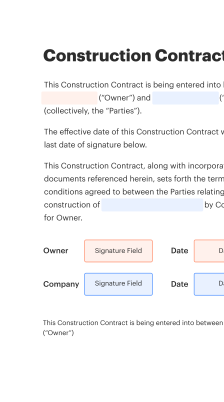
How an electronic signature form flows from sender to signed record

An electronic signature form typically moves through discrete stages that ensure identity, data integrity, and final storage.

  • Design: Creator prepares the form with fields and rules.
  • Authenticate: Signer verifies identity via chosen method.
  • Complete: Signer fills fields and applies signature.
  • Capture: System records audit trail and stores document.
Collect signatures
24x
faster
Reduce costs by
$30
per document
Save up to
40h
per employee / month

Quick setup: create an electronic signature form

Follow these basic steps to build a compliant electronic signature form and start collecting signed documents efficiently.

  • 01
    Upload document: Import PDF, DOCX, or image file to start.
  • 02
    Add fields: Place signature, date, and data fields where required.
  • 03
    Configure signers: Set signer order and authentication requirements.
  • 04
    Send or embed: Deliver by email, link, or embedded form.

Detailed steps to complete an electronic signature form

This step-by-step grid explains what signers typically encounter when completing an electronic signature form.

01

Receive link:

Open secure email or portal link
02

Verify identity:

Complete required authentication step
03

Fill fields:

Enter requested information accurately
04

Review terms:

Read attached agreement and disclosures
05

Apply signature:

Use drawn, typed, or certified signature
06

Download record:

Save signed PDF with audit log
be ready to get more

Why choose airSlate SignNow

  • Free 7-day trial. Choose the plan you need and try it risk-free.
  • Honest pricing for full-featured plans. airSlate SignNow offers subscription plans with no overages or hidden fees at renewal.
  • Enterprise-grade security. airSlate SignNow helps you comply with global security standards.
illustrations signature

Typical workflow settings for automated electronic signature forms

Configure these settings to align form behavior with organizational policies and processing expectations.

Setting Name Configuration
Reminder Frequency 48 hours
Signer Order Sequential
Expiration Period 30 days
Notification Settings Email alerts
Retention Policy Store 7 years

Supported platforms and device requirements for electronic signature forms

Electronic signature forms generally work across modern desktop browsers and mobile devices when the platform supports secure TLS connections and standard file formats.

  • Desktop browsers: Chrome, Edge, Safari
  • Mobile platforms: iOS and Android
  • File formats: PDF and DOCX

For embedded or API-driven forms, verify SDK compatibility and test on target devices; ensure accessibility considerations are included for users with assistive technologies.

Security features commonly applied to electronic signature forms

Encryption at rest: AES-256 or equivalent
Encryption in transit: TLS 1.2+ enforced
Access controls: Role-based permissions
Multi-factor authentication: Optional MFA
Audit logging: Detailed event records
Document tamper seals: Integrity checks

Industry scenarios where electronic signature forms provide value

Real-world examples show how a well-configured electronic signature form simplifies compliance, speeds processing, and reduces manual steps.

Healthcare Consent

A clinic uses an electronic signature form for patient intake that collects medical history and consent

  • field validation ensures required clinical data is entered
  • secure identity verification reduces fraudulent entries

Leading to faster check-ins and auditable consent records for regulatory compliance.

Sales Contract

A regional sales team sends an electronic signature form for subscription agreements

  • automated pricing fields prevent manual errors
  • integrated CRM updates the account record immediately

Resulting in shorter sales cycles and consistent contract storage tied to customer accounts.

Best practices for building accurate and secure electronic signature forms

Adopting a consistent set of practices improves form reliability, signer experience, and legal defensibility while minimizing mistakes and rework.

Design fields to minimize errors and confusion
Use clear labels, logical tab order, and field-level validation. Implement conditional fields only when necessary to avoid overwhelming signers and causing incorrect entries.
Match authentication level to transaction risk
For low-risk forms, simple email verification may suffice; for contracts, HIPAA forms, or high-value transactions, require stronger methods like SMS codes, knowledge-based authentication, or SSO.
Keep an auditable trail and immutable records
Ensure each signed form includes a timestamped audit log with signer IP, authentication method, and a tamper-evident certificate stored alongside the final document.
Test integrations and retention workflows regularly
Run periodic tests for CRM, cloud storage, and backup integrations; confirm retention schedules and export routines to prevent data loss and meet compliance obligations.

FAQs and troubleshooting for electronic signature forms

Common questions and resolutions help administrators and signers avoid delays and preserve legally defensible records.

Feature availability comparison for common eSignature platforms

A concise comparison of key capabilities shows what to expect from major providers when implementing electronic signature forms in U.S. workflows.

Feature signNow (Featured) DocuSign Adobe Sign
ESIGN / UETA Compliance
Mobile signing support
Bulk Send capability Limited
API and webhook access
be ready to get more

Get legally-binding signatures now!

Retention and backup milestones for electronic signature forms

Define clear retention and backup checkpoints to meet legal, regulatory, and operational requirements for signed records.

Immediate backup:

Store signed record in primary repository within minutes.

Daily snapshot:

Create daily backups for recovery and versioning.

Retention review:

Review retention schedules annually against policy.

Archival transfer:

Move aged records to long-term archive after retention period.

Legal hold:

Suspend deletion when litigation or audit requires preservation.

Risks and penalties of poor electronic signature form management

Noncompliance fines: Regulatory penalties
Contract disputes: Evidence gaps
Data breaches: Exposure costs
Operational delays: Process downtime
Loss of trust: Customer impact
Audit failures: Remediation burden

Representative pricing and feature tiers among leading providers

Typical starting prices, trial policies, and enterprise features vary; the table summarizes common entry points and capabilities across providers used in U.S. organizations.

Platform signNow (Recommended) DocuSign Adobe Sign HelloSign PandaDoc
Starting Price (monthly) $8 per user $10 per user $9 per user $12 per user $19 per user
Free Trial 7 days 30 days 7 days 14 days 14 days
Per-user API limits High Moderate High Moderate Moderate
Advanced Authentication options SMS, SSO SMS, SSO Certificates, SSO SMS, SSO SSO
Common enterprise use case Midmarket contracts Large enterprise contracts Creative & legal workflows Small teams & startups Sales proposals and quoting

Make simpler complex workflows

Create, perform, and manage workflows of any intricacy, electronically from near any place. Scalable electronic signature functionality let you share papers with the right people in the right way and determine roles for every receiver. Complete document workflows faster and easier than ever before.

Automate document managing

Improve sophisticated signing procedures with airSlate SignNow�s highly effective functions to boost your operation. Take control of your automated signature workflows to ensure they're running at peak performance with fast notices and reminders.

Enhance in team communication

Bring teams together in a protected, shared workplace. Manage paperwork, use form templates and notifications to create better cross-company interaction. Relieve your workers from having to spend time on repeated routines so that they can give attention to valuable, business-essential tasks.

Integrate into your existing systems

Manage your jobs with market-leading integration. Assemble Salesforce, Microsoft Teams, and SharePoint in one business flow. Connect your applications to a single environment for endless opportunities and higher performance.

Stay compliant with industry-leading data safety

Feel confident with the knowledge that your data is protected by the latest in encryption security. airSlate SignNow is GDPR and eIDAS certified and offers you transparence into your eSigning process with court-admissible audit trails. Configure user access permissions and roles to manage who has access to what.


walmart logo
exonMobil logo
apple logo
comcast logo
facebook logo
FedEx logo
be ready to get more

Get legally-binding signatures now!