Fabrication Bill Format for Animal Science

Effortlessly send and eSign documents to streamline your workflow. Experience an easy-to-use, cost-effective solution tailored for your business needs.

Award-winning eSignature solution

What a fabrication bill format for animal science is and why it matters

A fabrication bill format for animal science is a standardized document that records the production, preparation, or modification of biological materials and specimens used in animal research or animal-based teaching. It typically lists itemized materials, quantities, source identifiers, processing steps, responsible personnel, and dates. Proper formatting improves traceability, supports inventory control, and documents chain of custody for compliance, safety reviews, and institutional recordkeeping. When digitized, these bills reduce manual errors, speed approvals, and create auditable records for internal audits and external inspections.

Why a consistent fabrication bill format improves operations

A standardized fabrication bill format reduces ambiguity across teams, simplifies reconciliations, and supports consistent compliance with institutional policies and federal requirements.

Why a consistent fabrication bill format improves operations

Common challenges when using fabrication bills in animal science

  • Inconsistent item descriptions leading to inventory mismatches and procurement delays.
  • Manual calculations and handwritten entries increasing the risk of recording errors.
  • Insufficient provenance tracking for biological samples complicating reproducibility and audits.
  • Fragmented approvals across teams causing slow turnaround and lost documentation.

Representative user roles and responsibilities

Lab Manager

Manages day-to-day lab operations including inventory, staff training, and quality checks. The manager uses fabrication bills to verify that materials and specimens are prepared according to protocols and to reconcile supply invoices with recorded consumption for grant reporting and audits.

Procurement Officer

Oversees ordering and vendor relationships and ensures purchase records align with lab usage. The procurement officer references fabrication bills to confirm quantities, vendor lot numbers, and delivery dates before authorizing payments and updating institutional asset records.

Teams that rely on fabrication bill formats in animal science

Research staff, veterinary services, procurement, and compliance officers commonly interact with fabrication bills to document material preparation and transfers.

  • Principal investigators and research technicians who prepare and verify specimen details for experiments.
  • Veterinary and animal care teams managing supplies and ensuring humane handling documentation.
  • Compliance officers and auditors who validate records for regulatory and grant requirements.

Clear role definitions speed approvals, reduce rework, and ensure documents meet institutional and regulatory expectations.

Additional tools that enhance fabrication bill workflows

These capabilities further reduce manual work, improve integration, and strengthen compliance controls for fabrication bill processes.

Conditional fields

Show or hide sections based on specimen type, experiment phase, or biosafety level to keep bills concise and relevant while ensuring required information is captured.


Barcode and QR capture

Support scanning of sample or lot barcodes to eliminate manual typing, improve accuracy, and link bills directly to physical specimens and inventory systems.

Bulk actions

Create, assign, or archive multiple fabrication bills simultaneously to manage batch processes and reduce repetitive administrative tasks for high-volume operations.

Role templates

Predefined role assignments and approval chains speed routing for common procedures and reduce configuration overhead for recurring fabrication workflows.

Integration connectors

Prebuilt connectors to common lab information management systems (LIMS), cloud storage, and CRM tools enable synchronization of identifiers and supplier data.

Reporting dashboards

Dashboards summarize fabrication activity, outstanding approvals, and retention status to support managers and compliance reviewers with actionable insights.

be ready to get more

Choose a better solution

Document features that improve accuracy and control

Key document capabilities reduce errors and accelerate approvals when managing fabrication bills across teams and systems.

Structured templates

Customizable templates lock required fields, enforce data validation, and include conditional sections for different specimen types to maintain consistent records across experiments and operational units.

Reusable fields

Shared fields and prefilled data reduce duplicate entry, support barcode or sample ID integration, and speed repeated bill creation for routine fabrication tasks.

Approval workflows

Configurable multi-step routing ensures the correct sequence of reviewers and approvers with reminders and escalation rules for timely authorization.

Searchable archive

Indexed storage with metadata filters allows rapid retrieval of bills by sample ID, date range, personnel, or supplier for audit and research needs.
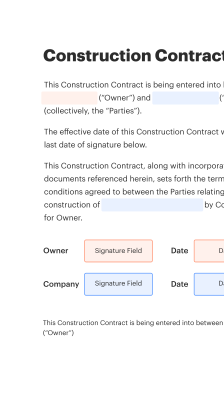
How to create and use the fabrication bill online

An online workflow streamlines creation, approval, and storage of fabrication bills while preserving an audit-ready record.

  • Draft: Populate template fields and attachments.
  • Route: Send to reviewers with defined order.
  • Sign: Collect electronic signatures from approvers.
  • Store: Archive in secure, searchable storage.
Collect signatures
24x
faster
Reduce costs by
$30
per document
Save up to
40h
per employee / month

Quick step-by-step: creating a fabrication bill format for animal science

Follow these core steps to compose and validate a fabrication bill that meets operational and compliance needs.

  • 01
    Identify fields: List required data points and metadata.
  • 02
    Select template: Use an approved document template.
  • 03
    Enter details: Record items, quantities, and lot identifiers.
  • 04
    Review and archive: Approve, sign, and store an auditable copy.
be ready to get more

Why choose airSlate SignNow

  • Free 7-day trial. Choose the plan you need and try it risk-free.
  • Honest pricing for full-featured plans. airSlate SignNow offers subscription plans with no overages or hidden fees at renewal.
  • Enterprise-grade security. airSlate SignNow helps you comply with global security standards.
illustrations signature

Suggested workflow settings for fabrication bill automation

Configure these settings to enforce approvals, reminders, and archival behavior for fabrication bills in a digital environment.

Workflow Automation Setting Name Header Default configuration values for common workflows
Reminder Frequency for Assigned Signers 48 hours
Conditional Routing Based on Specimen Type Enabled by rule
Template Version Control Policy Enforce versioning
Automatic Archival After Approval Immediate archival
Retention Policy Enforcement Apply institutional schedule

Platform compatibility: mobile, tablet, and desktop considerations

Ensure the system supports modern browsers and native apps so users can create and sign fabrication bills on any device.

  • Desktop browsers: Chrome, Edge, Safari support
  • Mobile platforms: iOS and Android native apps
  • Offline support: Local capture with sync

Verify supported operating systems, browser versions, and app requirements across desktops, tablets, and mobile devices; confirm offline capture and synchronization options if fieldwork or intermittent connectivity is expected.

Security controls for digitized fabrication bills

Encryption: AES-256 encryption at rest and in transit
Access controls: Role-based permissions and multi-factor authentication
Audit logs: Immutable, time-stamped action history
Data residency: Regional storage options available
Document recovery: Regular backups and retention policies
User authentication: Single sign-on and strong password rules

Practical examples of fabrication bill use in animal science

Two concise scenarios show how standardized fabrication bills support different animal science contexts and stakeholders.

University research lab

A lab prepares a fabrication bill each time animal tissues are processed to document reagents, lot numbers, and personnel involved

  • The bill includes sample IDs and preservation methods
  • This reduces mislabeling and supports reproducibility across experiments

Resulting in clearer audit trails and faster internal reviews that support funding compliance.

Livestock processing facility

A production facility uses fabrication bills to log feed additives, vaccine lots, and processing stages for batches of animals

  • Each bill captures supplier details and timestamps
  • That practice improves traceability for recalls and safety investigations

Leading to more efficient regulatory reporting and reduced operational risk during inspections.

Best practices for secure and accurate fabrication bills

Adopt these practices to ensure fabrication bills remain reliable records that support safety, compliance, and reproducibility across animal science workflows.

Define mandatory fields and validation rules
Specify required fields such as sample identifiers, reagent lot numbers, and handler names. Implement validation to prevent incomplete records and reduce downstream reconciliation work during audits or inventory checks.
Use version-controlled templates
Maintain controlled template versions with change logs and approval history. Version control prevents unauthorized edits and ensures all teams use the current format required by institutional policies.
Enforce role-based approvals and separation of duties
Assign clear responsibilities for drafting, reviewing, and signing bills. Separation of duties reduces conflict of interest and supports traceability for regulatory inspections and grant compliance.
Retain secure backups and retention schedules
Establish retention policies aligned with institutional and sponsor requirements, ensure encrypted backups, and document disposition procedures to meet legal and audit expectations.

FAQs about fabrication bill format for animal science

Common questions address legal validity, signature methods, integration, and error correction for digital fabrication bills.

Comparing signNow-based digital bills to paper-based fabrication records

A concise comparison highlights availability of core capabilities and practical differences between a signNow-enabled digital approach and traditional paper records.

signNow (Recommended) versus Paper-Based Comparison signNow (Recommended) Paper-Based
Legal validity under ESIGN and UETA laws
Audit trail and tamper evidence Limited
Turnaround time for approvals Hours to days Days to weeks
Storage searchability and access Searchable Manual
be ready to get more

Get legally-binding signatures now!

Typical timing and retention considerations

Key timing windows and retention periods help teams plan approvals and meet regulatory or institutional recordkeeping requirements.

01

Approval turnaround goal

48 to 72 hours for routine bills

02

Immediate retention

Archive signed copy instantly

03

Short-term review period

30 to 90 days for reconciliation

04

Long-term retention

Years as required by policy

Document retention timelines commonly used

Adopt retention schedules that reflect grant, regulatory, and institutional requirements for animal research records.

Institutional policy retention:

Minimum seven years archival storage

Grant-specific records:

Retention per sponsor terms

Regulatory inspection records:

Retain until inspection closure

Clinical or veterinary follow-up:

Duration tied to treatment outcomes

Disposal and destruction:

Controlled deletion once retention expires

Regulatory and operational risks from poor documentation

Regulatory fines: Noncompliance penalties
Grant impact: Funding jeopardy
Data loss: Irrecoverable records
Reproducibility failures: Invalidated results
Operational delays: Procurement slowdowns
Reputation harm: Institutional credibility loss

Representative pricing and feature availability across common eSignature providers

Typical entry-level pricing and feature availability can vary. The table lists starting prices, free tier status, bulk send support, HIPAA options, API access, and enterprise support characteristics.

E-signature Vendor Names signNow (Recommended) DocuSign Adobe Sign PandaDoc HelloSign
Starting price (monthly per user) $8 per user/month $10 per user/month $9.99 per user/month $19 per user/month $15 per user/month
Free tier availability Trial or limited free plan Trial available Trial available Free tier with limits Free tier with limits
Bulk Send capability Included on select plans Available on business plans Available on enterprise plans Included on higher tiers Available on paid plans
HIPAA-compliant options Business associate agreement available BAA available for enterprise BAA available BAA available for enterprise BAA available
API access and developer tools Public API with SDKs Robust API and integrations Full API and Adobe integrations API and webhooks API and developer docs
walmart logo
exonMobil logo
apple logo
comcast logo
facebook logo
FedEx logo
be ready to get more

Get legally-binding signatures now!