Fordbid Beneficiary Placeholder for Secure Signatures

Get rid of paper and automate digital document managing for more performance and limitless opportunities. eSign anything from a comfort of your home, fast and feature-rich. Discover a greater way of running your business with airSlate SignNow.

Award-winning eSignature solution

What fordbid beneficiary placeholder is and why it matters

fordbid beneficiary placeholder is a document field type used to designate an intended beneficiary that may be named, substituted, or confirmed later in a transaction. In electronic workflows it functions as a dynamic placeholder so parties can prepare agreements in advance, preserve signing order, and maintain clear responsibilities before final beneficiary data is available. When implemented correctly the placeholder reduces rework, supports conditional logic, and integrates with identity and records systems to ensure the correct beneficiary is captured during signature completion.

Why include a fordbid beneficiary placeholder in templates

Using a fordbid beneficiary placeholder streamlines pre-signature document setup by separating beneficiary designation from core contract content, reducing manual edits and preserving legal continuity while final beneficiary details are pending.

Why include a fordbid beneficiary placeholder in templates

Common challenges when using beneficiary placeholders

  • Placeholders left undefined at signature can cause ambiguous obligations and force post-signature amendments.
  • Incorrect mapping between placeholder fields and backend data sources leads to inaccurate beneficiary records.
  • Insufficient access controls may allow unauthorized users to alter beneficiary details before finalization.
  • Poorly documented placeholder usage increases audit complexity and compliance risk during reviews.

Who manages fordbid beneficiary placeholder fields

Trust Officer

Responsible for creating trust documents and maintaining beneficiary placeholders; coordinates final beneficiary verification with legal counsel and updates records after signature completion to reflect the final named individuals.

Estate Attorney

Drafts agreements that include placeholders, ensures the placeholder language meets statutory requirements, and advises on substitution procedures when beneficiaries are designated after initial signing.

Typical users and recipients of documents with beneficiary placeholders

Organizations across finance, legal, and nonprofit sectors use placeholders to prepare agreements before beneficiary names are finalized.

  • Trust administrators preparing estate documents that require later beneficiary naming.
  • Insurance agents sending policy forms where beneficiaries are selected at issuance.
  • HR teams handling benefits forms that need employee-dependent details updated later.

These users rely on placeholders to avoid repeated template edits and to keep signatures timely while preserving the option to insert definitive beneficiary details later.

Key features to support fordbid beneficiary placeholder workflows

Several product capabilities ensure beneficiary placeholders are usable, auditable, and secure across enterprise workflows.

Conditional Fields

Conditional logic displays or hides the beneficiary placeholder based on prior responses, reducing user error and ensuring that the field appears only when applicable.


Role Permissions

Granular role-based permissions limit who can edit or finalize beneficiary placeholders, allowing administrators to restrict changes to legal or compliance personnel.

Field Validation

Validation rules enforce formats such as name, SSN, or identifier formats and prevent submission until required beneficiary constraints are satisfied.

Audit Trail

An immutable audit log records each change, who made it, and when, ensuring a clear history of how a placeholder was completed and approved.

API Access

API endpoints allow back-end systems to populate or retrieve beneficiary data programmatically during automated onboarding or trust processing.

Template Library

A managed template library stores approved documents that include standardized beneficiary placeholders to ensure consistent language across teams and jurisdictions.

be ready to get more

Choose a better solution

Integrations and tools that enhance placeholder usage

Connectors and built-in tools reduce manual entry and ensure beneficiary placeholders are synchronized with authoritative data sources.

CRM Integration

Two-way synchronization with CRMs populates beneficiary name and contact fields from customer records and writes back signature status for centralized recordkeeping and reconciliation.

Document Editors

Native integration with document editors preserves placeholder formatting, enabling in-context edits and preventing layout changes during beneficiary insertion.

Cloud Storage

Linking to cloud repositories ensures final documents and placeholder metadata are archived with version control and retention policies intact.

Identity Providers

Single sign-on and directory integrations validate the identity of the person assigning a beneficiary, reducing the risk of impersonation or unauthorized changes.
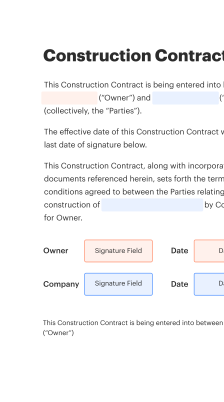
How a beneficiary placeholder works during signing

This sequence explains the typical lifecycle of a fordbid beneficiary placeholder from template creation to post-signature reconciliation.

  • Template creation: Designer inserts placeholder and notes constraints.
  • Pre-sign distribution: Document sent with placeholder unpopulated or provisionally filled.
  • Beneficiary assignment: Authorized party provides final beneficiary details.
  • Post-sign audit: System records final value and audit trail entry.
Collect signatures
24x
faster
Reduce costs by
$30
per document
Save up to
40h
per employee / month

Step-by-step: setting up a fordbid beneficiary placeholder

Follow these four steps to add and govern a beneficiary placeholder in an electronic document template.

  • 01
    Draft field: Insert descriptive placeholder label in document.
  • 02
    Set permissions: Restrict who can edit or finalize the field.
  • 03
    Configure validation: Apply data type checks or required flags.
  • 04
    Finalize workflow: Define when placeholder becomes mandatory to fill.
be ready to get more

Why choose airSlate SignNow

  • Free 7-day trial. Choose the plan you need and try it risk-free.
  • Honest pricing for full-featured plans. airSlate SignNow offers subscription plans with no overages or hidden fees at renewal.
  • Enterprise-grade security. airSlate SignNow helps you comply with global security standards.
illustrations signature

Recommended workflow settings for beneficiary placeholder automation

These settings are commonly applied to automate and control how beneficiary placeholders are processed in signature workflows.

Setting Name Configuration
Reminder Frequency 48 hours
Field Locking Policy Lock on finalize
Approval Routing Two-step
Auto-fill Source CRM connector
Retention Period 7 years

Supported platforms and device considerations

Ensure platform compatibility and device readiness when deploying fordbid beneficiary placeholder workflows across your organization.

  • Desktop browsers: Chrome, Edge
  • Mobile devices: iOS and Android
  • APIs and SDKs: REST endpoints

Confirm that chosen browsers and mobile OS versions meet the provider’s minimum requirements, verify SSO and MFA integrations work on mobile, and test API interactions for programmatic placeholder population to avoid deployment issues.

Security and authentication controls relevant to beneficiary placeholders

Encryption at rest: AES-256
Encryption in transit: TLS 1.2+
User authentication: Multi-factor
Access controls: Role-based
Audit logging: Immutable logs
Data residency: US storage

Industry use examples for fordbid beneficiary placeholder

Two concise case examples show how placeholders maintain workflow continuity when beneficiary details arrive later.

Estate Planning

A law firm prepares a trust agreement with a beneficiary placeholder allowing document circulation before beneficiary selection is finalized

  • Placeholder reduces repeated drafting
  • Final beneficiary inserted by authorized counsel before execution

Ensures the agreement records the correct beneficiary and minimizes post-signature amendments, preserving enforceability and audit transparency.

Group Insurance Enrollment

An insurance broker issues master policy documents containing beneficiary placeholders to expedite underwriting

  • Placeholder supports conditional fields for dependents
  • HR or agent fills details upon eligibility confirmation

Leading to faster policy issuance with accurate, auditable beneficiary records and fewer administrative corrections after issuance.

Best practices for secure and accurate beneficiary placeholders

Adopt these practical steps to reduce errors and strengthen compliance when using beneficiary placeholders in electronic workflows.

Standardize placeholder language and fields
Use consistent naming conventions and standardized field templates across documents to ensure placeholders are interpreted consistently by users and automated systems, reducing mapping errors and legal ambiguity.
Restrict edit rights to authorized roles
Enforce role-based permissions so only designated legal, compliance, or administrative personnel can modify beneficiary placeholders, minimizing the risk of unauthorized changes before finalization.
Enable strict field validation
Apply format checks, mandatory flags, and conditional dependencies on beneficiary fields to catch incomplete or malformed entries prior to signing and to maintain data quality for downstream systems.
Maintain comprehensive audit logs
Ensure the platform records every placeholder interaction with user ID, timestamps, and change history, and retain those logs in accordance with your legal and regulatory retention policies for defensible records.

FAQs and troubleshooting for fordbid beneficiary placeholder

Common questions and resolutions for issues that arise when implementing beneficiary placeholders in electronic documents.

Feature availability: signNow and major eSignature vendors

Quick comparison of core capabilities related to beneficiary placeholders and related workflow controls across major U.S. vendors.

Feature signNow (Recommended) DocuSign Adobe Acrobat Sign
Bulk Send
Audit Trail Detailed Detailed Detailed
Mobile Signing
HIPAA Support Available Available Available
be ready to get more

Get legally-binding signatures now!

Retention and timing guidelines for beneficiary placeholders

Document timing and retention checkpoints to align placeholder handling with legal and operational requirements.

Placeholder fill deadline:

Before final signature

Document retention period:

Seven years or per policy

Audit log retention:

Seven years minimum

Automated reminders schedule:

Every 48 hours

Post-sign reconciliation window:

30 days for corrections

Legal and operational risks tied to incorrect placeholders

Contract ambiguity: Invalidates terms
Regulatory violation: Noncompliance fines
Data breach: Exposure risk
Recordkeeping gaps: Audit failures
Identity disputes: Litigation risk
Operational delays: Processing backlogs

Pricing and plan availability across eSignature providers

A high-level look at plan availability and key price-sensitive features across common eSignature providers for U.S. buyers.

Plan signNow (Recommended) DocuSign Adobe Acrobat Sign Dropbox Sign PandaDoc
Free plan availability Limited free tier Trial only Trial only Free tier available Free eSign plan
Entry-level price (monthly) Low-cost individual plans starting low Personal plans start around $10 Included in Acrobat Pro subscription Starter plans under $15 Essentials from about $19
Business plan features Team management, API access Advanced workflow tools Enterprise integrations Simple workflows plus APIs Document templates and analytics
API access availability Available on paid plans Available on business plans Available via Adobe Sign APIs Available on paid tiers Available on paid tiers
Enterprise support Dedicated options & SLAs Enterprise-grade support Enterprise licensing available Business and enterprise support Enterprise onboarding available

Simplify complex workflows

Create, execute, and manage workflows of any complexity, electronically from virtually anywhere. Scalable eSignature capabilities allow you to share documents with the right people in the correct order and define roles for each recipient. Execute document workflows faster and easier than ever before.

Automate document management

Optimize complex signing processes with airSlate SignNow’s powerful features to enhance your business. Control your automated eSignature workflows to ensure they're running at peak performance with instant notifications and reminders.

Optimize in team collaboration

Bring teams together in a secure, shared environment. Manage documents, use form templates and notifications to create more efficient cross-organization collaboration. Free your employees from having to spend time on repetitive activities so that they can focus on valuable, business-critical tasks.

Integrate into your existing systems

Run your projects with industry-leading integration. Collect Salesforce, Microsoft Teams, and SharePoint all in one business flow. Connect your software to a single system for endless possibilities and more productiveness.

Stay compliant with best-in-class data safety

Feel safe understanding that your information is protected by the most recent in encryption security. airSlate SignNow is GDPR and eIDAS compliant and provides you transparence into your eSigning experience with court-admissible audit trails. Configure user authorization and roles to manage who has access to what.


walmart logo
exonMobil logo
apple logo
comcast logo
facebook logo
FedEx logo
be ready to get more

Get legally-binding signatures now!