Index Conditional Field Contract with SignNow

Award-winning eSignature solution

What an index conditional field contract is and how it works

An index conditional field contract uses indexed data points to show, hide or modify fields within a contract based on predefined conditions. This approach lets templates adapt dynamically to signer data, reducing manual edits and improving accuracy across repeated transactions. In practical terms, an indexed conditional field references a data source or prior field value and applies logic rules so only relevant inputs appear to the recipient. For eSignature platforms, this capability supports complex forms, conditional approvals, and streamlined workflows while maintaining a clear audit trail for each executed agreement.

Why adopt index conditional field contract logic

Using indexed conditional fields reduces signer errors, accelerates form completion, and enforces consistent data handling across contracts. The feature supports scalable template management and decreases manual oversight for repetitive agreements.

Why adopt index conditional field contract logic

Typical users responsible for index conditional field contracts

Template Administrator

A Template Administrator manages contract libraries, creates index fields, and defines conditional logic. This role documents index schemas, tests variations, and coordinates with legal and IT to ensure templates meet organizational standards and compliance requirements.

Integration Engineer

An Integration Engineer implements API payloads for indexed data, maps external systems to template variables, and monitors automated generation processes. They validate data formats, handle error logging, and maintain scripts that batch-generate indexed contract instances.

Key tools that support index conditional field contracts

The following features are commonly used to design, test, and maintain index conditional field contracts across eSignature platforms and document workflows.

Index fields

Named index fields let you group repeated sections or reference specific rows, enabling templates to iterate over sets of data or trigger rules for particular entries within a contract document.


Conditional logic

Rule builders allow boolean and comparative expressions that determine whether a field is visible, required, or prefilled based on index values or other field data during document generation.

Template variables

Variables and merge tags populate indexed fields from external sources such as CRMs or CSV uploads, ensuring each rendered contract instance uses accurate, contextual data without manual editing.

API integration

APIs enable programmatic insertion of index arrays and condition parameters during envelope creation, supporting automated bulk generation and system-to-system workflows.

Preview mode

A preview or testing mode simulates index combinations and conditional paths so administrators can validate form behavior before sending live contracts to signers.

Audit logging

Detailed audit records capture which index-driven fields appeared, what values were used, and when each decision occurred to support compliance and dispute resolution.

be ready to get more

Choose a better solution

Core features to leverage with index conditional field contracts

Focus on these features when designing index-driven contract templates to improve accuracy and maintainability across documents.

Repeatable sections

Repeatable or table rows keyed by an index allow multi-item lists—such as line items, units, or beneficiaries—to be rendered dynamically so each entry can contain its own set of conditional fields and validation rules.

Field validation

Schema and validation rules applied to indexed fields ensure numeric, date, and format constraints are enforced consistently for each repeated entry, reducing downstream corrections and manual review.

Merge and prefill

Use merge tags and data mapping to prefill indexed entries from external systems, ensuring that index-driven fields reflect authoritative data and minimizing manual rekeying during template generation.

Version control

Maintain template versions and change logs for index logic so administrators can roll back or compare behavior across contract revisions and maintain a consistent production environment.
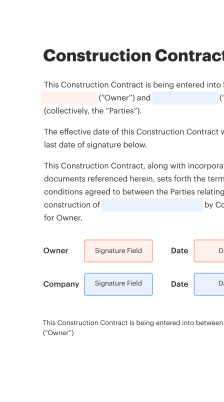
How index conditional field contracts function in a signing flow

Index conditional field contracts combine indexed data references with conditional logic to produce context-sensitive documents during preparation and signing.

  • Data binding: Link form fields to named index entries or external data sources.
  • Logic evaluation: The platform evaluates conditions when the document is generated.
  • Dynamic rendering: Only fields that meet conditions are displayed to signers.
  • Audit capture: All changes and conditional decisions are recorded in the audit trail.
Collect signatures
24x
faster
Reduce costs by
$30
per document
Save up to
40h
per employee / month

Quick setup: Create an index conditional field contract

Follow these core steps to configure an index conditional field contract template and apply conditional logic before sending for signatures.

  • 01
    Upload document: Add the source contract or template to your eSignature workspace.
  • 02
    Define index: Create an index field that identifies conditional groups or repeating items.
  • 03
    Set conditions: Map logical rules that show or hide fields based on index values.
  • 04
    Preview and save: Test each index scenario and save the template for distribution.

Audit trail and verification steps for conditional indexing

Follow these audit and verification steps to ensure each indexed conditional decision is transparent and defensible.

01

Capture index inputs:

Log original index values submitted with the envelope.
02

Record conditional decisions:

Record which conditional branches executed.
03

Timestamp events:

Include time and timezone for each action.
04

Signer acknowledgements:

Capture signer interactions with conditional fields.
05

Preserve rendered PDF:

Store the final rendered document for audit.
06

Exportable logs:

Provide CSV or JSON audit exports.
be ready to get more

Why choose airSlate SignNow

  • Free 7-day trial. Choose the plan you need and try it risk-free.
  • Honest pricing for full-featured plans. airSlate SignNow offers subscription plans with no overages or hidden fees at renewal.
  • Enterprise-grade security. airSlate SignNow helps you comply with global security standards.
illustrations signature

Workflow settings for index conditional field contract automation

Configure workflow settings to ensure index conditional field contracts execute reliably when generated, sent, and audited.

Setting Name and Configuration Header Default configuration values used by index conditional field contract
Reminder Frequency and Retry Policy 48 hours
Signer Authentication Method Email and optional SMS OTP
Index Data Source Mapping CSV import or API payload
Template Preview Requirement Enabled for administrators
Audit Trail Retention Period 7 years

Platform and device considerations for index conditional field contracts

Ensure your eSignature provider, browser or mobile app supports dynamic form rendering and template variables before deploying index-based conditional logic.

  • Browser support: Modern Chromium, Safari, and Firefox browsers
  • Mobile app: iOS and Android native apps support dynamic fields
  • API access: REST API required for advanced indexing

Validate templates on each target platform, including mobile devices, to catch rendering or input differences and ensure signers encounter the intended conditional fields during execution.

Security controls relevant to indexed conditional contracts

Encryption at rest: AES-256 encryption
Encryption in transit: TLS 1.2+ for data transfer
Access controls: Role-based permissioning
Authentication options: Multi-factor methods available
Document integrity: Cryptographic signature hashes
Audit records: Immutable event logs

Industry examples using index conditional field contracts

These examples show how indexed conditional logic addresses common document variability across industries.

Real estate lease templates

A property manager uses an indexed unit list to add tenant-specific clauses for each leased unit

  • Conditional clauses display only for units with certain amenities
  • Reduces duplicate templates and manual edits

Resulting in faster lease generation and fewer errors during tenant onboarding.

Employee onboarding packets

An HR team references an indexed benefits table to show only applicable enrollment forms

  • Conditions match employee type and location
  • New hires see only relevant forms to complete

Leading to cleaner records and reduced compliance risk in personnel files.

Best practices for designing index conditional field contracts

Apply these practical guidelines to keep templates reliable, auditable, and easier to maintain when using indexed conditional fields.

Use clear index naming conventions
Adopt consistent, descriptive names for index variables that reflect the underlying data model. Clear naming reduces errors when mapping external data, aids team members in understanding logic, and simplifies maintenance across template libraries.
Limit complexity in single templates
Avoid embedding too many nested conditions in one template. Break complex documents into modular templates or use staged workflows to improve testability, reduce rendering time, and lower the chance of conditional conflicts during document generation.
Test with representative data sets
Validate template behavior using a variety of realistic index arrays and edge cases. Testing should include maximum and minimum index counts, missing values, and unexpected formats to ensure fields render and validate correctly for every signer scenario.
Document logic and governance
Keep a versioned specification for each template describing indexes, condition rules, and data sources. Good documentation supports audits, simplifies training for new administrators, and clarifies expected behavior during legal or compliance reviews.

Common issues and FAQs about index conditional field contracts

Answers to frequent questions and troubleshooting tips for template authors and administrators working with index-driven conditional logic.

Feature comparison: support for index conditional field contracts

Compare how major eSignature vendors handle indexed conditional field logic and related capabilities relevant to contract templating.

signNow (Recommended) | DocuSign | Adobe Sign Column headers for vendor feature support
Conditional Field Support
Indexed repeatable sections Limited
API index payload handling Advanced Advanced Standard
Built-in preview/testing
be ready to get more

Get legally-binding signatures now!

Retention and timeline considerations for indexed conditional contracts

Establish retention schedules and timelines that align with legal, regulatory, and operational needs when using dynamic contract templates.

Document retention period:

Seven years recommended for many contract types

Audit log preservation:

Preserve logs for the same retention period

Template review cadence:

Annual reviews for logic and compliance

Index data archival:

Archive source data after retention period

Legal hold procedures:

Suspend deletions when litigation is possible

Pricing snapshot for vendors supporting index conditional field contracts

Estimated pricing and common commercial tiers for vendors; actual prices may vary by contract, promotions, or enterprise agreements.

signNow (Featured) | DocuSign | Adobe Sign | Dropbox Sign | PandaDoc Vendor headers for pricing comparison
Entry-level monthly cost per user $8 per user per month billed annually $10 per user per month billed annually $12.99 per user per month billed annually Free tier with paid upgrades available $19 per user per month billed annually
Typical business plan features included Core eSignatures, templates, API access Templates, advanced workflow, API E-sign with Acrobat integration Simple eSign, Dropbox integration Document generation, eSign, templates
API availability and limits API available with reasonable rate limits API available with tiered limits API available with enterprise controls API available with Dropbox Sign plans API available with usage tiers
Enterprise contract options Custom pricing and SLAs for enterprises Custom enterprise pricing and integrations Enterprise licensing through Adobe Enterprise plans via Dropbox Sign Enterprise agreements and custom pricing
Free trial or free tier Free trial available for evaluation Free trial available Free trial via Acrobat subscription Free tier with limited sends Free trial available

How to Index conditional field contract For Free

Index conditional field contract feature gets easily available when you make use of airSlate SignNow's complete eSignature platform. Use this solution for your business irrespective of the sector you’re doing work in. The set of features presented by airSlate SignNow perfectly suits for people who attempt to make their enterprise strategies more productive and streamline their workflow.

Be assured that your contracts will always be organized properly, filled out by the appropriate parties and signed digitally using the digital signature that complies with the ESIGN Act and also other governmental requirements. Integrate fillable fields to make any document interactive, collect signatures from many persons and apply receiver authentication to make sure that the document was received by the appropriate individual. All this you are able to do when working either from the desktop computer or from the mobile gadget to save lots of time and close essential deals on-the-go.


walmart logo
exonMobil logo
apple logo
comcast logo
facebook logo
FedEx logo
be ready to get more

Get legally-binding signatures now!