Audit Trail
Detailed, tamper-evident logs capture signer identity, timestamps, IP addresses, and action history to support ESIGN/UETA compliance and internal audits.





Intranet e sign reduces paper handling, speeds approvals, and centralizes records while maintaining internal network controls. It supports compliance with U.S. signature laws and lets IT enforce company policies with minimal external exposure.

An HR Manager uses intranet e sign daily to send onboarding documents, collect employee acknowledgements, and maintain centralized personnel records. Their needs focus on reliable templates, simple signer flows, and retention policies that meet internal audit requirements while preserving privacy.
The IT Administrator configures SSO, manages user access groups, and integrates the e-signature platform with internal file shares. They prioritize secure API credentials, encryption standards, and compatibility with existing backup and monitoring tools.
Internal teams that handle approvals, contracts, and HR processes often adopt intranet e sign to reduce manual steps and centralize governance.
Adoption is most effective when IT provides single sign-on, clear role definitions, and ready-made templates to minimize user setup and errors.
Detailed, tamper-evident logs capture signer identity, timestamps, IP addresses, and action history to support ESIGN/UETA compliance and internal audits.
Flexible signer authentication supports SSO integration, two-factor methods, and identity verification to match transaction risk and regulatory expectations such as HIPAA where required.
End-to-end protection with TLS in transit and strong encryption at rest ensures documents and signing metadata remain unreadable to unauthorized parties.
Reusable, role-aware templates reduce errors, standardize fields and approvals, and allow administrators to enforce mandatory fields and standardized clauses.
Trigger-based routing, reminders, and conditional logic reduce manual tasks by advancing documents through approval stages automatically when criteria are met.
Prebuilt connectors and APIs enable linking with HRIS, ERP, document management, and cloud storage systems to maintain a single source of truth.
Embed signing into Google Docs for draft collaboration, send from Drive, and store signed PDFs in Drive while preserving internal access controls and audit metadata.
Connect to leading CRMs to auto-populate customer data into contracts, track signature status on opportunities, and attach signed documents to account records.
Automatically save signed documents to protected Dropbox folders, apply retention rules, and maintain folder-level permissions consistent with intranet policies.
Use REST APIs to embed signing into internal portals, trigger workflows programmatically, and pull structured status and audit information for reporting.
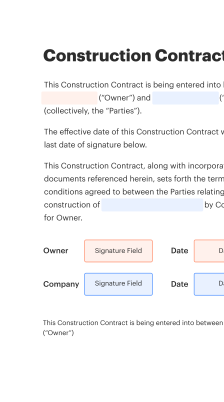
| Setting Name | Configuration |
|---|---|
| Reminder Frequency | 48 hours |
| Signing Order | Sequential |
| Auto-Expire Window | 30 days |
| Field Validation Rules | Required fields enforced |
| Default Storage Location | Internal archive |
Confirm device compatibility and browser requirements before deploying intranet e sign to avoid user access issues and security gaps.
For controlled intranet deployments, ensure internal firewalls allow necessary outbound API endpoints if using hosted services, or provision internal servers with updated TLS certificates and monitoring for on-premises installations.
A state agency used intranet e sign to centralize vendor contract approvals and maintain records within a government network
Resulting in faster procurements and improved public accountability through retained internal evidence.
A public university deployed intranet e sign for internal departmental approvals and student staff paperwork
Leading to fewer manual signatures, clearer access controls, and more reliable document retention.
| Vendor | signNow (Recommended) | DocuSign | Adobe Sign |
|---|---|---|---|
| On-premises option | Private-hosted | Limited | Limited |
| Bulk Send | |||
| HIPAA support | |||
| API access | REST API | REST API | REST API |
| Vendor | signNow (Recommended) | DocuSign | Adobe Sign | Dropbox Sign | PandaDoc |
|---|---|---|---|---|---|
| Starting monthly price | $8 per user | $10 per user | $10 per user | $7 per user | $9 per user |
| Free tier available | Limited free | Trial only | Trial only | Basic free | Trial only |
| Team/Business tier | Team plans with templates | Business and advanced | Business and enterprise | Advanced team plan | Business automation |
| API access cost | Included on plans | Add-on or higher | Add-on or higher | Included on business | Add-on or higher |
| Enterprise features | SSO and private hosting options | Advanced compliance controls | Enterprise DLP and SSO | Team management and audit | CRM-native automation |
Create, execute, and manage workflows of any complexity, electronically from virtually anywhere. Scalable eSignature capabilities allow you to share documents with the right people in the correct order and define roles for each recipient. Execute document workflows faster and easier than ever before.
Optimize complex signing processes with airSlate SignNow’s powerful features to enhance your business. Control your automated eSignature workflows to ensure they're running at peak performance with instant notifications and reminders.
Bring teams together in a secure, shared environment. Manage documents, use form templates and notifications to create more efficient cross-organization collaboration. Free your employees from having to spend time on repetitive activities so that they can focus on valuable, business-critical tasks.
Run your projects with industry-leading integration. Collect Salesforce, Microsoft Teams, and SharePoint all in one business flow. Connect your software to a single system for endless possibilities and more performance.
Feel safe understanding that your data is protected by the most recent in encryption security. airSlate SignNow is GDPR and eIDAS certified and provides you visibility into your eSigning process with court-admissible audit trails. Set up user authorization and roles to manage who has access to what.