



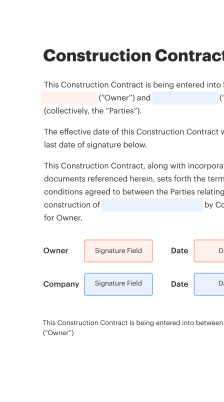
Inventory Management Software Proposal for Legal Services

Empower your business to effortlessly send and eSign documents. Discover a cost-effective solution designed to enhance efficiency and collaboration.

Award-winning eSignature solution

What an inventory management software proposal for legal services covers

An inventory management software proposal for legal services is a structured document that outlines requirements, scope, technical specifications, security controls, compliance expectations, deployment options, and cost estimates for acquiring or upgrading systems that track physical and digital assets used by a law firm or legal department. The proposal typically describes integration points with practice management, document management, and eSignature systems, and clarifies data retention, access controls, reporting needs, and vendor responsibilities to ensure operational continuity and regulatory compliance.

Why prepare a formal proposal for legal inventory systems

A formal proposal aligns stakeholders, defines security and compliance requirements, and establishes measurable acceptance criteria to reduce procurement risk and support defensible recordkeeping for client matter assets.

Why prepare a formal proposal for legal inventory systems

Common procurement and implementation challenges

  • Fragmented data sources requiring custom integrations and mapping between matter IDs and asset records.
  • Compliance obligations like HIPAA or FERPA complicate data handling for certain legal matters.
  • Undefined retention and disposal policies increase legal risk during litigation or audits.
  • Poorly scoped user roles lead to overbroad access and weak separation of duties controls.

Typical roles interacting with the inventory system

Records Manager

A records manager oversees retention schedules, audits physical inventories, ensures chain of custody for legal exhibits and client materials, and coordinates destruction or transfer according to firm policy and regulations.

IT Administrator

An IT administrator configures integrations with practice and document management systems, manages access controls and backups, and enforces encryption, authentication, and logging policies required by compliance teams.

Primary users and stakeholders for the proposal

Legal departments, practice group leaders, procurement, IT, records managers, and compliance officers all contribute requirements and approval during procurement.

  • General counsel and compliance teams who set policy and approve controls for client data.
  • IT and security teams who validate integration, authentication, and encryption requirements.
  • Records and facilities managers who own retention, tracking, and physical asset processes.

The proposal should bridge legal, technical, and operational perspectives so final selection meets business needs and regulatory obligations.

be ready to get more

Choose a better solution

Key features to require in proposals

Specify functional and compliance features so each vendor response is directly comparable and addresses legal operations needs.

Matter linking

Ability to tag, search, and report inventory items by matter number or client identifier; supports chain of custody, discovery exports, and matter-specific retention rules for legal compliance and operational efficiency.

Role-based access

Granular permissioning by role and team with audit controls; ensures only authorized users can view, edit, or transfer sensitive items and supports privilege separation required in legal contexts.

Integrations

Pre-built connectors and APIs for practice management, document management, and eSignature platforms to synchronize matter IDs, attachments, and signing events for streamlined workflows and reduced manual reconciliation.

Reporting & audit

Comprehensive reporting, exportable audit trails, and chain-of-custody records that support internal audits, litigation holds, and regulatory inquiries with searchable timestamps and user actions.

How the proposal supports procurement and deployment

A well-structured proposal clarifies responsibilities, acceptance tests, timelines, and compliance obligations so procurement can evaluate vendors objectively.

  • Requirements gathering: Collect stakeholder needs and regulatory constraints
  • Vendor shortlisting: Map vendor capabilities to core requirements
  • Pilot and testing: Run integration and security tests for acceptance
  • Rollout plan: Sequence deployment, training, and cutover activities
Collect signatures
24x
faster
Reduce costs by
$30
per document
Save up to
40h
per employee / month

Step-by-step: drafting the proposal

Follow these core steps to create a clear, traceable inventory management software proposal tailored to legal services.

  • 01
    Define scope: Document covered asset types and matter linkage
  • 02
    Specify security: List encryption, authentication, and logging requirements
  • 03
    Integration needs: Enumerate integrations with practice and document systems
  • 04
    Acceptance criteria: Describe tests, KPIs, and onboarding plan
be ready to get more

Why choose airSlate SignNow

  • Free 7-day trial. Choose the plan you need and try it risk-free.
  • Honest pricing for full-featured plans. airSlate SignNow offers subscription plans with no overages or hidden fees at renewal.
  • Enterprise-grade security. airSlate SignNow helps you comply with global security standards.
illustrations signature

Recommended workflow and default configurations

Define default settings that address common legal workflows while allowing customization during implementation.

Setting Name Configuration
Default reminder frequency in hours 48 hours
Default authentication method for users Single sign-on
Default document retention policy setting 7 years
Default signing order enforcement Sequential
Default audit log retention period 10 years

Platform requirements and supported devices

Specify supported operating systems, browsers, and mobile platforms to ensure compatibility with the firm's standard devices and user workflows.

  • Desktop support: Windows and macOS supported
  • Browser compatibility: Chrome, Edge, Safari
  • Mobile apps: iOS and Android

Also request minimum browser versions, API stability commitments, and offline or limited-connectivity behaviors so the vendor response covers real-world usage and deskless scenarios.

Core security features to specify

Encryption at rest: AES-256 or equivalent
Encryption in transit: TLS 1.2+ connections
Access controls: Role-based permissions
Multi-factor authentication: MFA for admin users
Audit logging: Immutable event logs
Backup and recovery: Regular encrypted backups

Industry use cases and implementation examples

Two common scenarios show how proposals are structured to meet legal workflows and compliance needs.

Case Study 1

A mid-size law firm needed matter-level custody tracking for physical exhibits and technology assets

  • Implemented asset tagging and matter mapping
  • Reduced time to locate exhibits and clarified custody for audit

Resulting in faster discovery responses and clearer chain of custody for court proceedings.

Case Study 2

A corporate legal department required integrated inventory and contract management to track licensed devices tied to vendor agreements

  • Integrated the inventory system with the contract repository and access logs
  • Improved license compliance and automated renewals alerts

Leading to fewer contract breaches and measurable cost avoidance on license overages.

Best practices when preparing proposals and evaluations

Adopt practical controls and testing requirements that protect client data, support discovery, and allow objective vendor comparison.

Use standardized requirement checklists across vendors
Create a consistent checklist of mandatory and optional requirements covering security, integrations, retention, and access controls; use the checklist to score vendor responses objectively and document procurement decisions for audit purposes.
Include clear acceptance and testing criteria
Define integration, performance, and security tests that vendors must pass during a pilot phase; specify data sets, success metrics, and remediation steps to avoid ambiguous acceptance disputes after deployment.
Specify legal and regulatory obligations explicitly
List applicable statutes and standards such as ESIGN and UETA for electronic signatures, HIPAA where health data is present, and any client-specific confidentiality or data residency requirements so vendors provide compliant controls.
Plan for ongoing governance and review
Establish regular reviews of access rights, retention schedules, audit logs, and vendor performance metrics; include contract clauses for audits, incident response times, and SLA remedies.

Frequently asked questions about inventory management software proposals

Answers to common procurement and implementation questions when preparing proposals for legal services.

Feature availability across leading eSignature vendors for proposals

Compare common capabilities across providers so procurement can evaluate which eSignature options meet legal and technical requirements.

Feature availability across three vendors signNow (Recommended) DocuSign Adobe Sign
Basic eSignature capability across platforms
Bulk Send or mass-signature support
Native template and team templates
Advanced identity verification options Knowledge-based verification ID verification ID verification
be ready to get more

Get legally-binding signatures now!

Regulatory and operational risks to address

Data breach fines: Substantial financial penalties
Evidence inadmissibility: Lost litigation value
Contractual liability: Client claims exposure
Operational downtime: Business interruption losses
Reputational harm: Client trust erosion
Noncompliance notices: Regulatory enforcement actions

Plan and pricing overview for shortlisted eSignature providers

Outline plan-level features to assess total cost of ownership and which vendor plans align with legal requirements for scale and compliance.

Pricing and plan features signNow (Featured) DocuSign Adobe Sign HelloSign PandaDoc
Entry-level plan summary and inclusions Business plan with core eSignatures, templates, and API access Personal/Standard with essential features Individual plan focused on signatures Essentials plan for small teams Essentials plan with document workflows
Available API access and developer limits API access included; usage tiers available API available with paid plans API included with business plans API available via business tiers API available on higher tiers
Bulk Send and template automation availability Bulk Send and templates included in business tiers Available on mid-tier plans Included on enterprise plans Templates available; bulk limited Template workflows available
Compliance and enterprise controls included Security controls, SSO, and enterprise settings in higher tiers Enterprise controls on advanced plans Enterprise features available Business-grade controls optional Advanced controls on enterprise plan
Typical target customer and scale SMBs and legal teams seeking cost-effective eSignatures Enterprises and regulated industries Adobe customers seeking document cloud integration Small to medium teams focused on ease of use Sales and document-heavy teams needing proposals and contracts
walmart logo
exonMobil logo
apple logo
comcast logo
facebook logo
FedEx logo
be ready to get more

Get legally-binding signatures now!