Invoice Statement Template Excel for Technology Industry

Watch your invoicing process turn quick and effortless. With just a few clicks, you can perform all the required actions on your invoice statement template excel for Technology Industry and other important files from any device with internet access.

Award-winning eSignature solution

What an invoice statement template in Excel delivers for technology businesses

An invoice statement template in Excel for the technology industry is a standardized spreadsheet designed to capture product and service line items, usage metrics, licensing terms, payment schedules, and tax calculations specific to software and hardware vendors. It combines structured tables, formula-driven totals, and fields for contract references so finance teams can generate consistent billings. When paired with an eSignature workflow, the template becomes a verifiable, timestamped commercial record that supports collections, dispute resolution, and reconciliations across platforms and accounting systems.

Why standardized Excel invoice statements matter for tech firms

Standard Excel invoice statements reduce billing errors, accelerate approvals, and ensure consistent representation of usage-based charges and licensing. They simplify integration with accounting and CRM systems while preserving a human-readable, auditable source for contract and compliance reviews.

Why standardized Excel invoice statements matter for tech firms

Common billing challenges technology companies face

  • Complex pricing models such as tiered usage, seat licenses, and overage charges lead to frequent calculation errors and invoice disputes.
  • Multiple data sources — usage meters, license portals, and project statements — complicate consolidation into a single Excel invoice statement.
  • Manual preparation of statements delays billing cycles, increases days sales outstanding, and reduces forecasting accuracy for finance teams.
  • Poor template version control can result in inconsistent legal references or outdated payment terms across customer invoices.

Typical user profiles in a technology billing workflow

Finance Manager

Responsible for invoice accuracy, revenue recognition, and reporting. This user configures template formulas, reviews aggregated usage data for billing periods, and authorizes final statements for distribution to customers and accounting systems.

Account Manager

Manages customer relationships and approves statement details tied to contracts. This role validates chargebacks, approves discounts or credits, and communicates discrepancies with customers prior to final invoice issuance.

Teams and roles that typically use Excel invoice statements

Finance and revenue operations teams in technology companies rely on Excel invoice statements for accurate billing and month-end close activities.

  • Finance managers handling recurring billing and revenue recognition tasks for SaaS and licensed products.
  • Account managers preparing consolidated statements for enterprise customers with multiple subscriptions or services.
  • Operations and billing specialists reconciling usage records, discounts, and tax calculations before sending invoices.

Collaboration between product, finance, and account teams ensures templates capture metrics and contractual terms consistently across customers.

Key features to look for when using Excel invoice templates in tech

Effective invoice statement workflows combine template controls, integration points, and secure signature capabilities to support unique technology billing needs.

Template Fields

Custom, persistent fields let you map contractual identifiers, subscription IDs, and unique customer metadata directly into Excel templates for consistent, machine-readable invoices across accounts.


Automated Calculations

Built-in formulas and conditional logic reduce manual adjustment by automatically computing prorations, tiered pricing, taxes, and currency conversions suitable for multi‑region billing.

Line Item Tables

Structured line-item sections support variable-length service lists, serial-number level billing, and attachments so statements remain clear and reconcile directly to usage records.

Integrations

Connectors to accounting, CRM, and usage systems enable automated population of invoice templates and one-click export to general ledger or collections workflows.

Bulk Send

Mass delivery options allow sending customized invoice statements to large customer lists with individualized fields and per-recipient attachments to streamline monthly billing.

Audit Trail

Comprehensive logs capture every upload, edit, access, and signature event with timestamps and IP data, supporting audits and dispute resolution needs in regulated environments.

be ready to get more

Choose a better solution

Common integrations for Excel invoice statements used by technology teams

Integration capability determines how smoothly Excel invoice statements feed into billing, CRM, and file storage systems used across technology organizations.

Google Workspace

Two-way sync and conversion preserve spreadsheets and allow automatic export of generated invoices and signed PDFs to shared Drive locations for team access and archival.

CRM systems

Prebuilt connectors map customer records, contract terms, and billing schedules from CRMs into template fields so invoices reflect account-level pricing and discount rules.

Cloud storage

Direct integration with Dropbox and other providers archives signed invoice PDFs alongside related documents and enforces retention policies at the storage layer.

Accounting platforms

Exports to QuickBooks, NetSuite, or Xero automate posting of invoice line items, reducing manual journal entries and accelerating revenue recognition processes.
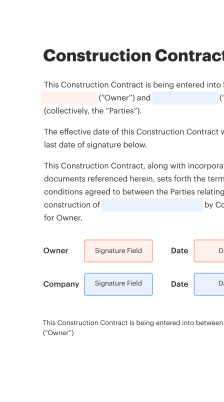
How online creation and signature of Excel invoice statements typically works

The online process moves a completed Excel statement through verification, signature, and archival while keeping an audit trail and secure transport.

  • Prepare template: Populate fields, formulas, and line items in Excel.
  • Upload document: Convert or attach the spreadsheet to the signing platform.
  • Configure recipients: Assign signers, order, and authentication methods.
  • Complete signing: Recipients sign and the platform records timestamps.
Collect signatures
24x
faster
Reduce costs by
$30
per document
Save up to
40h
per employee / month

Step-by-step: complete an Excel invoice statement for tech services

Follow these core steps to prepare an accurate invoice statement in Excel and ready it for secure signing and delivery.

  • 01
    Import data: Pull usage and transaction exports into the template.
  • 02
    Verify formulas: Check calculations and tax/gross totals for accuracy.
  • 03
    Attach references: Add contract IDs, PO numbers, and service descriptions.
  • 04
    Send for signature: Deliver via an eSignature workflow with audit logging.
be ready to get more

Why choose airSlate SignNow

  • Free 7-day trial. Choose the plan you need and try it risk-free.
  • Honest pricing for full-featured plans. airSlate SignNow offers subscription plans with no overages or hidden fees at renewal.
  • Enterprise-grade security. airSlate SignNow helps you comply with global security standards.
illustrations signature

Suggested workflow configuration for automated invoice statement delivery

Configure these workflow settings to standardize template processing, validation, and delivery for recurring invoice statements in technology environments.

Workflow Feature and Configuration Header Default configuration values and notes
Reminder Frequency for Automated Notifications 48 hours before due date
Signature Authentication Level Required Email plus optional SMS
Document Retention and Archival Policy 7 years secure storage
Bulk Send Batch Size Limit 500 recipients per batch
API Rate Limit Handling Strategy Queue with exponential backoff

Security controls relevant to using Excel invoice statements

Encryption at rest: AES-256 encryption
Encryption in transit: TLS 1.2+
Access controls: Role-based limits
Document watermarking: Visible identifiers
Audit logging: Tamper-evident logs
Multi-factor authentication: Optional enforced MFA

Industry use cases illustrating Excel invoice statements with eSign

Real-world scenarios show how a well-structured Excel invoice statement improves billing accuracy and accelerates collections across technology operations.

SaaS usage billing reconciliation

A mid‑sized SaaS vendor consolidated hourly usage exports into a templated Excel statement to standardize monthly charges and reduce disputes by 60%

  • Automated formulas converted raw metrics to invoice line items
  • Integrations exported totals to accounting for faster posting

Resulting in shorter billing cycles and fewer customer inquiries while preserving auditable records for finance.

Hardware maintenance contract invoicing

A hardware vendor used Excel templates to combine service fees, part replacements, and prorated warranties into single statements for enterprise clients

  • Line-item tables simplified cost attribution per serial number
  • Standardized terms and signature fields ensured consistent acceptance

Leading to clearer renewal conversations, faster approvals, and a documented sign-off trail for compliance and warranty claims.

Best practices for secure and accurate Excel invoice statements

Implement consistent template governance and security controls to reduce errors, protect customer data, and speed collections across billing cycles.

Establish a single source template
Maintain one approved Excel template stored in a secure repository with versioning. Limit edit rights to finance owners and use change logs so any formula or term updates are reviewed, tested, and communicated to billing teams to prevent divergent statements.
Automate data imports and validations
Use integration scripts or ETL routines to pull usage and invoiceable events into the template and run automated validation checks that flag mismatches or missing contract references before statements are issued.
Preserve formulas while exporting
When converting Excel to signed PDFs, ensure calculations are flattened only after verification. Keep a locked source file with formulas intact and export a printable, non-editable PDF for signature to preserve auditability and prevent downstream edits.
Apply layered security and logging
Encrypt stored templates, enforce MFA for access, and use eSignature workflows that record signer identity, authentication method, and timestamps to maintain an auditable chain of custody for each invoice.

FAQs about Excel invoice statements and electronic signatures

Answers to common questions about preparing, signing, and managing Excel invoice statements in technology environments.

Capability comparison: signNow and major eSignature providers

A concise capability matrix comparing signNow with other leading eSignature platforms on features relevant to Excel invoice statements and technology billing.

Capability Comparison Across eSignature Vendors signNow (Recommended) DocuSign Adobe Acrobat Sign
Legal validity under US electronic signature law
Bulk Send and mass delivery capabilities
API access for automated workflows
Native mobile app and SDK support
be ready to get more

Get legally-binding signatures now!

Retention and backup timelines for invoice statements and related files

Define clear retention and backup schedules to meet tax, audit, and operational needs for Excel invoice statements and signed records.

Primary document retention period:

Seven years

Signed PDF archival frequency:

Immediate upon signature

Backup schedule for repositories:

Daily incremental backups

Disaster recovery snapshot cadence:

Weekly full snapshots

Retention review and disposition:

Annual retention audit

Risks and penalties from improper invoice handling

Late payment penalties: Interest charges
Contract disputes: Credit holds
Regulatory fines: Compliance costs
Revenue leakage: Lost income
Data breaches: Liability exposure
Audit failures: Restatements

Pricing and plan overview across common eSignature vendors

High-level plan and availability comparison to help technology teams evaluate ongoing costs and feature tiers for invoice statement workflows.

Plan Tier and Description signNow (Recommended) DocuSign Adobe Acrobat Sign Dropbox Sign PandaDoc
Free or trial availability Free trial available Free trial available Free trial available Free tier available Free trial available
Individual plan typical monthly price Approx $8–$15 per user Approx $10 per user Approx $9.99 per user Approx $15 per user Approx $19 per user
Business plan highlights Team templates, bulk send, API access Advanced workflows, CLM add-ons Integrated Adobe PDF workflows Simple eSign and templates Document creation and eSign
API availability and limits REST API with tiered limits Extensive API with broad features REST API integrated with Adobe ecosystem API via Dropbox Sign API available with limits
Enterprise contract and support Custom contracts and SLAs Enterprise SLAs and onboarding Enterprise licensing options Enterprise agreements available Enterprise plans available
walmart logo
exonMobil logo
apple logo
comcast logo
facebook logo
FedEx logo
be ready to get more

Get legally-binding signatures now!