



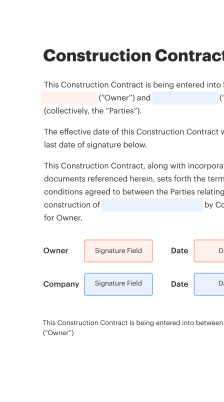
Legal Billing Template for Accounting and Tax

Effortlessly manage documents and eSign with airSlate SignNow's user-friendly, cost-effective solution. Experience efficiency like never before in your billing processes.

Award-winning eSignature solution

What a legal billing template for accounting and tax looks like

A legal billing template for accounting and tax is a standardized document that captures client billing details, itemized services, applicable taxes, retainer balances, and payment terms to support professional invoicing and regulatory recordkeeping. These templates streamline fee descriptions for legal and tax work, ensure consistent tax code application across engagements, and reduce dispute risk by providing clear line-item rates, hours, and tax calculations. When combined with an eSignature-enabled workflow, a template speeds approval, preserves an audit trail, and integrates with accounting systems for reconciliation and reporting.

Why standardized legal billing templates matter

Standardized templates for accounting and tax ensure accuracy, simplify compliance, and reduce time spent preparing invoices while improving transparency for clients and regulators.

Why standardized legal billing templates matter

Common challenges when managing legal billing templates

  • Inconsistent fee descriptions across invoices lead to client confusion and payment delays.
  • Manual tax calculations increase error risk and complicate month-end reconciliations.
  • Lost or unsigned invoices create audit gaps and extend receivable cycles.
  • Difficulty mapping billing codes to accounting systems causes reconciliation overhead.

Typical user profiles for templates

Small CPA Firm

A small CPA firm uses the template to standardize billings across partners and engagements, capture tax IDs and client billing preferences, and ensure invoices record applicable sales and service taxes for accurate accounting and client transparency.

Tax Law Practice

A tax law practice applies the template to itemize advisory hours, court-related disbursements, and statutory penalties, while keeping a clear trail for trust accounting, retainers, and compliance with client engagement letters.

Who typically uses legal billing templates

Law firms, CPA firms, tax preparers, and in-house legal or finance teams use legal billing templates to standardize invoicing processes.

  • Small accounting firms managing recurring client engagements and retainers.
  • Corporate tax departments consolidating billings across jurisdictions and teams.
  • Law practices tracking billable hours, disbursements, and tax treatment.

These templates help diverse teams maintain compliance, speed approvals, and provide consistent documentation for audits and client records.

be ready to get more

Choose a better solution

Core features to include in your template toolkit

These four template elements address accuracy, compliance, and integration needs typical for accounting and tax invoices used by legal and financial professionals.

Template Fields

Custom fields for client identifiers, matter numbers, tax IDs, and line-item codes that ensure consistent data capture across invoices and source systems to support accounting reconciliation.

Tax Logic

Configurable tax rules per jurisdiction, automatic tax calculations on taxable line items, and override capabilities so teams can reflect variable tax treatment accurately on each invoice.

Time & Fees

Integrated time entry or imported timesheets mapped to billing rates with automated calculations to ensure fees are itemized and supported by recorded hours or fixed-rate line items.

eSign Integration

Embedded electronic signature fields and acceptance records that create a verifiable audit trail and preserve signed invoices for compliance and dispute resolution.

How a template moves through the workflow

Understand the typical flow from draft to signed invoice and ledger entry so teams can align responsibilities and automation steps.

  • Draft: Prepopulate template fields from client record.
  • Review: Internal approval and tax verification.
  • Sign: Client signs electronically on file.
  • Record: Export to accounting and archive.
Collect signatures
24x
faster
Reduce costs by
$30
per document
Save up to
40h
per employee / month

Quick setup: create a legal billing template

Follow these core steps to build a practical legal billing template for accounting and tax that captures fees, taxes, client data, and signature acceptance.

  • 01
    Define fields: Add client name, tax ID, line items.
  • 02
    Set tax rules: Map jurisdictional tax rates.
  • 03
    Include terms: Add payment and late fee terms.
  • 04
    Enable signing: Add signature and date fields.
be ready to get more

Why choose airSlate SignNow

  • Free 7-day trial. Choose the plan you need and try it risk-free.
  • Honest pricing for full-featured plans. airSlate SignNow offers subscription plans with no overages or hidden fees at renewal.
  • Enterprise-grade security. airSlate SignNow helps you comply with global security standards.
illustrations signature

Typical workflow settings for billing template automation

Configure these workflow settings to automate approvals, reminders, and posting for templates used in accounting and tax billing.

Setting Name Configuration
Reminder Frequency 48 hours
Approval Workflow Two-step
Default Currency USD
Tax Rate Handling Per-jurisdiction
Access Expiration 90 days

Supported platforms for templates and signing

Legal billing templates and signing workflows should function across desktop and mobile platforms to match client and staff needs.

  • Web browsers: Chrome, Edge, Safari supported
  • Mobile OS: iOS 13+ and Android 9+
  • File formats: PDF preferred for fidelity

Maintain current browser and OS versions, and standardize PDF templates to ensure consistent rendering, data capture, and secure signing across devices.

Security features to protect billing documents

Encryption: AES-256 in transit
Access controls: Role-based permissions
Authentication: Multi-factor options
Document locking: Prevent edits after signing
Audit logs: Detailed event records
Data residency: Configurable storage region

How firms use legal billing templates in practice

Real-world examples show how templates reduce errors and speed collections while meeting accounting and regulatory needs.

Mid-size Accounting Firm

A regional accounting firm standardized all client invoices using a legal billing template to include tax jurisdiction and retainer balance for each client

  • template automatically populated service codes from the engagement letter
  • finance reconciled payments three times faster

Resulting in clearer client statements and a 25 percent reduction in disputed invoices within six months.

Tax Advisory Boutique

A tax advisory boutique adopted a template that captured billable hours, jurisdictional tax treatment, and compliance notes for each engagement

  • the template enforced required client identifiers and signature acceptance
  • the practice integrated signed invoices into the general ledger for audit trails

Leading to faster year-end close and improved readiness for tax authority inquiries.

Best practices for secure and accurate billing templates

Adopt practices that protect data, maintain compliance, and reduce manual reconciliation work when using legal billing templates for accounting and tax.

Use role-based access and approval workflows
Limit who can edit templates and require managerial approval for invoices above defined thresholds. This prevents unauthorized changes, reduces billing errors, and creates a documented approval chain for audits and internal controls.
Maintain versioned templates with change logs
Store each template version and record the rationale for changes, such as tax rule updates or fee schedule revisions. Versioning ensures historical invoices remain auditable and that teams can reproduce prior billing behavior if needed.
Standardize tax and accounting mappings
Map template fields directly to GL accounts and tax codes to automate posting. Clear mappings reduce reconciliation time and ensure invoices conform to internal accounting policies and external tax reporting requirements.
Retain signed copies and audit trails
Keep immutable, timestamped signed invoices and an event log that records access, edits, and signatures. Retention supports regulatory compliance and provides evidence in client disputes or tax authority reviews.

FAQs and troubleshooting for templates and signing

Answers to common questions about building, sending, and validating legal billing templates for accounting and tax.

Feature availability: signNow compared to major providers

A concise comparison of common billing-template features and compliance support among leading eSignature providers.

Feature Comparison Matrix signNow (Recommended) DocuSign Adobe Sign
Legal validity (US)
HIPAA support Yes (BAA) Yes (BAA) Yes (BAA)
Bulk Send
API Availability REST API REST API REST API
be ready to get more

Get legally-binding signatures now!

Key risks from poor billing template management

Billing Errors: Revenue loss
Noncompliance: Regulatory fines
Client Disputes: Damaged relationships
Audit Failures: Penalties
Data Breach: Confidentiality loss
Delayed Payments: Cash flow issues

Pricing snapshot for common billing-related features

Pricing and plan capabilities vary; this snapshot highlights base pricing, trial availability, and common enterprise features for comparison.

Plan signNow (Featured) DocuSign Adobe Sign HelloSign
Starting price (per user) $8/month $10/month $15/month $15/month
Free trial Yes Yes Yes Yes
Enterprise available Yes Yes Yes Yes
Dedicated support options Email & phone Phone & email Phone & email Email only
Monthly eSignatures included Unlimited Tiered limits Tiered limits Tiered limits
walmart logo
exonMobil logo
apple logo
comcast logo
facebook logo
FedEx logo
be ready to get more

Get legally-binding signatures now!