Maintenance Contract for Hightech Solutions

Effortlessly send and eSign documents with our user-friendly platform. Experience a cost-effective solution tailored for modern businesses.

Award-winning eSignature solution

What a maintenance contract for hightech covers

A maintenance contract for hightech defines obligations, service levels, response and resolution times, spare parts provisioning, and escalation paths for complex hardware and software systems. It typically includes service level agreements (SLAs), warranty terms, preventive maintenance schedules, update and patch provisions, scope exclusions, and termination conditions. Using an electronic signature-enabled workflow preserves a complete record of acceptance, amendments, and renewals while reducing administrative delays. Properly structured contracts improve vendor accountability, track compliance with technical specifications, and keep maintenance windows aligned with operational risk management for critical systems.

Why digital maintenance contracts matter for hightech operations

Electronic maintenance contracts accelerate approvals, maintain auditable records, and reduce downtime by enabling faster vendor engagement and clearer SLA enforcement across distributed teams.

Why digital maintenance contracts matter for hightech operations

Common challenges when managing hightech maintenance contracts

  • Complex SLA definitions that vary by equipment type and location, making standardized enforcement difficult across sites and vendors.
  • Coordinating multi-vendor responses for integrated systems often causes delays and unclear responsibility for root-cause resolution.
  • Version control issues when amendments and addenda are exchanged by email, increasing risk of conflicting obligations.
  • Regulatory and data-handling requirements across sectors complicate contract terms and introduce extra procedural checks.

Representative users and roles

Field Service Manager

Field Service Managers coordinate onsite maintenance schedules, prioritize critical equipment repairs, and monitor SLA performance. They need signed contracts to authorize work, document accepted terms, and confirm warranty compliance across multiple vendor engagements.

Contract Administrator

Contract Administrators centralize contract versions, manage renewals, and track milestones. They require reliable audit trails, template libraries, and role-based access to ensure accurate recordkeeping and timely renewals for hightech assets.

Teams that typically manage maintenance contracts for hightech

Facility, IT, and procurement teams use maintenance contracts to coordinate uptime, parts inventory, and vendor responsibilities across technical estates.

  • Procurement and sourcing teams that negotiate terms, pricing, and vendor SLAs for long-term maintenance.
  • Field service and operations managers who schedule preventive maintenance and manage service calls.
  • Legal and compliance teams who review contract language, data handling clauses, and regulatory obligations.

Those groups rely on clear SLAs and audit-ready records to minimize operational risk and ensure accountable vendor support.

Advanced capabilities for enterprise maintenance contracts

Enterprises managing many assets benefit from advanced signing, governance, and integration features that scale across teams and geographies.

Role-based templates

Templates scoped by role let legal, operations, and procurement each access tailored draft clauses and approval paths, ensuring only authorized edits and consistent contract language across asset classes and jurisdictions.


Advanced authentication

Support for multi-factor and certificate-based signer authentication increases assurance for high-risk signatures involving critical infrastructure and regulated data handling obligations.

API integrations

APIs connect contract workflows to asset management, helpdesk, and ERP systems so signed obligations automatically trigger work orders and inventory allocations for parts and technicians.

Bulk renewals

Bulk-renewal capabilities let organizations issue standardized renewal notices and amended SLAs to many vendors with tracking for each signer and consolidated reporting on acceptance rates.

Compliance reporting

Built-in compliance reports summarize executed agreements, key clause versions, and audit log activity to support internal audits and regulatory reviews.

Conditional fields

Conditional document fields adapt contract language based on selected equipment types, service tiers, or geographic requirements to reduce manual edits and misapplied clauses.

be ready to get more

Choose a better solution

Essential tools for managing maintenance contracts

Certain features reduce friction when negotiating and maintaining hightech service agreements; these tools support templates, bulk updates, auditing, and integrations with asset systems.

Template Library

Centralized templates allow legal-approved maintenance clauses to be reused across vendors and asset classes, reducing drafting time and ensuring consistent SLA language and compliance controls for recurring agreements.

Bulk Send

Bulk Send enables distributing identical contract offers or renewal notices to many vendors or sites simultaneously while tracking individual signer status and collecting signed acknowledgements efficiently.

Audit Trail

A comprehensive, tamper-evident audit trail records signer identity, timestamps, IP addresses, and document changes to support dispute resolution and regulatory inspections without manual reconciliation.

System Integrations

Integrations with CMMS, CRM, and contract repositories sync contract metadata and asset identifiers so maintenance obligations map directly to physical equipment inventories and service histories.
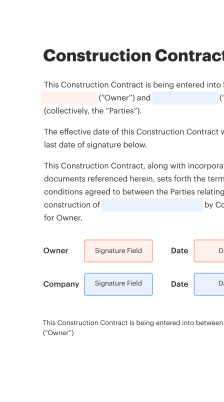
How a digital workflow handles maintenance contract execution

Digital workflows move a maintenance contract from draft to signed status while preserving traceability and automating routine checks.

  • Upload: Import template or draft document.
  • Annotate: Add fields and required metadata.
  • Route: Sequence signers and reviewers.
  • Archive: Save final signed copy with audit log.
Collect signatures
24x
faster
Reduce costs by
$30
per document
Save up to
40h
per employee / month

Quick setup: preparing a maintenance contract for hightech

A concise four-step sequence helps teams create, approve, and store signed maintenance contracts for hightech assets.

  • 01
    Define scope: List covered equipment and services.
  • 02
    Draft SLAs: Specify response and resolution times.
  • 03
    Approve parties: Collect signatures from stakeholders.
  • 04
    Store securely: Archive with version control.

Step-by-step: executing a single maintenance contract

A practical six-step grid shows typical actions from creation to archival for an individual maintenance contract.

01

Create draft:

Use approved template
02

Attach attachments:

Add asset lists
03

Specify SLAs:

Enter measurable targets
04

Route for sign-off:

Assign signer order
05

Collect signatures:

Monitor signer progress
06

Archive executed copy:

Link to asset record
be ready to get more

Why choose airSlate SignNow

  • Free 7-day trial. Choose the plan you need and try it risk-free.
  • Honest pricing for full-featured plans. airSlate SignNow offers subscription plans with no overages or hidden fees at renewal.
  • Enterprise-grade security. airSlate SignNow helps you comply with global security standards.
illustrations signature

Typical workflow settings for maintenance contract execution

Configure these settings to align contract routing, reminders, authentication, and retention with organizational policies.

Setting Name Configuration
Reminder Frequency 48 hours
Signing Order Sequential
API Callback URL Webhook
Document Retention 7 years
Authentication Method MFA

Supported platforms for signing and management

Maintenance contracts for hightech are typically processed via web browsers, desktop applications, and mobile apps to support in-field and office-based workflows.

  • Web browsers: Chrome, Edge, Safari
  • Mobile apps: iOS and Android
  • Desktop access: Windows and macOS

Ensure platform compatibility for corporate endpoints and field devices, verify browser and OS versions, and confirm that mobile users have secure network access and multi-factor authentication in place before enabling signing workflows.

Security controls to protect maintenance contract documents

Encryption at rest: AES-256 encryption
Encryption in transit: TLS 1.2+ connections
Role-based access: Granular permissions
Multi-factor authentication: Two-step verification
Tamper-evident audit trail: Immutable logs
Key management: Secure rotation

Industry examples of maintenance contract for hightech

Two brief case examples show typical contractual needs and the outcomes when digital signing and workflows are applied.

Large Data Center Lease

A hyperscale data center operator required unified maintenance SLAs across multiple equipment vendors to minimize unplanned outages and coordinate on-call rotations.

  • Centralized SLA templates for rack, power, and cooling systems.
  • Faster vendor acknowledgment and consolidated incident reporting.

Resulting in standardized response times and clearer crediting of service failures, reducing dispute resolution time and preserving uptime.

Medical Device Field Service

A medical device manufacturer needed signed maintenance agreements that included HIPAA-conscious data handling and scheduled preventive service to avoid clinical disruption.

  • Template clauses for patient data segregation and device calibration.
  • Clear service-window coordination and escalation paths.

Leading to consistent compliance reviews and documented evidence of maintenance actions, which simplified audits and reduced regulatory exposure.

Practical best practices for accurate and secure contracts

Follow operational and legal guidelines to reduce ambiguity, speed execution, and maintain compliance across maintenance contract lifecycles.

Standardize SLA definitions and metrics
Define response times, uptime targets, measurement methods, and acceptable exceptions in plain language. Use measurable metrics and include how incident classification determines priority and escalation to reduce interpretation disputes.
Use approved template clauses for liability and data handling
Include clauses for liability limits, data protection, encryption expectations, and breach notification. Ensure templates are reviewed by legal and tailored for region-specific regulatory obligations when required.
Maintain a single source of truth for contract versions
Store executed contracts in a centralized, access-controlled repository with versioning and retention policies. Link contracts to asset records so maintenance history and obligations remain synchronized.
Automate renewals and reminders with clear workflows
Configure automated alerts for renewal windows, service milestones, and certificate expirations. Use role-based routing so responsible stakeholders receive timely notices and approvals without manual follow-up.

FAQs and troubleshooting for maintenance contract for hightech

Common questions and solutions address signature failures, version confusion, compliance checks, and integration issues that teams typically encounter.

Feature availability comparison for maintenance contract eSignatures

A concise capability comparison shows common features needed for maintenance contracts across leading eSignature providers.

Capability signNow (Recommended) DocuSign Adobe Sign
ESIGN / UETA compliance
Audit trail detail Comprehensive Comprehensive Comprehensive
API type REST API REST API REST API
Mobile support iOS & Android iOS & Android iOS & Android
be ready to get more

Get legally-binding signatures now!

Key timing milestones for maintenance contract lifecycles

Track important dates to ensure continuity of service and minimize interruption.

Contract effective date:

Date services begin

Renewal notice window:

60–90 days prior

Service level review:

Annual review

Preventive maintenance schedule:

Per equipment plan

Termination notice period:

30–90 days

Contract risks and potential penalties

Liquidated damages: Monetary fines
Service credits: Reduced payments
Termination clauses: Contract loss
Regulatory fines: Compliance penalties
Reputational damage: Customer impact
Operational downtime: Productivity loss

Pricing and capabilities overview for common eSignature vendors

An overview of entry pricing and core capabilities that affect maintenance contract operations and integrations across several mainstream eSignature providers.

Plan / Feature signNow (Recommended) DocuSign Adobe Sign Dropbox Sign PandaDoc
Starting price (per user, monthly) $8/user/mo $10+/user/mo $29+/user/mo $15+/user/mo $19+/user/mo
API access availability Included Included Included Included Included
Free trial length 7–14 days 30 days 7–14 days 14 days 14 days
Template library and management Yes, robust Yes, robust Yes, robust Yes, basic Yes, robust
Bulk send limits High-volume options Enterprise tiers Enterprise tiers Moderate Enterprise tiers
walmart logo
exonMobil logo
apple logo
comcast logo
facebook logo
FedEx logo
be ready to get more

Get legally-binding signatures now!