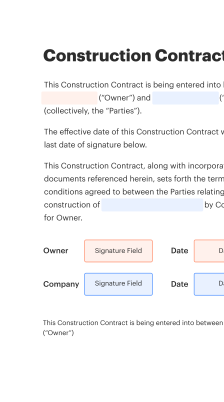
Mark Blood Donation Consent with SignNow
What it means to mark blood donation consent electronically
Why use eSignatures for blood donation consent
Electronic consent streamlines donor intake, reduces manual errors, and centralizes records while maintaining legal validity when processed under U.S. e-signature laws and appropriate health privacy safeguards.
Common challenges when capturing consent electronically
- Ensuring the donor has received and understood all required disclosures before signing can be harder without standardized presentation of consent language.
- Verifying identity for walk-in donors when only minimal identification is available creates potential authentication gaps.
- Integrating signed consent records with hospital or blood bank information systems can require custom mapping and validation.
- Maintaining HIPAA-compliant storage and access controls for consent documents demands consistent policies and technical safeguards.
Typical user profiles involved in electronic consent
Blood Drive Coordinator
Coordinates donor outreach, sets up digital intake stations, and reviews signed consent records for completeness. They ensure forms include required disclosures and that donor identity checks meet organizational policies before collection.
Donor
Completes pre-donation screening, reviews consent language, and provides an electronic signature. The donor expects clear explanations about testing, use of blood products, and privacy protections for their health information.
Organizations and roles that commonly mark blood donation consent
Blood centers, hospital transfusion services, mobile drive coordinators, and public health agencies routinely capture donor consent using electronic forms and signatures.
- Blood banks and collection centers performing routine donor intake and recordkeeping.
- Community and corporate blood drive organizers managing large-volume donor check-in.
- Clinical staff and transfusion services that require auditable donor authorizations.
Implementations range from standalone tablets at mobile drives to integrated EMR or donor management workflows, tailored to each organization's security and reporting needs.
Choose a better solution
Core tools that improve marking blood donation consent
Audit Trail
Detailed, time-stamped logs of each consent transaction, including signer IP, device metadata, and sequence of events to support compliance and retrospective review.
Authentication Options
Multiple verification methods such as SMS codes, email validation, and organization-managed SSO to match organizational risk tolerance for donor identity assurance.
Template Management
Reusable consent templates with locked fields and version control to ensure every donor sees standardized language and required disclosures without manual modification.
Integrations
Prebuilt connectors and API endpoints to sync signed consent records into donor management systems, EMRs, and cloud storage for consistent data flow.
How the electronic consent flow typically works
-
Pre-Screening: Donor answers health questions online or on-site.
-
Authentication: Confirm identity via ID, email, or SMS code.
-
Consent Capture: Donor signs consent text electronically.
-
Record Sync: Consent saved and linked to donor record.
Step-by-step: how to mark blood donation consent electronically
-
01Prepare Form: Include required disclosures and signature fields.
-
02Verify Donor: Confirm identity per policy before signing.
-
03Capture Signature: Collect signature and timestamp on device.
-
04Store Record: Save consent with audit trail and access controls.
Why choose airSlate SignNow
-
Free 7-day trial. Choose the plan you need and try it risk-free.
-
Honest pricing for full-featured plans. airSlate SignNow offers subscription plans with no overages or hidden fees at renewal.
-
Enterprise-grade security. airSlate SignNow helps you comply with global security standards.
Configuring a consent workflow for blood donation
| Setting Name | Configuration |
|---|---|
| Consent Template Version | Locked v1.2 |
| Signer Authentication Level | SMS code |
| Retention Policy | 7 years |
| Notification Recipients | Donor Admin |
| Automatic Backup | Daily |
Device and platform considerations for capturing consent
Plan for the devices and connectivity you will use—tablets at drives, kiosks in clinics, and mobile phones for pre-registration each have different requirements.
- Tablet Support: Modern browsers
- Mobile Phones: Responsive forms
- Desktop/Clinic Kiosks: Secure workstation
Ensure devices run updated operating systems, use secure network connections, and have policies for device access and wiping; consider offline capture with later secure synchronization if drives encounter unreliable connectivity.
Practical examples of marking blood donation consent
Mobile Blood Drive
At a workplace mobile drive, donors pre-register online and review consent language on their phones before arrival
- staff confirm identity at check-in
- consent is captured electronically at a tablet and linked to the donor record
Resulting in faster throughput, fewer paper forms, and reduced post-drive data entry.
Hospital Collection Center
In a hospital, transfusion services present consent and testing disclosures via a kiosk integrated with the hospital electronic medical record
- clinicians verify donor information against the EMR
- finalized consent is stored in the patient and donor files with an audit trail
Leading to consistent documentation, easier compliance reporting, and centralized record access.
Best practices for secure and accurate marking of consent
FAQs about marking blood donation consent electronically
- Is an electronic signature legally valid for blood donation consent?
Yes. In the United States, electronic signatures that meet ESIGN and UETA requirements are legally valid for most consent transactions. For healthcare-related consent involving protected health information, organizations must also ensure HIPAA compliance and follow any state-specific rules regarding consent language and patient authentication before relying solely on an electronic signature.
- What authentication is sufficient to verify a donor?
Authentication should match the organization's risk tolerance. For routine donations, verifying government ID at check-in or using a pre-registration email plus an SMS code is common. Clinical or high-risk contexts may require multi-factor authentication or institutional identity verification tied to medical records.
- How should signed consent be stored to meet regulatory needs?
Store signed consents in encrypted systems with role-based access controls, immutable audit logs, and regular backups. Maintain retention schedules according to organizational policy and applicable laws; ensure the record includes the consent text, signer identity data, timestamps, and any authentication evidence.
- Can donors withdraw consent that was signed electronically?
Yes. Organizations should provide a clear process for donors to withdraw consent, document the withdrawal, and update donor records accordingly. The original signed consent should be retained as a record of prior authorization, with the withdrawal recorded and linked to the file.
- Does using eSignatures require a business associate agreement under HIPAA?
If a third-party eSignature provider will store or process protected health information on behalf of a covered entity, a business associate agreement is typically required. Confirm the provider's HIPAA support and execute appropriate agreements to document responsibilities for PHI protection.
- What are common troubleshooting steps when a consent form fails to save?
Check network connectivity, verify device time and browser compatibility, confirm required fields are completed, and review user permissions. If problems persist, export any local data securely, retry submission, and consult system logs or the eSignature platform's support diagnostics to identify errors.
Feature availability: signNow and leading eSignature vendors
| Criteria and Vendor Column Headers | signNow (Recommended) | DocuSign | Adobe Sign |
|---|---|---|---|
| ESIGN/UETA legal validity | |||
| HIPAA-support options | |||
| Bulk Send for mass drives | |||
| API access for integration |
Get legally-binding signatures now!
Legal and operational risks if consent is mishandled
Typical plans and availability across eSignature providers
| Plan Comparison Across Vendors | signNow (Recommended) | DocuSign | Adobe Sign | Dropbox Sign | PandaDoc |
|---|---|---|---|---|---|
| Free Tier or Trial | Free trial available for new accounts | Free trial available | Free trial available | Free tier for limited users | Free trial available |
| Individual / Basic Monthly Plan | Personal and Business subscriptions available | Individual/Standard plans available | Individual plans via Adobe Express integrations | Individual plan available | Individual plan available |
| Business / Team Plan | Business plans with team features and templates | Business and Advanced solutions | Business plans with admin controls | Business plans for teams | Team plans with collaboration |
| Enterprise & Compliance | Enterprise offerings with HIPAA and custom controls | Enterprise with advanced compliance options | Enterprise agreements and compliance support | Enterprise controls available | Enterprise plans with SSO |
| API & Developer Access | API packages included in commercial plans | Robust API and SDKs offered | Comprehensive API with developer tools | API available with paid plans | API access in corporate plans |
Simplify challenging workflows
Generate, perform, and control workflows of any complexity, electronically from almost anywhere. Scalable electronic signature features ensure you can share documents with the right people in the correct way and assign roles for every receiver. Stream document workflows faster and simpler than ever before.
Automate document flow
Optimize complicated signing tasks with airSlate SignNow�s powerful capabilities to enhance your operation. Take control of your automated eSignature workflows to make sure they're running at top performance with fast notices and reminders.
Enhance in team communication
Get teams together in a protected, shared workplace. Manage paperwork, use form templates and notifications to produce more efficient cross-company interaction. Relieve your staff from having to spend time on repeating actions to enable them to concentrate on beneficial, business-critical activities.
Integrate into your existing network
Manage your projects with best-in-class integration. Capture Salesforce, Microsoft Teams, and SharePoint in multi functional business flow. Hook up your software to a single environment for unlimited possibilities and higher productiveness.
Remain compliant with market-leading data security
Feel safe with the knowledge that your information remains secure by the newest in encryption security. airSlate SignNow is GDPR and eIDAS certified and offers you awareness into your eSigning process with court-admissible audit trails. Configure user authorization and roles to manage who has access to what.