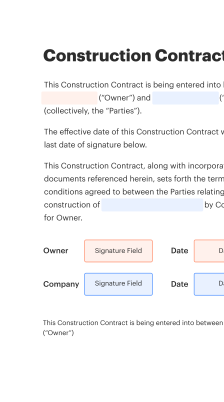
Mark Service Contract Template for Secure Agreements
What a mark service contract template is and when to use it
Why standardized mark service contract templates matter
Standard templates cut drafting time, reduce legal review costs, and maintain consistent obligations across engagements, improving operational efficiency while reducing signature and compliance errors.
Common challenges without a template
- Inconsistent clauses increase dispute risk and lengthen legal review cycles across similar service agreements.
- Manual assembly leads to data entry errors and missing signature blocks for required parties.
- Slow turnaround on approvals and signatures delays project starts and invoice schedules.
- Poor version control can result in outdated terms being used across multiple client engagements.
Representative user profiles
Facilities Manager
A Facilities Manager uses a mark service contract template to standardize maintenance and vendor service terms across multiple sites, ensuring consistent SLAs and pricing. They rely on templates to speed renewals, track service histories, and retain signed records for compliance and budgeting purposes.
Account Executive
An Account Executive generates proposals using the template to reduce turnaround time between agreement acceptance and service delivery. The template ensures pricing and scope fields are accurate, which minimizes contract negotiation and accelerates revenue recognition.
Typical users of mark service contract templates
Organizations and roles that rely on repeatable service agreements for operations, sales, and compliance.
- Operations managers who need consistent service scopes and SLA language for recurring vendors.
- Sales teams preparing standardized client proposals that require contract signatures before onboarding.
- Legal and compliance teams enforcing uniform terms and retention policies across contracts.
These templates reduce review cycles and support easier auditing, allowing different teams to work from a single approved form.
Choose a better solution
Key features to include in a mark service contract template
Reusable fields
Predefined form fields allow consistent capture of client information, dates, pricing, and service details. Reusable fields reduce manual entry and ensure identical data appears wherever required in the document.
Conditional content
Conditional clauses or sections display only when relevant, letting one template serve multiple scenarios while avoiding conflicting terms or unnecessary complexity for specific clients.
Role-based signing
Designated signer roles and signing order guarantee the right approvers sign in sequence, maintaining internal control and a clear legal chain for the execution process.
Template locking
Lock critical clauses to prevent post-signature edits. This preserves the integrity of approved language and supports reliable audit trails and compliance reviews.
How to create and send the mark service contract template online
-
Create template: Upload a base document and add form fields.
-
Define roles: Assign signer and viewer roles with permissions.
-
Configure workflow: Set signing order and reminders.
-
Send for signature: Deliver via email link or platform invite.
Step-by-step: Preparing a mark service contract template
-
01Draft core terms: Define scope, deliverables, and payment schedule.
-
02Add variables: Insert fields for client name, dates, and pricing.
-
03Set approval flow: Specify signing order and reviewer roles.
-
04Lock and publish: Protect fixed clauses and publish to team templates.
Audit trail and recordkeeping for template-based contracts
Enable Audit Trail:
Capture IP and timestamps:
Store signed PDF:
Export CSV logs:
Preserve version history:
Support legal holds:
Why choose airSlate SignNow
-
Free 7-day trial. Choose the plan you need and try it risk-free.
-
Honest pricing for full-featured plans. airSlate SignNow offers subscription plans with no overages or hidden fees at renewal.
-
Enterprise-grade security. airSlate SignNow helps you comply with global security standards.
Typical workflow settings for mark service contract templates
| Setting | Configuration |
|---|---|
| Reminder Frequency | 48 hours |
| Signature Order Enforcement | Sequential |
| Access Expiration | 30 days |
| Audit Log Retention | 7 years |
| Template Access Control | Role-restricted |
Platform and device considerations for drafting and signing templates
Confirm compatibility and security requirements for the systems your teams and clients use before publishing templates.
- Browser support: Chrome, Edge, Safari
- Mobile OS: iOS and Android
- Storage options: Cloud and on-prem
Ensure chosen platforms meet regulatory controls for your industry, support secure mobile signing, and integrate with existing storage or identity providers to maintain workflow continuity and compliance.
How mark service contract templates work in practice
Facility Maintenance Program
A regional facilities provider uses a mark service contract template to standardize monthly maintenance scopes and payment terms
- The template includes fixed SLAs and recurring payment fields
- This reduces drafting time and missed clauses by centralizing terms
Resulting in faster renewals and clearer vendor accountability.
Managed IT Support Agreement
An IT managed services firm applies a template for multi-site support agreements with defined response times
- The document captures service tiers, escalation contacts, and scope exclusions
- Automated fields populate client details and pricing to prevent manual entry errors
Leading to fewer disputes and faster onboarding across client accounts.
Best practices for secure and accurate templates
FAQs about mark service contract templates
- Are signed templates legally binding in the United States?
Yes. Electronic signatures on properly executed templates meet ESIGN and UETA requirements when intent to sign is clear, parties consent, and records are retained. Ensure the signing workflow captures authentication, timestamps, and an audit trail to support enforceability in disputes.
- How can I restrict template edits after approval?
Use template locking and role-based permissions to prevent unauthorized changes. Lock approved clauses, restrict who can publish templates, and track edits through version history so only designated legal or admin roles can modify live templates.
- What authentication methods improve signer verification?
Common methods include email verification, access codes, SMS one-time passcodes, and knowledge-based authentication. For higher assurance, use identity providers or certificate-based signatures; retain evidence of the chosen method in the audit trail.
- How do I handle template updates and version control?
Maintain a single master repository with versioning. Publish updates only after legal review, archive old versions, and tag templates with effective dates. Communicate changes to users and migrate active transactions to new templates only when appropriate.
- Can templates integrate with CRM and document storage?
Yes. Most modern eSignature providers offer integrations with CRMs, cloud storage, and document editors, enabling automated population of client data, storage of executed contracts, and seamless recordkeeping for downstream processes.
- What retention policies should I apply to executed templates?
Align retention with contractual, regulatory, and internal requirements. Common practices include retaining executed contracts for seven years, supporting legal holds, and using secure archival storage with controlled access and clear disposal workflows.
Feature comparison for mark service contract template workflows
| Comparison Criteria and Technical Requirements Table | signNow | DocuSign | Adobe Sign |
|---|---|---|---|
| Legal validity under ESIGN and UETA | |||
| Bulk Send capability | |||
| Advanced conditional fields | |||
| Price for basic tier (monthly) | From $8 | From $10 | From $14.99 |
Get legally-binding signatures now!
Risks of inadequate template management
Pricing and plan comparison for template-driven eSignature use
| Plan Tier and Price Grid | signNow (Recommended) | DocuSign | Adobe Sign | HelloSign | PandaDoc |
|---|---|---|---|---|---|
| Starting monthly price per user | Starting $8/user | Starting $10/user | Starting $14.99/user | Starting $15/user | Starting $19/user |
| Template and reusable fields | Included | Included | Included | Included | Included |
| Bulk send and mass signing | Included | Add-on | Included | Add-on | Included |
| API access and integrations | Included | Included | Included | Included | Included |
| Support and onboarding options | Standard support | Standard & paid | Standard & paid | Standard support | Standard & paid |
Streamline complicated workflows
Create, deliver, and manage workflows of any difficulty, digitally from virtually anywhere. Scalable eSignature features ensure you can share contracts with the right people in the proper order and determine roles for every signee. Complete document workflows faster and simpler than ever before.
Automate document managing
Enhance complicated signing tasks with airSlate SignNow�s effective tools to improve your operation. Control your automatic signature workflows to guarantee they're operating at peak functionality with immediate notices and reminders.
Enhance in team collaboration
Join teammates together in a protected, shared workplace. Handle paperwork, use form templates and notifications to deliver better cross-company collaboration. Free your workers from having to hang out on repetitive routines so that they can center on valuable, business-crucial tasks.
Integrate into your existing network
Work your assignments with industry-leading integration. Collect Salesforce, Microsoft Teams, and SharePoint in one business thread. Connect your applications to a single system for unlimited opportunities and higher productiveness.
Stay compliant with best-in-class data safety
Feel safe knowing that your data remains secure by the most up-to-date in encryption security. airSlate SignNow is GDPR and eIDAS compliant and gives you transparence into your signing process with court-admissible audit trails. Set up user authorization and rights to regulate who has access to what.