Mark Time Management Matrix with SignNow

Remove paperwork and automate digital document management for higher productivity and unlimited possibilities. Explore the best way of doing business with airSlate SignNow.

Award-winning eSignature solution

What the mark time management matrix is and why it matters

The mark time management matrix is a structured framework for categorizing tasks by urgency and importance to guide prioritization, time allocation, and scheduling. It helps teams and individuals separate high-value work from routine or low-impact activities, supporting clearer daily plans and resource decisions. When implemented consistently it reduces reactive work, clarifies roles and handoffs, and makes time audits actionable for continuous improvement across projects and operational processes.

Practical benefits of adopting a mark time management matrix

Using the matrix increases focus on high-value tasks, reduces context switching, and supports measurable productivity improvements over time through better planning and fewer urgent crises.

Practical benefits of adopting a mark time management matrix

Common implementation challenges to watch for

  • Confusing urgency with importance can push strategic work into low-priority status and undermine long-term goals.
  • Inconsistent categorization across team members makes consolidated planning unreliable and reduces the matrix's usefulness.
  • Overloading high-priority quadrants without reallocating resources creates burnout and unsustainable schedules.
  • Failing to review or update the matrix regularly turns it into a static artifact rather than a dynamic planning tool.

Representative user profiles who benefit from the matrix

Project Manager

A project manager uses the matrix to allocate team capacity across critical milestones, coordinate cross-functional dependencies, and run weekly prioritization sessions. They document which tasks require escalation, which can be deferred, and which need additional resources to maintain delivery timelines and stakeholder expectations.

Individual Contributor

An individual contributor leverages the matrix to protect focused work blocks, identify tasks to delegate, and minimize ad-hoc interruptions. They use it to plan daily and weekly tasks, track completion rates, and demonstrate alignment between their priorities and team goals.

Typical users and where the matrix fits in workflows

Teams and individual contributors use the mark time management matrix for weekly planning, sprint backlog refinement, and personal prioritization.

  • Project managers balancing deadlines and stakeholder requests across multiple workstreams.
  • Individual contributors structuring daily work to protect focus time and deliverables.
  • Operations and support teams triaging incoming requests and escalation paths.

The matrix integrates with common planning rituals such as standups and weekly reviews to maintain alignment and continuous reprioritization.

Core tools and features that enhance a mark time management matrix

Effective matrix implementations combine clear categorization, shared visibility, and lightweight automation to keep priorities aligned without adding overhead.

Shared boards

Centralized, team-visible boards let contributors see quadrant placement, ownership, and due dates in one view for coordinated execution.


Tagging

Consistent tagging of projects, stakeholders, and impact levels enables filtered views and aggregated reporting across multiple matrices.

Recurring reviews

Scheduled reviews with automated reminders preserve cadence, ensure re-prioritization, and prevent outdated items from lingering in high-priority quadrants.

Integration hooks

Connect task lists to calendars, issue trackers, and document repositories to keep matrix items linked to execution artifacts and timelines.

Change history

Maintain timestamped edit logs for task moves between quadrants to support retrospectives and process improvement analyses.

Access controls

Role-based permissions prevent unauthorized edits while enabling necessary collaboration for triage and decision-making workflows.

be ready to get more

Choose a better solution

Integrations and templates that accelerate matrix adoption

Templates and integrations reduce manual work: link matrices to shared documents, CRM records, cloud storage, and eSignature tools when approvals or signoffs are required.

Google Docs

Embed or link canonical matrix templates in Google Docs for collaborative editing and version control within familiar document workflows.

CRM systems

Sync high-priority sales or customer tasks to CRM records so account and opportunity context travels with the task for faster resolution.

Cloud storage

Store archived matrices and audit exports in Dropbox or similar repositories to centralize historical records and backup policies.

signNow integration

When matrix items require formal approvals or signed acknowledgements, signNow can attach compliant eSignature workflows to documents while maintaining audit trails and US-focused legal compatibility.
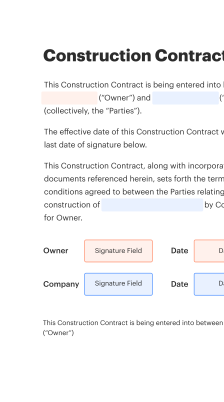
How to create and maintain your mark time management matrix online

Use a shared document or lightweight app to build the matrix, keep a canonical task list, and update it during planning and triage sessions.

  • Create template: Build a reusable four-quadrant template.
  • Share access: Provide view or edit rights to the team.
  • Tag tasks: Use labels for projects and owners.
  • Review weekly: Adjust priorities at cadence meetings.
Collect signatures
24x
faster
Reduce costs by
$30
per document
Save up to
40h
per employee / month

Quick setup: Build your first mark time management matrix

Start simple: create the four-quadrant matrix, agree on definitions for urgency and importance, and run a short calibration workshop with stakeholders.

  • 01
    Define quadrants: Clarify urgency and importance definitions.
  • 02
    List tasks: Collect active tasks and initiatives.
  • 03
    Assign owners: Designate responsible persons for tasks.
  • 04
    Schedule reviews: Set recurring review cadence.

Audit trail management for matrix decisions and changes

Track who moved items, when, and why to maintain accountability and evidence for process reviews and audits.

01

Record moves:

Log quadrant changes with timestamps.
02

Capture comments:

Require short rationale for re-prioritization.
03

Version snapshots:

Store periodic matrix exports for audits.
04

Ownership history:

Preserve past owner assignments.
05

Export formats:

CSV and PDF available.
06

Retention tags:

Apply retention labels for compliance.
be ready to get more

Why choose airSlate SignNow

  • Free 7-day trial. Choose the plan you need and try it risk-free.
  • Honest pricing for full-featured plans. airSlate SignNow offers subscription plans with no overages or hidden fees at renewal.
  • Enterprise-grade security. airSlate SignNow helps you comply with global security standards.
illustrations signature

Automation and workflow settings to support the matrix

Define automation rules to reduce manual triage, notify owners, and escalate unattended high-priority items automatically.

Setting Name Configuration
Reminder Frequency 48 hours
Escalation Threshold 72 hours
Approval Sequence Sequential
Auto-archive Age 30 days
Notification Channel Email and Slack

Using the matrix on mobile, tablet, and desktop

The mark time management matrix is effective across devices; choose tools that sync in real time and preserve permissions consistently.

  • Desktop: Full feature access
  • Tablet: Touch-friendly review
  • Mobile: Quick triage and updates

Ensure your chosen app or document format supports device syncing, offline edits, and secure authentication so users can update priorities from any location without losing change history or access controls.

Data and security considerations for digital matrix tools

Access controls: Role-based permissions
Encryption: At-rest and in-transit
Authentication: Multi-factor support
Audit logging: Detailed change history
Data residency: US-based hosting options
Backup: Automated snapshots

Industry examples applying the mark time management matrix

Below are concise case examples showing how the matrix applies to different operational contexts and outcomes.

Healthcare Scheduling

A hospital operations team used the matrix to prioritize patient-discharge tasks and transfer planning

  • Reduced bottlenecks in bed turnover
  • Lowered average discharge delays and overtime hours

Resulting in improved throughput and clearer shift handoffs.

Sales Pipeline Management

A sales operations group categorized leads and proposal work by urgency and contract value

  • Focused reps on high-value proposals with short windows
  • Reduced churn on priority deals and improved forecast accuracy

Leading to higher close rates and predictable revenue.

Best practices to ensure accurate and secure matrix use

Adopt consistent rules, document decision criteria, and combine the matrix with lightweight automation and secure tools to protect data and enforce process.

Define clear categorization rules
Create a short, written guide that explains how to evaluate urgency and importance with examples to ensure consistent quadrant assignments across the team.
Schedule regular reviews and retrospectives
Establish a consistent cadence for re-prioritization and include a brief retrospective on the matrix during sprint or planning meetings to refine use and remove outdated items.
Use role-based access and approvals
Limit edit rights to triage owners, require approvals for moving critical items, and use secure authentication to reduce accidental or unauthorized changes.
Automate reminders and escalation
Configure notifications for overdue high-priority items and automatic escalations to designated leads to maintain momentum and reduce operational risk.

FAQs about using the mark time management matrix

Common questions and concise answers to help teams implement, maintain, and troubleshoot matrix-based prioritization.

Digital versus paper approaches for maintaining a mark time management matrix

Compare essential capabilities of digital matrix tools with traditional paper-based approaches to understand trade-offs for tracking, auditability, and collaboration.

Criteria signNow (Featured) DocuSign Adobe Sign
Real-time updates
Audit trail
Mobile editing
Centralized backups
be ready to get more

Get legally-binding signatures now!

Storage, retention, and archival practices for matrix records

Define retention rules for active and archived matrices to meet operational needs and any regulatory requirements while keeping storage organized and searchable.

Active matrix retention:

Keep active matrices accessible for 90 days

Audit snapshot retention:

Retain exported audit snapshots for three years

Signed approval retention:

Store signed documents for seven years

Access logs retention:

Maintain logs for two years

Archival schedule:

Archive completed matrices quarterly

Risks and compliance considerations when logging work

Data exposure: Unauthorized access
Incomplete logs: Reduced traceability
Regulatory gaps: Noncompliant handling
Retention failures: Loss of records
Audit issues: Weak evidence trails
Operational delays: Misrouted approvals

Cost and tooling comparison for eSignature-enabled matrix workflows

When matrix items require signed approvals, compare common metrics across eSignature vendors to assess costs, compliance options, and integration capacity.

Plan metric overview signNow (Featured) DocuSign Adobe Sign Dropbox Sign PandaDoc
Free tier availability Limited free trial available No free tier for business features Trial via Acrobat subscription Limited free tier Free trial available
API access Available with paid plans Available with business plans Available via Adobe sign APIs Available on paid tiers Available on business plans
HIPAA-ready options Offered with BAAs on certain plans Enterprise-level options Enterprise agreements possible Available via enterprise Available with enterprise contracts
Typical starting price $8 per user/month $25 per user/month $14.99 per user/month $15 per user/month $19 per user/month
Template management Shared templates and bulk send Advanced templates and workflows Template libraries via Acrobat Template support available Template and content library

Simplify challenging workflows

Prepare, deliver, and control workflows of any difficulty, digitally from near any place. Scalable electronic signature functionality allow you to share contracts with the right users the proper sequence and assign roles for every signee. Perform document workflows faster and easier than ever before.

Automate document flow

Optimize intricate signing procedures with airSlate SignNow�s effective features to improve your company. Control your automatic signature workflows to ensure they're running at top efficiency with quick notifications and reminders.

Enhance in team communication

Join teams together in a protected, shared environment. Manage paperwork, use form templates and notifications to produce more efficient cross-company collaboration. Free your staff from having to hang out on recurring actions so that they can give attention to beneficial, business-crucial tasks.

Integrate into your current network

Run your tasks with market-leading integration. Capture Salesforce, Microsoft Teams, and SharePoint all in one business stream. Hook up your applications to a single unit for unlimited opportunities and higher efficiency.

Remain compliant with industry-leading data security

Feel confident understanding that your data remains secure by the newest in encryption security. airSlate SignNow is GDPR and eIDAS compliant and offers you exposure into your signing experience with court-admissible audit trails. Configure user authorization and roles to control who has access to what.


walmart logo
exonMobil logo
apple logo
comcast logo
facebook logo
FedEx logo
be ready to get more

Get legally-binding signatures now!