Medical Bill Book Format for Finance

See your billing procedure become quick and seamless. With just a few clicks, you can perform all the necessary actions on your medical bill book format for Finance and other important files from any gadget with web connection.

Award-winning eSignature solution

What the medical bill book format for finance means in practice

A medical bill book format for finance is a structured digital template and record model used to create, track, and reconcile patient billing, insurer claims, and payment records. It standardizes line-item entries, CPT/ICD references, payment terms, and remittance notes so finance teams can maintain consistent ledgers and reports. When implemented as an electronic form it supports fillable fields, signature capture, and audit logs, enabling smoother handoffs between clinical, billing, and accounting teams. Platforms such as signNow can integrate eSignature and secure storage to preserve authenticity and streamline approval workflows without replacing core accounting systems.

Why a standardized medical bill book format matters for finance

Using a consistent medical bill book format reduces coding errors, speeds claims processing, and improves reconciliation accuracy while supporting compliance checks and audit readiness across payer and provider interactions.

Why a standardized medical bill book format matters for finance

Typical users and their responsibilities

Billing Manager

Oversees the medical bill book format for finance, configures templates, monitors collections, and coordinates payer appeals. The manager ensures formats match payer requirements, validates CPT/ICD mapping, and reviews audit logs to reduce denials and accelerate cash flow.

Medical Office Administrator

Prepares patient-facing billing statements and collects consent signatures using the format. This role ensures patient data is accurate, attaches remittance advice, and routes documents for signature and archival while following privacy and retention policies.

Advanced features that enhance billing workflows

Consider adding capabilities that increase scale, accuracy, and visibility for finance teams handling high volumes or complex billing rules.

Bulk Send

Send standardized bill batches to many recipients at once while maintaining per-recipient fields and individualized audit logs for compliance and efficiency.


Conditional Fields

Show or hide fields based on payer, service type, or billing scenario to reduce clutter and prevent irrelevant or incorrect data entry.

Mobile Signing

Enable on-the-spot signature capture via tablets or phones so patient consents and payments can be completed at point of care.

Prefill Rules

Automatically populate recurring fields from patient or insurance records to reduce manual input and speed generation of accurate bills.

Payment Collection

Integrated payment fields and processors let teams capture co-pays, installment plans, and card authorizations inside the same document.

Reporting

Built-in dashboards and exportable reports provide visibility into collections, denials, and aging to support finance decision-making.

be ready to get more

Choose a better solution

Core features to include in a medical bill book format for finance

Choose features that reduce manual work, ensure accuracy, and preserve legal and audit requirements for billing documents.

Integration

Seamless connectors to EHRs, practice management, and accounting systems allow prefilling of patient and charge data, reducing entry errors and ensuring consistent ledgers across clinical and finance systems.

Document templates

Customizable templates let finance teams enforce standard fields, validation rules, and payer-specific formats so bills conform to insurer and internal requirements before sending.

Audit trail

Comprehensive, immutable logs capture every change, view, and signature event to support compliance reviews, appeals, and financial reconciliations with a verifiable chain of custody.

Automation

Automated reminders, conditional routing, and prefill rules remove routine tasks from staff workflows, accelerating approvals and reducing days sales outstanding without sacrificing control.
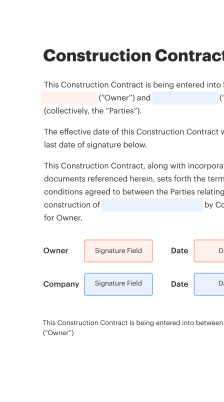
How the format functions across document lifecycle

A clear document lifecycle ensures each bill is created, approved, signed, and archived with traceable events.

  • Draft: Populate billing items and patient details
  • Review: Validate codes and totals
  • Sign: Collect electronic signatures from required parties
  • Store: Save final record with an audit trail
Collect signatures
24x
faster
Reduce costs by
$30
per document
Save up to
40h
per employee / month

Quick setup steps to deploy a medical bill book format for finance

Follow these basic steps to create and publish a standardized billing template that supports signatures and recordkeeping.

  • 01
    Create template: Design fields for codes, amounts, and dates
  • 02
    Add validation: Apply rules for required entries and formats
  • 03
    Assign signers: Designate payer, patient, and approver roles
  • 04
    Publish: Distribute template for use and archiving

Steps to manage audit trails for billing transactions

Implement a reproducible sequence to capture, retain, and review audit information for each billing document.

01

Enable audit logging:

Turn on immutable logs
02

Capture user context:

Record user and role info
03

Record timestamps:

Log precise event times
04

Preserve document versions:

Keep historical copies
05

Export reports:

Generate CSV or PDF logs
06

Review regularly:

Schedule audits and spot checks
be ready to get more

Why choose airSlate SignNow

  • Free 7-day trial. Choose the plan you need and try it risk-free.
  • Honest pricing for full-featured plans. airSlate SignNow offers subscription plans with no overages or hidden fees at renewal.
  • Enterprise-grade security. airSlate SignNow helps you comply with global security standards.
illustrations signature

Workflow settings to configure for billing templates

Configure these workflow settings to align the billing format with approval, notification, and retention needs.

Setting Name Configuration
Reminder Frequency 48 hours
Signing Order Sequential
Data Retention Policy 7 years
Prefill Source EHR integration
Payment Integration Enabled

Supported devices and platform considerations

Most modern web browsers, tablets, and smartphones support electronic medical bill book format for finance templates when configured correctly.

  • Desktop browsers: Chrome, Edge, Safari
  • Mobile devices: iOS and Android
  • PDF support: Standard PDF 1.7+

For consistent behavior test templates across targeted devices, enforce up-to-date browsers and secure connections, and confirm mobile form layouts for signature capture and payments prior to broad deployment.

Security controls applied to medical billing documents

Encryption in transit: TLS 1.2+ protected
Encryption at rest: AES-256 key
Role-based access: Least-privilege limits
Audit logging: Immutable event logs
HIPAA safeguards: Access and audit controls
Multi-factor authentication: Optional for users

Industry examples using a medical bill book format for finance

Two representative scenarios show how the format streamlines billing operations across settings.

Hospital revenue cycle

A large hospital standardized its medical bill book format for finance to consolidate inpatient and outpatient charges into a single reconciled ledger with field-level validation and payer-specific templates.

  • Integrated payer-specific templates and automated CPT matching.
  • Reduced claim rejections and shortened days sales outstanding.

Resulting in measurable improvement to cash flow through fewer denials, faster remits, and clearer audit trails that supported quarterly internal reviews and external audits.

Private practice collections

A multi-provider clinic implemented a tailored medical bill book format for finance to capture co-pays, insurance estimates, and patient payment plans with clear signature fields and prefilling from the EHR.

  • Prefilled patient and insurance data to reduce manual entry.
  • Improved collection rates and patient transparency at checkout.

Leading to more predictable revenue, fewer billing disputes, and a simplified month-end reconciliation process that reduced administrative time.

Practical best practices for accurate billing and recordkeeping

Adopt standardized controls and checks to reduce errors, speed collections, and maintain compliance across payers and patients.

Enforce structured field validation and required entries
Set mandatory fields for CPT/ICD codes, dates of service, patient identifiers, and insurer details. Apply controlled lists and format checks to prevent common data entry mistakes that lead to denials and delayed payments.
Keep templates aligned with payer rules and regulatory changes
Regularly review and update billing templates to reflect insurer requirements, regulatory guidance, and coding updates so submissions meet current acceptance criteria and minimize rework.
Maintain clear signature and consent records
Capture patient and authorized representative signatures with time-stamped audit logs. Retain consent forms and disclosures to demonstrate lawful collection and processing of protected health information when required.
Automate reconciliation and reporting workflows
Use scheduled exports, prefills, and automated posting into accounting systems to reduce manual reconciliation effort and surface exceptions for focused follow-up by revenue cycle teams.

Common questions and troubleshooting for medical bill book format for finance

Answers to frequent issues and operational questions encountered when implementing and maintaining a billing format.

Digital signing capabilities: signNow compared with DocuSign

A concise comparison of key capabilities relevant to the medical bill book format for finance showing availability and support levels.

Signing Capability and Provider Comparison signNow (Recommended) DocuSign
HIPAA Support
Audit Trail Detailed Detailed
Mobile Signing
Bulk Send
be ready to get more

Get legally-binding signatures now!

Retention and deadline considerations for medical billing records

Establish retention periods and process deadlines that comply with legal and payer requirements while supporting operational needs.

Minimum retention period:

Seven years for many providers

Timely claims submission window:

Follow payer-specific limits

Records disposal schedule:

Documented and auditable process

Audit readiness checkpoints:

Quarterly internal reviews

Patient access requests:

Response within regulatory timeframe

Pricing and plan characteristics across providers

Comparative pricing models and plan features to consider when evaluating providers for a medical bill book format for finance implementation.

Pricing by Provider signNow (Recommended) DocuSign Adobe Acrobat Sign HelloSign PandaDoc
Starter Plan Monthly individual plan Free trial then monthly Subscriber plan Essentials monthly Free trial available
Business Plan Team plans with templates Standard/Business Pro tiers Business or team tiers Business plan features Business subscriptions
Enterprise Plan Custom enterprise pricing Custom enterprise pricing Enterprise agreements Enterprise features Enterprise licensing
HIPAA Add-on Available under Business/Enterprise Available via BAA Available via BAA Available under advanced plans Available on request
Support Response Time Business hours and enterprise SLA Standard and premium SLAs Enterprise SLAs Email support Priority for paid tiers
walmart logo
exonMobil logo
apple logo
comcast logo
facebook logo
FedEx logo
be ready to get more

Get legally-binding signatures now!