Medical Bill Format for Nonprofit Organizations

Watch your invoice workflow become quick and effortless. With just a few clicks, you can execute all the necessary actions on your medical bill format for Nonprofit and other crucial documents from any gadget with web connection.

Award-winning eSignature solution

What a nonprofit medical bill format is and why it matters

A medical bill format for nonprofit organizations is a standardized template and process used to issue invoices for patient care, track payments, and document charity or discounted services. It captures service dates, CPT/HCPCS codes when applicable, payer and patient details, allowed adjustments, and clear statements of responsibility. For nonprofits, the format should also record charitable discounts, grant funding references, and eligibility determinations to support audits and donor reporting. A consistent format reduces billing errors, improves collections, and provides an auditable record for compliance and financial oversight.

Why standardizing your nonprofit medical billing format helps

A consistent medical bill format for nonprofit use reduces disputes, speeds reimbursement, and simplifies compliance reporting for grants and auditors.

Why standardizing your nonprofit medical billing format helps

Common billing challenges nonprofits face

  • Inconsistent itemization across departments leads to denied claims and slower reconciliations with payer remittances.
  • Manual entry of charity adjustments increases errors and complicates tracking of donated care for tax reporting.
  • Fragmented storage of signed billing agreements and release forms creates audit gaps and retrieval delays.
  • Difficulty proving valid patient authorization or signature when using paper forms during remote or mobile outreach.

Responsible roles and typical user scenarios

Billing Manager

Oversees invoice creation, posts adjustments for sliding scale and charity care, reconciles payer remittances, and prepares monthly reports for the finance director. Ensures entries match chart documentation and grant restrictions.

Program Director

Validates that billing aligns with program rules and donor restrictions, reviews aggregated charity care totals, and coordinates with compliance for audits and regulatory reporting requirements.

Typical users and teams involved with nonprofit medical billing

Billing and finance teams, compliance officers, clinical intake staff, and program managers collaborate to create and maintain nonprofit medical bill formats.

  • Billing managers who prepare invoices, apply charitable discounts, and reconcile payments across fund sources.
  • Compliance and grants staff who verify documentation required for audit trails and donor reporting.
  • Clinical intake teams who collect patient consent, insurance details, and charity eligibility information.

Clear role definitions and access controls help maintain integrity of medical billing records across all nonprofit functions.

Essential features for an effective nonprofit medical bill format

An effective format combines functional fields, automation, and compliance features tailored to nonprofit billing needs.

Custom Fields

Ability to add charity codes, grant IDs, eligibility flags, and donor-restricted fund markers to every invoice entry to support reporting and auditability.


Conditional Logic

Rules that auto-apply sliding-scale discounts, hide irrelevant fields, or require additional approvals when specific criteria are met to reduce manual oversight.

Bulk Send

Send multiple invoices or signature requests in a single action to cohorts of patients, reducing manual delivery time and improving consistency.

Audit Trail

Comprehensive logs capturing each action, signer authentication details, timestamps, and document history to meet compliance and audit requirements.

Template Library

Centralized, versioned templates for different programs or grant-funded services to ensure consistent billing language and required disclosures.

Role Permissions

Granular controls for who can edit templates, send invoices, apply write-offs, or export financial records to protect sensitive data and maintain separation of duties.

be ready to get more

Choose a better solution

Key integrations to streamline nonprofit medical billing

Integrations reduce manual entry and keep billing records in sync with core systems used by nonprofit healthcare providers.

Google Docs

Template synchronization with Google Docs lets staff maintain billing templates collaboratively, push finalized invoices to sign-ready PDFs, and preserve version history for audit and review purposes while keeping editorial control within the organization.

CRM Systems

Two-way CRM connections automatically populate patient and donor details into the bill format, record payment statuses, and update constituent records so fundraising and finance teams share a single view of donor-funded care.

Dropbox

Direct saving of signed invoices to Dropbox ensures centralized backup, consistent folder structure for grants, and secure archival with controlled sharing for auditors and program managers.

Accounting Software

Integration with accounting packages posts invoice line items and payments automatically, reducing reconciliation time and ensuring nonprofit financial statements reflect restricted fund activity accurately.
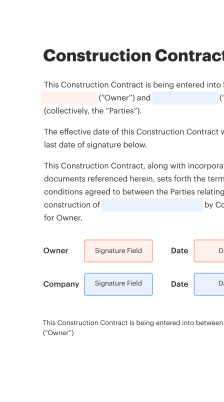
How online billing and signatures work for nonprofit invoices

Digital workflows enable remote signing, secure transmission, and automated storage of nonprofit medical bills while preserving legal validity under U.S. e-signature laws.

  • Prepare Document: Upload template and populate billing fields.
  • Authorize Signer: Set signer roles and authentication level.
  • Collect Signature: Signer receives secure link to review and sign.
  • Store Audit Trail: System logs timestamp, IP, and signer details.
Collect signatures
24x
faster
Reduce costs by
$30
per document
Save up to
40h
per employee / month

Quick setup steps to create your nonprofit medical bill format

Follow these essential steps to design a compliant, auditable medical bill format for nonprofit operations.

  • 01
    Define Fields: List patient, service, payer, discount, and grant fields.
  • 02
    Map Codes: Assign procedure and diagnosis codes where applicable.
  • 03
    Set Rules: Create rules for discounts, write-offs, and billing hierarchy.
  • 04
    Test Workflow: Pilot with sample visits and reconcile results.

Audit trail setup and ongoing management

Establish audit trail practices to preserve evidence of authorizations, adjustments, and access for nonprofit medical billing.

01

Enable Logging:

Turn on comprehensive event logging for all billing documents.
02

Define Retention:

Set retention periods consistent with grants and state laws.
03

Record Signer Details:

Capture signer name, email, IP address, and timestamp.
04

Attach Source Documents:

Link intake forms, eligibility proofs, and consents to invoices.
05

Regular Exporting:

Schedule periodic exports for backup and audit review.
06

Access Reviews:

Conduct quarterly permission audits for all billing users.
be ready to get more

Why choose airSlate SignNow

  • Free 7-day trial. Choose the plan you need and try it risk-free.
  • Honest pricing for full-featured plans. airSlate SignNow offers subscription plans with no overages or hidden fees at renewal.
  • Enterprise-grade security. airSlate SignNow helps you comply with global security standards.
illustrations signature

Recommended workflow settings for nonprofit billing automation

Configure these workflow settings to automate reminders, approvals, and storage for medical billing in nonprofit environments.

Setting Name and Configuration Header Configuration Value
Reminder Frequency for Overdue Bills 48 hours before due date, then repeat every 72 hours
Approval Workflow for Large Write-offs Require director approval for adjustments over $250
Automatic Charity Coding Rule Apply charity code when income threshold flagged
Signed Consent Storage Location Save to secure donor-grant folder
Audit Log Retention Period Retain logs for seven years

Device and platform considerations for signing and billing

Ensure templates and signing links work reliably on desktop, tablet, and mobile devices to accommodate field staff and remote patients.

  • Desktop Support: Modern browsers, secure cookies
  • Mobile Experience: Responsive design, touch signatures
  • Offline Capture: Local caching for field visits

Test the full workflow on representative devices used by intake, outreach clinicians, and administrative staff, verifying that authentication methods, required fields, and attachments render correctly across platforms and that signed documents upload to central storage reliably.

Security and authentication elements to include

Access Controls: Role-based user permissions
Encryption: AES-256 at rest and TLS in transit
User Authentication: Multi-factor authentication supported
Document Integrity: Tamper-evident audit logs
Data Segmentation: Patient data compartmentalization
Export Controls: Secure, logged data exports

Real-world nonprofit billing scenarios

Two representative case examples show how a clear medical bill format supports operations, compliance, and donor reporting.

Community Clinic Billing

A small community clinic used a standardized bill template to capture sliding-scale discounts and grant credits for each visit

  • Template included service codes, discount reason codes, and grant reference fields
  • This made reconciliation with restricted fund reports much faster and reduced manual adjustments

Resulting in cleaner audits and faster grant reimbursements for the clinic.

Mobile Health Outreach

A nonprofit mobile health program adopted an electronic bill format to collect patient consent and payment agreements onsite

  • The format auto-applied charity eligibility and logged staff attestations
  • Centralized storage allowed remote finance staff to batch-verify charges post-visit

Leading to accurate monthly financial statements and reduced claim denials across outreach sites.

Best practices for secure, compliant nonprofit medical billing

Implement these practices to improve accuracy, protect patient data, and reduce audit risk.

Standardize templates across programs
Use centrally managed, versioned templates to ensure all invoices include required fields for charity coding, grant identifiers, and compliance statements; maintain a change log and restrict template editing to authorized staff to prevent inconsistent billing language.
Enforce role-based permissions
Limit who can edit billing templates, apply discounts, or export financial records; require managerial approvals for large write-offs and run periodic access reviews to align system privileges with staffing changes.
Retain complete audit trails
Store signed documents, authentication metadata, and change histories for the retention periods required by funders and regulators; ensure exportable logs are available for audits and internal reviews.
Train staff on compliance and documentation
Provide regular training on documentation standards, privacy obligations under HIPAA, and correct use of the medical bill format to minimize errors and ensure consistent application of charity policies.

Frequently asked questions and troubleshooting tips

Answers to common questions about creating, sending, and securing a medical bill format for nonprofit organizations, with practical troubleshooting steps.

Feature availability: signNow compared with other major eSignature providers

A concise feature comparison showing common capabilities relevant to nonprofit medical billing and secure signature collection.

Feature Criteria and Vendor Columns signNow (Recommended) DocuSign Adobe Sign
HIPAA Compliance and Data Protection
Bulk Send Capability and Limits Yes, scalable Yes, limited tiers Yes, enterprise only
API Access and Integration Options REST API available REST API available REST API available
Audit Trail and Tamper Evidence
be ready to get more

Get legally-binding signatures now!

Retention and record-keeping timelines for nonprofit medical bills

Set clear retention timelines to meet grant, tax, and state record requirements while balancing storage costs and access needs.

Nonprofit Billing Document Retention Period:

Keep invoices and associated signed consents for at least seven years to satisfy most funding and tax audit requirements.

Audit Trail and Log Retention Requirements:

Retain detailed audit logs for seven years or according to funder-specific terms, ensuring logs include signer metadata and change histories.

Grant-specific Documentation Retention:

Follow grant agreements which may require retention for the grant life plus additional years; document exceptions and archival locations.

Patient Record Linkage Duration:

Keep invoice references linked to patient health records for the length required by state health record laws, typically five to seven years.

Scheduled Backup and Export Cadence:

Perform quarterly exports of invoicing ledgers and signed documents to secure offsite storage as part of disaster recovery plans.

Risks and potential compliance consequences

HIPAA Violations: Monetary penalties
Grant Noncompliance: Funding recoupment
Fraud Allegations: Legal exposure
Audit Failures: Operational sanctions
Data Breach: Notification obligations
Contract Breach: Service disruptions

Pricing and plan highlights across popular eSignature providers

Compare typical entry-level pricing, compliance availability, and notable plan features that matter for nonprofit medical billing operations.

Vendor Pricing and Core Features signNow (Recommended) DocuSign Adobe Sign PandaDoc Dropbox Sign
Starting Price (monthly per user) Starts at $8 per user per month, billed annually, entry plan available Starts at $10 per user per month, billed monthly or annually Starts at $12 per user per month as part of Acrobat web services Starts at $19 per user per month for eSign features in business plan Starts at $15 per user per month for basic e-sign functions
Free Trial and Onboarding Offers 14-day trial and self-serve onboarding resources included 30-day trial available for some plans Free trial with Adobe account; guides provided Free trial with product tutorials and templates Free trial with Dropbox account integration help
HIPAA-compliant Plan Availability HIPAA-ready configurations available upon request and BAA options offered HIPAA compliance available on select enterprise plans with BAA HIPAA support available via Adobe Sign enterprise and BAA HIPAA options available in higher-tier plans; BAA required Offers BAA for qualifying accounts through Dropbox Sign enterprise
Bulk Send and High-volume Pricing Bulk Send included with certain plans; scalable options for large batches Bulk Send available with volume-based pricing tiers Bulk sends possible via enterprise contracts and add-ons Bulk sending included in higher tiers with volume discounts Bulk send supported with Dropbox Sign enterprise pricing
API Access and Developer Resources Full REST API with SDKs and developer docs; reasonable usage quotas Extensive API, SDKs, and marketplace integrations; tiered rate limits API via Adobe Document Cloud with robust SDK support API access with developer docs and templates; enterprise features available REST API and developer guides; integrations with Dropbox ecosystem
walmart logo
exonMobil logo
apple logo
comcast logo
facebook logo
FedEx logo
be ready to get more

Get legally-binding signatures now!