Medical Receipt Generator for Construction Industry

Streamline your document management with airSlate SignNow's user-friendly solution. Enjoy cost-effective eSigning and document sharing tailored for your construction business.

Award-winning eSignature solution

What the medical receipt generator for construction industry does

A medical receipt generator for construction industry creates standardized, itemized receipts for on-site medical visits, first-aid treatments, and occupational health services. It captures patient identifiers, treatment details, dates, provider names, and cost breakdowns in a consistent format suitable for payroll, workers' compensation, and insurance workflows. When integrated with an eSignature and document management platform, receipts can be signed, time-stamped, and archived with an audit trail. Proper configuration reduces manual entry, improves record accuracy, and supports compliance obligations when personal health information is involved.

Why a construction-focused medical receipt generator matters

Using a specialized generator reduces billing errors, speeds administrative processing, and preserves consistent records for jobsite incidents and occupational health reporting.

Why a construction-focused medical receipt generator matters

Common operational challenges addressed

  • Inconsistent receipt formats cause processing delays with insurers and payroll providers, increasing administrative overhead.
  • Manual entry of treatment details introduces transcription errors and incomplete patient identifiers that complicate claims.
  • Unclear signature and timestamp records make it difficult to prove receipt authenticity during audits or disputes.
  • Fragmented storage across email, paper, and shared drives complicates retrieval and retention compliance for incidents.

Typical user roles and responsibilities

Site Safety Manager

Site Safety Managers use the generator to create accurate incident receipts that include date, treatment, and cost details. They ensure the record aligns with OSHA reporting requirements and coordinate follow-up documentation with HR and insurance providers to close out incidents promptly.

Occupational Nurse

Occupational Nurses capture medical observations and treatment codes, then generate signed receipts for patient records and employer files. The tool helps them maintain consistent clinical notes while minimizing duplicate data entry across health records and incident reports.

Who typically uses a construction medical receipt generator

Project managers, safety officers, and on-site medical staff rely on receipt generation to document incidents and medical care.

  • Site safety officers who document incidents and coordinate follow-up care with health providers.
  • Human resources teams that manage worker benefits, claims, and payroll adjustments after incidents.
  • Occupational health clinicians and contracted nurses providing on-site treatment and documentation.

Centralized receipt generation supports cross-team visibility, simplifies insurance submissions, and creates consistent records that safety, HR, and finance teams can use for audits and regulatory reporting.

Extended capabilities to consider for enterprise deployments

For larger construction firms, additional features provide scalability, auditability, and integration depth beyond basic receipt generation.

Template versioning

Version control for receipts preserves historical template definitions and ensures older records remain verifiable against the format used when generated, supporting audits and compliance reviews.


Role-based approvals

Multi-step approvals allow safety officers, clinicians, and HR to sign off in sequence, enforcing organizational controls and traceable authorization for medical expenses and incident closures.

Advanced authentication

Support for multi-factor methods and identity verification reduces risk of fraudulent signatures and increases confidence for insurers and legal reviewers when validating receipt origin.

Bulk processing

Bulk create and send capabilities handle multiple receipts from incident logs, allowing batch processing for mass events or routine occupational health visits to improve throughput.

Single sign-on (SSO)

SSO integration with corporate identity providers simplifies access management, enforces enterprise authentication policies, and reduces account administration overhead.

Records export and eDiscovery

Export tools and eDiscovery-ready indexing support legal holds and fast retrieval of receipts during investigations or claims litigation, maintaining chain-of-custody metadata.

be ready to get more

Choose a better solution

Core features for effective construction medical receipts

Look for features that ensure accuracy, auditability, and integration with payroll, HR, and claims systems when choosing a receipt generator.

Custom templates

Template builders let teams create jobsite-specific receipt layouts with predefined fields for diagnoses, treatment codes, and cost breakdowns so each receipt contains the information insurers and payroll need.

Field validation

Built-in validation enforces required fields and controlled vocabularies for medical codes and worker identifiers, reducing downstream errors and claim rejections due to incomplete data.

Audit trail

Comprehensive logs record creation, edits, signatures, and exports, providing a defensible timeline of actions for compliance reviews and incident investigations.

Integrations

Connectors for Google Docs, CRMs, and cloud storage streamline data flow between incident reports, HR systems, and document archives to reduce duplicate entry and accelerate processing.
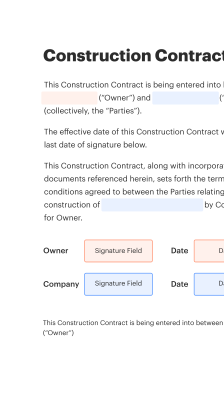
How online receipt generation and signing flows operate

A typical online workflow automates form population, signing, and secure storage to reduce manual handoffs and preserve evidentiary detail.

  • Upload or create: Start from a template or import an existing form.
  • Auto-fill: Populate fields from jobsite or HR data sources.
  • Obtain signatures: Use eSignature methods with authentication.
  • Store securely: Save signed receipts with timestamps and logs.
Collect signatures
24x
faster
Reduce costs by
$30
per document
Save up to
40h
per employee / month

Quick steps to generate a compliant medical receipt

Follow these practical steps to prepare and produce standardized medical receipts for construction-related care.

  • 01
    Prepare template: Add fields for patient, treatment, cost, and provider details.
  • 02
    Enter data: Fill incident and treatment information accurately.
  • 03
    Sign receipt: Collect provider and patient signatures with eSign.
  • 04
    Archive: Store with audit trail and retention metadata.
be ready to get more

Why choose airSlate SignNow

  • Free 7-day trial. Choose the plan you need and try it risk-free.
  • Honest pricing for full-featured plans. airSlate SignNow offers subscription plans with no overages or hidden fees at renewal.
  • Enterprise-grade security. airSlate SignNow helps you comply with global security standards.
illustrations signature

Configuring automated workflows for receipt generation

Recommended workflow settings help ensure receipts are generated, signed, and retained with minimal manual intervention.

Setting Name Configuration
Reminder Frequency 48 hours
Signing Order Provider then Patient
Data Retention Policy 7 years
Authentication Level MFA required
Template Locking Administrators only

Security controls and protections to look for

Encryption at rest: AES-256 encryption
Transport encryption: TLS 1.2+ in transit
Access controls: Role-based permissions
Audit logging: Immutable transaction trails
Authentication options: Multi-factor available
Data isolation: Tenant-level segregation

Construction use cases and examples

Two practical examples show how a receipt generator streamlines incident documentation and supports administrative workflows on worksites.

Jobsite First-Aid Visit

A worker receives on-site first-aid for a laceration with documented treatment time and materials used.

  • Auto-populated patient and employer fields reduce form completion time.
  • Ensures consistent cost and treatment entries for payroll and insurance.

Resulting in faster claims processing, clearer incident histories, and reduced follow-up administration for safety and HR teams.

Occupational Clinic Follow-Up

A referral to an occupational clinic is logged and the clinic issues a detailed receipt showing diagnosis and billed services.

  • Integrated templates capture procedure codes and clinician notes.
  • Improves accuracy for worker compensation claims and employer records.

Resulting in consistent medical documentation across providers, fewer disputes about services rendered, and streamlined reimbursement workflows.

Operational best practices for secure, accurate receipts

Adopt consistent procedures to protect sensitive information while ensuring receipts meet regulatory and payer requirements.

Standardize templates and required fields across sites
Use centrally managed templates to require key fields such as incident date, treatment code, clinician name, and cost breakdown. Standardization reduces variance between sites, supports consistent claims submissions, and simplifies audits by ensuring each receipt contains the same essential data elements.
Limit PHI exposure and apply least-privilege access
Restrict access to personal health information on a need-to-know basis and use role-based permissions. Minimizing who can view or export receipts helps reduce the risk of unauthorized disclosures and aligns access with operational responsibilities.
Maintain retention schedules and archival integrity
Define retention periods that meet legal and insurer requirements, automate archival to immutable storage where possible, and routinely test retrieval to ensure receipts remain accessible for audits or claims disputes.
Document authentication and audit readiness
Capture signature metadata, authentication method, and a secure audit trail for every receipt. Maintain administrative processes to reconcile and review receipts periodically to detect anomalies or incomplete records.

FAQs and troubleshooting for medical receipt generation

Common questions and practical troubleshooting steps for generating, signing, and storing medical receipts on construction projects.

Feature availability across major eSignature providers

A concise availability comparison shows how common features align across leading providers for construction medical receipts.

Core Feature Availability and Limits signNow (Recommended) DocuSign Adobe Sign
Two-factor Authentication
Bulk Send / Batch Signing
HIPAA-compliant configurations Available Available Available
Template API access Full API Full API Full API
be ready to get more

Get legally-binding signatures now!

Compliance risks and potential penalties

HIPAA violations: Civil penalties
Incorrect billing: Claim denials
Insufficient audit logs: Regulatory scrutiny
Unauthorized access: Data breach costs
Retention failures: Noncompliance fines
Inaccurate records: Legal exposure

Pricing snapshot for common entry and security features

Overview of starting prices and common plan attributes to help compare baseline costs and included capabilities.

Plan and Pricing Comparison signNow (Recommended) DocuSign Adobe Sign OneSpan PandaDoc
Starting Monthly Price $8/user $10/user $9.99/user $25/user $19/user
Free Trial 7 days 30 days 30 days 14 days 14 days
Included Signatures Per Month Unlimited on plans Tiered limits Tiered limits Tiered limits Unlimited on plans
Enterprise Security Features SOC 2, HIPAA support SOC 2, HIPAA support SOC 2, HIPAA support FIPS, enterprise PKI SOC 2, HIPAA support
API Availability and Limits Full API, generous quotas Full API, standard quotas Full API Developer API offerings Full API, documented limits
walmart logo
exonMobil logo
apple logo
comcast logo
facebook logo
FedEx logo
be ready to get more

Get legally-binding signatures now!