Merge Digital Signature Business Requirements Document Template BRD

Eliminate paper and automate document processing for higher performance and limitless opportunities. eSign anything from a comfort of your home, fast and professional. Experience the best strategy for running your business with airSlate SignNow.

Award-winning eSignature solution

Overview of the merge digital signature business requirements document template brd

The merge digital signature business requirements document template brd is a structured template and workflow pattern used to combine document merging with electronic signature collection for Business Requirements Documents (BRDs). It standardizes sections, embeds merge fields for dynamic data population, and defines signer roles and signing order. The template supports conditional fields, reusable components, and audit logging to capture who signed what and when. Used correctly, it reduces manual assembly, ensures consistent BRD formatting, and integrates with common document stores and CRMs to automate distribution and archival.

Why use a merged digital-signature BRD template

A merged digital-signature BRD template reduces assembly errors, preserves version control, and enforces consistent signer workflows while supporting compliance and traceability requirements across projects.

Why use a merged digital-signature BRD template

Common challenges addressed by the template

  • Manual copy-paste of client data into BRDs causes inconsistencies and delays that increase review cycles.
  • Unclear signer order and missing signature fields lead to rejected approvals and project deadlock.
  • Lack of standardized templates complicates audits and makes compliance reporting time-consuming.
  • Inefficient storage and naming conventions make retrieval and retention for regulatory audits difficult.

Representative user profiles

Product Manager

Creates the BRD framework, assigns reviewer and signer roles, and approves final content. Responsible for ensuring merge fields map to source systems and for coordinating version-controlled sign-offs across stakeholders.

IT Administrator

Configures integrations, enforces encryption and retention policies, and manages API keys for automated merging. Ensures compliance settings and user permissions align with enterprise security controls.

Typical teams and roles that use the template

Product, project, and delivery teams use merged BRD templates to streamline requirements sign-off and maintain a single source of truth for scope and acceptance criteria.

  • Product managers coordinating stakeholder reviews and approvals across departments.
  • Business analysts assembling standardized requirement sections and change logs.
  • Legal and compliance teams verifying signature evidence and archival integrity.

The template supports cross-functional workflows and provides consistent artifacts for procurement, legal review, and project governance.

Essential tools for effective merged BRD workflows

A complete merged BRD feature set includes template management, field merging, signer controls, automation, auditability, and storage integration.

Template Library

Centralized storage for approved BRD templates with version control, role-based editing, and templating rules to ensure consistency across teams and projects.


Merge Fields

Dynamic placeholders that map to external data sources, CSV imports, or API responses to auto-populate client and project-specific values.

Signing Controls

Flexible signer assignment, sequential or parallel signing, signer authentication options, and visible signing order for governance.

Workflow Automation

Triggers for sending documents, scheduled reminders, conditional routing, and integrations that reduce manual handoffs in the BRD lifecycle.

Audit and Reporting

Comprehensive logs capture every action, timestamps, IP addresses, and certificate details for compliance and dispute resolution.

Storage & Retention

Policies for automatic archival, retention schedules, and secure export to enterprise repositories for legal hold and audits.

be ready to get more

Choose a better solution

Integrations and template customization options

Integrations with document editors and storage platforms reduce manual steps when merging data into BRD templates and simplify signature collection.

Google Docs

Create and edit BRD content in Google Docs then use the merge connector to populate fields from spreadsheets or CRM systems before routing for signature.

CRM Integration

Pull account and opportunity data directly into BRD templates, auto-fill client details, and attach signed BRDs to CRM records for traceability.

Dropbox

Store and retrieve template versions from Dropbox, enable merged output to be saved automatically, and manage retention through folder policies.

Custom Templates

Build reusable BRD templates with conditional sections, custom merge tags, and standardized headers to enforce organization-wide documentation standards.
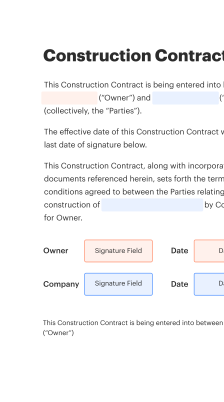
How to create and use a merged BRD online

The online process ties a template to data sources, configures signer steps, and automates signature collection through secure channels.

  • Create Template: Upload base BRD and define merge placeholders.
  • Connect Data: Link CRM, spreadsheet, or API to populate fields.
  • Configure Workflow: Set signing order, reminders, and authentication.
  • Collect Signatures: Monitor signing progress and archive final PDF.
Collect signatures
24x
faster
Reduce costs by
$30
per document
Save up to
40h
per employee / month

Step-by-step: Complete a merged BRD template with digital signatures

Follow these core steps to prepare, merge, route, and finalize a business requirements document with electronic signatures and a maintained audit trail.

  • 01
    Prepare Template: Set static sections and placeholders for dynamic fields.
  • 02
    Map Merge Fields: Link placeholders to data sources or CSV columns.
  • 03
    Assign Signers: Define roles, signing order, and authentication methods.
  • 04
    Send and Finalize: Dispatch for signature and capture the completed audit trail.

Audit trail management: steps to capture and review evidence

Follow these operational steps to ensure every merged BRD signing event is captured, stored, and reviewable for compliance or dispute resolution.

01

Capture Event:

Record every action with timestamp
02

Timestamping:

Use UTC timestamps for consistency
03

Signer Identification:

Log authentication method details
04

Document Snapshot:

Archive final PDF with metadata
05

Access Log:

Track downloads and views
06

Retention Policy:

Apply legal retention schedules
be ready to get more

Why choose airSlate SignNow

  • Free 7-day trial. Choose the plan you need and try it risk-free.
  • Honest pricing for full-featured plans. airSlate SignNow offers subscription plans with no overages or hidden fees at renewal.
  • Enterprise-grade security. airSlate SignNow helps you comply with global security standards.
illustrations signature

Typical workflow configuration for merged BRD templates

Use these common workflow settings when automating the merge, routing, and signature collection for BRDs to ensure predictable behavior.

Workflow Setting Name and Description Default configuration values for each setting
Email Reminder Frequency Before Due Date 48 hours; two reminders
Signing Order and Routing Rules Sequential with optional parallel groups
Automatic Document Archival Location Save to enterprise folder
Merge Field Conflict Handling Rules Source precedence wins
Authentication Method for External Signers Email OTP or SMS OTP

Supported platforms and device considerations

Merged BRD templates and signing workflows should work across modern web browsers, mobile devices, and tablets to accommodate distributed teams and external signers.

  • Desktop Browsers: Chrome, Edge, Safari
  • Mobile Devices: iOS and Android supported
  • Tablets: Responsive signing UI

For large enterprises, confirm browser policies, single sign-on compatibility, and mobile authentication requirements with IT to ensure consistent signing experiences and secure access across all devices.

Key security controls and protections

Encryption at Rest: AES-256 encryption
Encryption in Transit: TLS 1.2+ transport
Two-Factor Authentication: Optional for signers
Role-Based Access: Granular permission sets
Document Redaction: Selective data masking
Audit Logging: Immutable event records

Industry examples using merged BRD templates

Two concise case examples show practical uses of merged BRD templates for different industries and outcomes.

Healthcare Procurement

A hospital procurement team used a merged BRD template to populate vendor and device specifications automatically from an internal catalog

  • Reduced manual entry and improved accuracy for device lists
  • Accelerated approvals and strengthened auditability

Resulting in faster vendor onboarding and clearer compliance records.

SaaS Product Rollout

A software company generated BRDs that merged client account data and technical requirements from CRM

  • One-click population of customer-specific integration points
  • Fewer review cycles and reduced rework during acceptance testing

Leading to predictable delivery timelines and cleaner contract archives for audits.

Best practices for secure and accurate merged BRDs

Adopt consistent processes to reduce errors, improve security, and maintain auditable documentation when using merged digital-signature BRD templates.

Define and Enforce Template Governance
Use a central template library with version control and approval gates so only validated BRD templates are used in production workflows, reducing the risk of inconsistent or outdated content.
Standardize Merge Field Naming Conventions
Adopt predictable merge tag names and document mapping rules to prevent mispopulation, especially when templates are sourced from multiple teams or integrated systems.
Select Appropriate Signer Authentication
Match signer authentication level to the BRD sensitivity; use multi-factor or identity verification for high-value contracts and standard email authentication for lower-risk approvals.
Retain Complete Audit Trails
Ensure every signed BRD includes immutable timestamps, signer IP addresses, and change logs to support compliance requirements and defend against disputes.

FAQs and troubleshooting for merged BRD templates

Answers to common problems and troubleshooting tips that arise when merging data into BRDs and collecting digital signatures.

Feature availability: signNow (Recommended) versus DocuSign

A focused comparison of key capabilities for merged BRD templates and signature workflows highlights availability and technical differences between two leading providers.

Feature Availability and Technical Detail signNow (Recommended) DocuSign
Audit Trail
Bulk Send
Native Google Docs Add-on Limited
HIPAA Compliance Available
API Availability REST API REST API
be ready to get more

Get legally-binding signatures now!

Document retention and key deadlines for BRD records

Establish retention milestones and review dates that align with legal, project, and audit requirements for signed BRD documents.

Initial Retention Review Period:

30 days after signing

Standard Retention Duration:

7 years per corporate policy

Legal Hold Trigger:

Upon litigation notice

Periodic Audit Checkpoint:

Annual compliance review

Secure Deletion Schedule:

After retention expiry

Risks and compliance penalties to consider

Noncompliance Fines: Monetary penalties
Breach Notification: Mandatory disclosures
Contract Disputes: Invalid signatures
Operational Delays: Project hold-ups
Reputational Damage: Customer trust loss
Data Retention Violations: Regulatory sanctions

Pricing snapshot across common eSignature providers

Compare entry-level pricing and selected commercial features across common eSignature platforms to evaluate cost and capabilities relevant to merged BRD use cases.

eSignature Platform Comparison signNow (Recommended) DocuSign Adobe Sign HelloSign PandaDoc
Entry-level Monthly Price $8/user $10/user $9.99/user $15/user $19/user
Free Trial Available Yes Yes Yes Yes Yes
HIPAA Compliance Option Available Available Available Not Available Available
API Access Included Add-on Included Included Add-on
Bulk Send Capability Included Add-on Add-on Included Add-on
Document Storage Unlimited Limited Limited Limited Limited

Simplify complex workflows

Create, execute, and manage workflows of any complexity, electronically from virtually anywhere. Scalable eSignature capabilities allow you to share documents with the right people in the correct order and define roles for each recipient. Execute document workflows faster and easier than ever before.

Automate document management

Optimize complex signing processes with airSlate SignNow’s powerful features to enhance your business. Control your automated eSignature workflows to ensure they're running at peak performance with instant notifications and reminders.

Optimize in team collaboration

Bring teams together in a secure, shared environment. Manage documents, use form templates and notifications to create more efficient cross-organization collaboration. Free your employees from having to spend time on repetitive activities so that they can focus on valuable, business-critical tasks.

Integrate into your existing systems

Run your projects with industry-leading integration. Collect Salesforce, Microsoft Teams, and SharePoint all in one business flow. Connect your software to a single system for endless possibilities and more productivity.

Stay compliant with industry-leading data protection

Feel confident knowing that your information is protected by the most recent in encryption security. airSlate SignNow is GDPR and eIDAS compliant and provides you visibility into your signing process with court-admissible audit trails. Set up user access permissions and rights to regulate who has access to what.


walmart logo
exonMobil logo
apple logo
comcast logo
facebook logo
FedEx logo
be ready to get more

Get legally-binding signatures now!