Merge Observer Placeholder for Secure eSignatures

Get rid of paper and automate digital document processing for higher productivity and endless opportunities. Sign anything from your home, quick and accomplished. Discover the perfect way of running your business with airSlate SignNow.

Award-winning eSignature solution

What a merge observer placeholder is and how it works

A merge observer placeholder is a template element used to identify, monitor, and merge external data into a document at the moment a document is generated or sent for signature. It acts as a dynamic field that listens for incoming values from data sources—CRM records, spreadsheets, or API payloads—and replaces the placeholder with validated content when the document is prepared. In eSignature workflows, the merge observer placeholder helps ensure that recipient-specific fields populate automatically, reducing manual entry and keeping templates consistent across multiple sends and recipients.

Why using merge observer placeholder matters in document workflows

A merge observer placeholder reduces manual editing and improves data accuracy by automating field population in templates. It streamlines multi-recipient and repeat-document workflows and integrates with data sources to lower processing time and human error.

Why using merge observer placeholder matters in document workflows

Common challenges addressed by merge observer placeholder

  • Inconsistent source data can cause incorrect merges and visible placeholder text in final documents.
  • Complex conditional logic for recipient fields often requires extra template rules and testing.
  • Late-arriving data from third-party systems can delay document preparation and signing windows.
  • Improper formatting of merged values can break downstream validations or regulatory fields.

Typical user profiles for merge observer placeholder

Sales Operations

Sales operations specialists configure templates, map CRM fields to placeholders, and validate merged outputs. They ensure each contract reflects account-specific terms and pricing and coordinate with IT for data source connections and scheduled batch sends.

HR Administrator

HR administrators create and maintain onboarding templates, define placeholders for employee data, and confirm merged documents meet internal policy and regulatory requirements before distribution and signature collection.

Teams and roles that commonly use merge observer placeholder

Legal, HR, sales operations, and customer onboarding teams use placeholders to standardize documents and reduce manual population work.

  • Sales operations for contract generation across account types and territories.
  • Human resources for offer letters, onboarding packages, and benefits enrollment forms.
  • Legal and compliance teams for standardized contract clauses and regulated disclosures.

Operational use typically leads to fewer reissues, more consistent document sets, and clearer audit trails for signature events.

Extended capabilities around merge observer placeholder

Beyond basic merging, these capabilities support complex workflows, conditional logic, and enterprise integrations to scale template-driven document production.

Conditional merges

Apply conditional rules so placeholders populate only when specified criteria are met, enabling different document variants from a single template without manual edits.


Multi-source mapping

Merge observer placeholder can be configured to pull data from multiple systems and resolve priority rules when fields exist in more than one source.

Template versioning

Maintain version history for templates so past documents remain reproducible and new placeholder changes do not alter signed archives.

Premerge validation engine

Run validation checks before finalizing a merge to identify missing fields, formatting issues, or values that violate business rules and halt sends if necessary.

Webhook and callbacks

Use webhooks to notify downstream systems when a merge completes, enabling synchronous processes such as CRM updates or downstream provisioning.

Role-based placeholder control

Limit who can edit placeholder mappings and template behavior using granular permissions to reduce configuration errors in shared accounts.

be ready to get more

Choose a better solution

Core features that make merge observer placeholder effective

These features help template managers and administrators reliably connect data sources, enforce formatting, and preserve an auditable history for each merge event.

Dynamic field mapping

Supports mapping from multiple data sources including CRM records, spreadsheets, and API payloads with conditional rules to select the correct value for each recipient and document instance.

Validation rules

Allow template owners to enforce formats like date, numeric ranges, and enumerations so merged content meets document requirements and reduces post‑merge corrections.

Conditional visibility

Placeholders can drive conditional rendering so fields only appear when criteria are met, keeping documents concise and preventing unnecessary data exposure.

Audit-ready logs

Every merge action produces a timestamped record showing source, value, and user context to support compliance and dispute resolution.
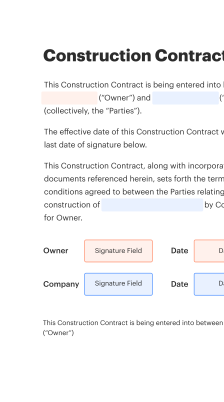
How the merge observer placeholder operates during document generation

Understanding the runtime behavior helps avoid common errors and ensures that placeholders receive correct values when a document is assembled.

  • Listen: The placeholder checks incoming payloads for matching field names.
  • Validate: Built-in rules verify format and presence of required data.
  • Replace: Valid values replace the placeholder in the final document.
  • Log: Each merge event records a timestamped audit entry.
Collect signatures
24x
faster
Reduce costs by
$30
per document
Save up to
40h
per employee / month

Quick setup steps for a merge observer placeholder

Follow these core steps to create and validate a merge observer placeholder in a template before using it in live sends.

  • 01
    Define placeholder: Create a uniquely named placeholder tag in the document template.
  • 02
    Map data: Connect the placeholder to a source field from CRM or upload CSV mappings.
  • 03
    Set validation: Apply formatting rules and required checks for merged values.
  • 04
    Test merge: Run sample merges and confirm output before production use.
be ready to get more

Why choose airSlate SignNow

  • Free 7-day trial. Choose the plan you need and try it risk-free.
  • Honest pricing for full-featured plans. airSlate SignNow offers subscription plans with no overages or hidden fees at renewal.
  • Enterprise-grade security. airSlate SignNow helps you comply with global security standards.
illustrations signature

Typical workflow settings for merge observer placeholder automation

These workflow settings represent a typical configuration set for automated merge-and-send operations using placeholders.

Setting Name Configuration Value and Notes
Automatic Field Mapping Rules for Templates Auto-map by field name
Merge Observer Trigger Frequency Setting On document creation
Fallback Value Handling for Missing Data Use default or flag error
Recipient Field Lock and Edit Permissions Lock by role
Reminder and Escalation Workflow Timing 48 hours then escalate

Supported platforms and technical requirements

Merge observer placeholder functionality is supported across modern browsers and the main signNow desktop and mobile clients, with recommended minimum versions for best results.

  • Desktop browsers: Chrome, Edge, Firefox supported
  • Mobile operating systems: iOS and Android recent versions
  • API client requirements: TLS 1.2 support required

For mobile and tablet use, keep the app updated to the latest release and verify network connectivity; for API integrations, ensure TLS and OAuth tokens are current and that payload sizes fall within documented limits to avoid merge failures.

Security and authentication features relevant to merge observer placeholder

Data encryption: End-to-end encryption
Access controls: Role-based permissions
Audit logging: Immutable event records
API authentication: OAuth 2.0 tokens
Transport security: TLS encrypted channels
Storage protection: Encrypted at rest

Industry use cases showing merge observer placeholder in practice

The merge observer placeholder helps organizations in regulated and high-volume environments automate personalized document production while maintaining data fidelity and an audit-ready trail.

Sales contract batch sends

An enterprise prepares 500 personalized sales contracts from CRM records in a single batch, using placeholders for pricing and client info

  • Templates map CRM account fields to contract clauses
  • Automation reduces manual entry errors and accelerates signature cycles

Resulting in faster deal closure and fewer reissued agreements.

Employee onboarding packets

A human resources team generates individualized onboarding packets that combine offer letters and benefits forms into one package

  • Placeholders pull employee name, tax info, and role details
  • Automated merging ensures forms are prefilled and consistent across hires

Leading to reduced onboarding time and clear compliance records.

Operational best practices for reliable merge observer placeholder usage

Adopting consistent configuration and validation practices minimizes merge failures and supports compliance requirements across departments.

Confirm data source mapping before running bulk merges
Always verify field names, data types, and sample values from the source system before executing a large merge to prevent incorrect population or template corruption.
Use strict validation rules for regulated fields and legal clauses
Apply format checks and required-field settings for tax IDs, dates, and contract amounts so merged documents comply with internal policy and external regulations.
Maintain versioned templates and change logs for placeholders
Track template revisions and the evolution of placeholder names so historic documents remain auditable and new sends use the intended field mappings.
Run staged tests with sample datasets before production sends
Test merges with a representative dataset to catch formatting issues or missing values early, and confirm the final document layout and signature placement.

Common problems and troubleshooting for merge observer placeholder

This FAQ-style troubleshooting section covers frequent issues with placeholders, merge failures, and validation errors, plus practical remediation steps.

Capabilities comparison: merge observer placeholder support

This table compares merge observation and real-time merge support among leading eSignature platforms, with signNow listed first as Recommended.

Criteria for merge observation comparison signNow (Recommended) DocuSign Adobe Sign
Supports placeholder observation
Real-time merge updates Requires configuration
Bulk merge capacity High volume batches High volume batches Medium to high
Webhook support for merges
be ready to get more

Get legally-binding signatures now!

Compliance risks and penalties to be aware of

Incorrect data merges: Contract disputes
Missing consent records: Regulatory fines
Weak access controls: Unauthorized access
Insufficient audit trail: Disallowed evidence
Non‑compliant data handling: Breach notifications
Retention policy violations: Legal exposure

Pricing and plan comparison for merge-related features

High-level pricing and plan differences for platforms that support placeholder merging and automation; signNow is listed first as Recommended for comparison.

Starting monthly price per user signNow (Recommended): From $8/user/mo DocuSign: From $10/user/mo Adobe Sign: From $14.99/user/mo Dropbox Sign: Free tier; paid from $15/user/mo PandaDoc: From $19/user/mo
Free plan or trial availability signNow: Free trial available DocuSign: Free trial available Adobe Sign: Trial via Adobe Dropbox Sign: Free tier PandaDoc: Free trial
API access included signNow: API included with paid plans DocuSign: API available on paid plans Adobe Sign: API available with plans Dropbox Sign: API on paid tiers PandaDoc: API included with business tiers
Bulk send / batch merge signNow: Batch merge supported DocuSign: Bulk send options Adobe Sign: Bulk send features Dropbox Sign: Limited bulk features PandaDoc: Bulk actions supported
HIPAA support options signNow: HIPAA-ready agreements available DocuSign: BAA available for qualifying plans Adobe Sign: HIPAA support via enterprise Dropbox Sign: BAA on enterprise PandaDoc: Not standard
Audit trail and compliance features signNow: Detailed audit logs included DocuSign: Comprehensive audit trails Adobe Sign: Full audit records Dropbox Sign: Audit logs available PandaDoc: Audit features present

Simplify complex workflows

Create, execute, and manage workflows of any complexity, electronically from virtually anywhere. Scalable eSignature capabilities allow you to share documents with the right people in the correct order and define roles for each recipient. Execute document workflows faster and easier than ever before.

Automate document management

Optimize complex signing processes with airSlate SignNow’s powerful features to enhance your business. Control your automated eSignature workflows to ensure they're running at peak performance with instant notifications and reminders.

Optimize in team collaboration

Bring teams together in a secure, shared environment. Manage documents, use form templates and notifications to create more efficient cross-organization collaboration. Free your employees from having to spend time on repetitive activities so that they can focus on valuable, business-critical tasks.

Integrate into your existing systems

Run your projects with industry-leading integration. Collect Salesforce, Microsoft Teams, and SharePoint all in one business flow. Connect your software to a single system for endless possibilities and more productiveness.

Stay compliant with best-in-class data protection

Feel safe with the knowledge that your data is protected by the newest in encryption security. airSlate SignNow is GDPR and eIDAS compliant and offers you awareness into your signing procedure with court-admissible audit trails. Set up user authorization and roles to manage who has access to what.


walmart logo
exonMobil logo
apple logo
comcast logo
facebook logo
FedEx logo
be ready to get more

Get legally-binding signatures now!