Move Radio Button Field with SignNow

Get rid of paperwork and improve digital document management for higher productivity and unlimited possibilities. Enjoy a better manner of doing business with airSlate SignNow.

Award-winning eSignature solution

What the move radio button field does

The move radio button field is a configurable form element used when preparing digital documents to capture a single choice among options. In eSignature platforms like signNow the field behaves as part of a mutually exclusive group, so relocating one radio option can affect grouping, tab order, and required validation. Moving the field is typically done in a document editor or template builder with drag-and-drop controls, precise alignment tools, and snapping options to keep layout consistent across devices and exports. Proper placement ensures signer clarity and preserves the integrity of automated workflows and data extraction.

Why repositioning radio fields matters

Accurate placement reduces signer mistakes and supports logical tab order, improving completion rates and reducing rework while preserving validation rules and conditional logic in document workflows.

Why repositioning radio fields matters

Roles that interact with radio field placement

Template Admin

Template Admins design and finalize document layouts, including precise placement of radio button fields. They are responsible for grouping options, setting permissions to lock fields, and validating preview behavior across devices to maintain consistent signer experience and data integrity.

Signer

Signers interact with radio button fields during the signing process; while most platforms do not permit signers to move fields, signers rely on proper placement to make accurate selections, so signer-focused testing helps ensure clarity and reduces signature or selection errors.

Core tools for managing radio button placement

Platforms provide specific tools to move and manage radio button fields; these features reduce layout errors and preserve form logic across signers and templates.

Drag-and-drop

Directly reposition radio options with the pointer or touch; preserves grouping and updates tab order automatically to maintain a logical signing flow across devices and templates.


Snap-to-grid

Align fields using a grid or guides to ensure consistent spacing and alignment across pages, which helps when exporting PDFs or when multiple signers use different screen sizes for signing.

Field grouping

Group radio options under a common name so only one option can be selected; moving one option keeps the group intact and preserves mutual exclusivity and validation rules.

Multi-device sync

Changes made to radio field placement sync across the cloud, ensuring templates and live documents reflect updated positions whether edited on desktop, tablet, or mobile.

Permission controls

Restrict who can move or lock fields at the template level to avoid accidental edits and preserve approved document layouts across teams and workflows.

Template reuse

Save positioned radio fields within templates for repeatable use, reducing setup time while keeping option placement and grouping consistent for recurring documents.

be ready to get more

Choose a better solution

Integrations that help with radio field placement and data flow

Integration points make it easier to position radio fields and route their values into other systems for streamlined workflows.

Google Docs

Insert and position radio fields when importing from Google Docs; mapped values can automatically populate form fields in the eSignature platform and be exported back to document metadata for recordkeeping and downstream processing.

Salesforce CRM

Place radio fields in templates used for quotes and approvals; option selections sync to Salesforce fields so sales and ops teams see signer choices without manual data entry.

Dropbox integration

When documents are stored in Dropbox, positioned radio fields remain intact during file transfers and automated workflows; completed selections can be saved back to the same storage location.

REST API

Programmatically adjust field coordinates or apply template versions; the API enables automated repositioning and field management in bulk for large-scale document operations.
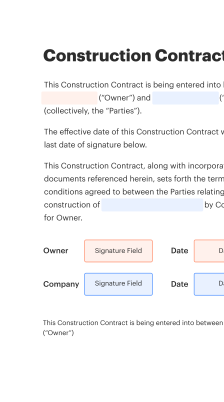
How to create and reposition radio fields online

Overview of creating a radio button group and adjusting individual options for clarity and workflow logic.

  • Add Field: Insert a radio button group into the document.
  • Group Options: Assign options to the same group name for exclusivity.
  • Move Field: Drag or nudge individual options to new positions.
  • Lock and Test: Lock placement and run a preview to verify behavior.
Collect signatures
24x
faster
Reduce costs by
$30
per document
Save up to
40h
per employee / month

Quick setup: reposition a radio button field

A concise step sequence for moving a radio button field in a template or live document editor.

  • 01
    Open editor: Load the document in the platform editor view.
  • 02
    Select field: Click the radio option to highlight it.
  • 03
    Drag to position: Use drag-and-drop or arrow keys to move field.
  • 04
    Save changes: Lock the field and save the template or document.

Audit trail steps for moved radio field events

Maintain an audit trail that captures moves, who made them, and associated timestamps for compliance and dispute resolution.

01

Enable audit logging:

Turn on change-event capture.
02

Capture events:

Record edits, moves, and saves.
03

Timestamp actions:

Log precise date and time.
04

Record actor identity:

Include user ID and role.
05

Export logs:

Produce reports for audits.
06

Retain records:

Store logs per retention policy.
be ready to get more

Why choose airSlate SignNow

  • Free 7-day trial. Choose the plan you need and try it risk-free.
  • Honest pricing for full-featured plans. airSlate SignNow offers subscription plans with no overages or hidden fees at renewal.
  • Enterprise-grade security. airSlate SignNow helps you comply with global security standards.
illustrations signature

Automation settings affecting field movement

Configure workflow defaults so moved radio fields behave predictably during sends, reminders, and automated routing.

Workflow Setting Name and Configuration Header Setting Value
Reminder Frequency for Document Notifications 48 hours
Field Locking Behavior After Positioning Enabled
Conditional Logic Triggering Based On Selection On selection
Bulk Send Template Field Positioning Template-locked
API Key Scope For Field Editing Field edit only

Repositioning radio fields on mobile, tablet, and desktop

Editor capabilities differ by device, so confirm supported platforms and browser versions before editing field placement.

  • Desktop browsers: Latest Chrome, Edge, Safari supported.
  • Mobile apps: iOS and Android apps support drag-and-drop.
  • Tablet interaction: Touch gestures and precision controls available.

When precise alignment is required, use desktop editors for pixel-level control; mobile and tablet tools are suitable for quick edits, verification, and signer-facing adjustments on the go.

Security controls impacting radio field edits

Encryption at rest: AES-256 encrypted
TLS in transit: TLS 1.2+ transport
Access controls: Role-based permissions
Audit logging: Field-change events tracked
Two-factor authentication: Optional 2FA for editors
HIPAA readiness: BAA available upon request

Industry examples using moved radio fields

Real-world scenarios show how correct radio field placement supports business logic and compliance across industries.

Healthcare intake forms

Clinics use radio groups to record a single patient choice in intake forms, ensuring consistent data capture across visits

  • Pre-positioned radio fields reduce signer confusion during check-in
  • This improves data accuracy for EHR integration and billing systems

Resulting in clearer consent records and reduced administrative follow-up time for clinical teams.

Sales approval routing

A sales operations team embeds radio buttons for approval levels in quote templates to standardize decision inputs

  • Correct placement ties each option to the right label and signature area
  • That selection maps to CRM fields to trigger conditional workflows and notifications

Leading to fewer exceptions, faster approvals, and improved tracking of authorization decisions in audit logs.

Best practices for secure and accurate radio field movement

Follow these practices to reduce errors when repositioning radio fields in templates or live documents.

Place fields near related content and labels
Position radio options adjacent to the question or choice label to reduce signer confusion; ensure labels remain readable at common device sizes and check alignment in preview modes to confirm the relation between option and label before saving the template.
Use grouping and consistent names for related options
Assign a consistent group name to all related radio buttons so moving one option preserves mutual exclusivity; avoid duplicating group names across unrelated questions to prevent selection conflicts when signers navigate the form.
Lock and version templates after layout changes
Once radio fields are positioned and validated, lock the template or create a new version to prevent inadvertent edits; maintain a version history so you can revert or audit previous layouts if disputes arise.
Test on multiple devices and with sample signers
Run previews on desktop, tablet, and mobile to confirm visual alignment and tab order; perform end-to-end tests with sample signers to validate that moved radio fields behave correctly and that selections map to data exports or integrations.

Common issues and FAQ about moving radio fields

Answers to frequent questions and troubleshooting steps when repositioning radio button fields in templates or documents.

Comparing move field support across platforms

A concise feature comparison showing availability and technical behavior for repositioning radio button fields on major eSignature vendors.

Feature and Compliance Criteria Table signNow (Featured) DocuSign Adobe Acrobat Sign
Move Field Availability and Behavior
Locking field positions after edit
API support for field coordinates
Mobile editor support for repositioning Limited
be ready to get more

Get legally-binding signatures now!

Storage and retention considerations for edited templates

Retention and deletion rules should reflect legal and operational needs for documents that include moved radio fields.

Retention period for signed documents:

Seven years standard

Template version retention policy:

Retain for three years

Legal hold procedures:

Freeze relevant records

Backup frequency for templates:

Daily snapshot

Deletion workflow for retired templates:

Archival then delete

Risks and legal considerations when moving fields

Invalid signature risk: Misplaced fields may cause invalidation
Misplaced fields: Confusing layout leads to signer errors
Data exposure: Incorrect mapping could leak data
Non-compliance fines: Regulatory violations carry penalties
Audit gaps: Missing change logs harm proof
Unauthorized edits: Weak permissions enable tampering

Pricing and feature comparison relevant to field management

High-level pricing and capability comparison for vendors, focused on features that affect field placement, templates, and API access.

Pricing header and vendor lineup signNow (Featured) DocuSign Adobe Acrobat Sign PandaDoc Dropbox Sign
Monthly starting price (billed annually) Starts at $8/user/month Starts at $10/user/month Starts at $9.99/user/month Starts at $19/user/month Starts at $15/user/month
Free plan availability and limits Limited free trial Free trial only Free trial only Free plan with limits Free tier with limits
Bulk Send and template scaling Bulk Send available Bulk Send available Bulk options via plans Bulk send included Bulk send available
API access and developer tools Full REST API available Full API with SDKs REST API and integrations API available REST API available
Enterprise compliance features BAA, SSO available Advanced compliance add-ons Enterprise security suites HIPAA available on plans Enterprise controls available

Make simpler challenging workflows

Prepare, perform, and control workflows of any difficulty, digitally from virtually anywhere. Scalable electronic signature functionality enable you to share papers with the right users the right way and set up roles for each recipient. Perform document workflows faster and easier than ever before.

Automate document management

Enhance sophisticated signing tasks with airSlate SignNow�s powerful functions to boost your operation. Manage your automatic signature workflows to make sure they're running at maximum efficiency with fast notices and alerts.

Enhance in team communication

Get teammates together in a safe, shared environment. Manage paperwork, use form templates and notices to create more efficient cross-organization communication. Relieve your staff from having to hang out on repeated activities to enable them to give attention to valuable, business-crucial activities.

Integrate into your current network

Manage your assignments with market-leading integration. Capture Salesforce, Microsoft Teams, and SharePoint all in one business flow. Connect your applications to a single environment for unlimited opportunities and higher productivity.

Stay compliant with best-in-class data security

Feel safe knowing that your data is protected by the most recent in encryption security. airSlate SignNow is GDPR and eIDAS compliant and gives you exposure into your signing process with court-admissible audit trails. Set up user access permissions and roles to regulate who has access to what.


walmart logo
exonMobil logo
apple logo
comcast logo
facebook logo
FedEx logo
be ready to get more

Get legally-binding signatures now!