Move Text Field with SignNow's eSignature Solution

Eliminate paper and automate digital document management for higher performance and unlimited possibilities. Experience the perfect strategy for running your business with airSlate SignNow.

Award-winning eSignature solution

What the move text field means in eSignature documents

The move text field is a document form element that can be repositioned, relocated or programmatically adjusted within a digital document during preparation or as part of a signing workflow. In eSignature platforms this capability supports layout corrections, dynamic content placement, and adaptive templates that respond to variable-length fields. Proper handling preserves data integrity, ensures consistent rendering across devices, and reduces post-signature edits. Vendors such as signNow support field movement within templates and envelopes while maintaining audit trails and metadata so changes are recorded for compliance and troubleshooting purposes.

Legal validity and compliance considerations for move text field

Using move text field functionality is legally valid in the United States when transactions meet ESIGN Act and UETA requirements for intent, consent, and record retention; platforms that maintain immutable audit trails and tamper-evident seals support admissibility in court.

Legal validity and compliance considerations for move text field

Common challenges when using a move text field

  • Misaligned fields after automated repositioning can lead to overlapping content and unreadable signatures.
  • Template versioning errors may cause moved text fields to appear in older, unintended documents.
  • Cross-device rendering differences can change field position between desktop and mobile views.
  • Insufficient audit metadata makes it hard to determine when or why a text field moved.

Representative user profiles for move text field workflows

Contract Manager

A Contract Manager prepares and maintains standard agreements and negotiates placement of clauses to meet organizational requirements. They use move text field features to ensure variable-length clauses do not overlap signatures, and they rely on audit logs to track who adjusted fields before sending for signature.

Field Agent

A Field Agent collects customer information on mobile devices and adjusts form layouts to accommodate handwritten notes or long address fields. They need predictable repositioning behavior and secure, timestamped records showing when adjustments were made during mobile signing sessions.

Typical users and teams working with move text field

Legal, HR, procurement and sales teams frequently rely on move text field features to adapt documents to varying content lengths and use cases.

  • In-house legal teams adapting contract clauses to fit page layouts.
  • Human resources managing offer letters with variable text blocks and signature areas.
  • Sales operations customizing proposal templates to customer-specific language and fields.

These teams expect consistent behavior, auditability, and access controls so repositioning does not create compliance or usability problems.

Advanced features that complement move text field capabilities

Beyond basic repositioning, a robust set of template controls and automation features improves reliability, governance, and integration with broader workflows.

Template versioning

Maintains versions of documents including field positions, enabling rollback after undesired moves and providing a historical record for governance and audit purposes.


API control

Programmatic field repositioning through an API allows integrations to set precise coordinates, revert changes, or apply bulk adjustments as part of system-to-system document generation workflows.

Conditional logic

Enables automatic reflow of fields based on entered data, ensuring fields move only under predefined conditions and maintain consistent layout for different document states.

Localization support

Adjusts field placement for language-specific text expansion or contraction so moved fields accommodate translated content without overlapping or truncation.

Template approval workflows

Require review and sign-off on templates that include movable fields to ensure changes are vetted before deployment to production documents.

Multi-device preview

Simulates rendering on a range of devices and screen sizes so teams can verify moved text fields appear correctly for all recipient contexts.

be ready to get more

Choose a better solution

Core tools for working with move text field

Effective management of move text field relies on editor features, template controls, and validation tools to ensure predictable behavior and traceable changes.

Drag-and-drop editor

An intuitive editor allows users to grab text fields and move them to new positions, visually aligning elements and snapping to guidelines for consistent spacing across pages and templates.

Field locking

Locking prevents accidental movement after layout adjustments; this control can be applied per role or per field so administrators maintain final layout while preparers retain flexible editing rights.

Conditional placement

Rules that move fields based on values or presence of other fields, enabling templates to adapt when optional sections appear or when variable-length data requires reflow.

Preview and validation

Preview modes simulate desktop and mobile rendering so users can confirm moved fields display correctly and perform automatic checks to detect overlaps or out-of-bounds placement.
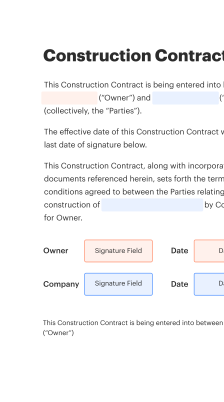
How automated move text field functions operate

Automated repositioning uses rules, triggers and responsive layout logic to place text fields based on content length, conditional data, or events in the signing workflow.

  • Rule triggers: Conditions that initiate a reposition action
  • Responsive layout: Dynamic adjustments for varying content sizes
  • Programmatic control: API or template rules set target coordinates
  • Verification: Preview and validation before sending
Collect signatures
24x
faster
Reduce costs by
$30
per document
Save up to
40h
per employee / month

Quick steps to move a text field during document setup

Follow these concise steps to reposition a text field safely before sending a document for signature.

  • 01
    Open template: Load the document template in editor mode
  • 02
    Select field: Click the text field or its handle to activate
  • 03
    Move field: Drag to new coordinates or enter precise values
  • 04
    Save changes: Save version and verify in preview mode

Maintaining audit trails for moved text fields

Capture detailed, structured audit data whenever a text field is moved so changes are traceable for compliance and troubleshooting.

01

Change timestamp:

Exact date and time
02

Actor identity:

User account or system service
03

Previous position:

X/Y coordinates or page reference
04

New position:

Updated X/Y coordinates
05

Change reason:

User note or automated trigger
06

Associated document version:

Template or envelope id
be ready to get more

Why choose airSlate SignNow

  • Free 7-day trial. Choose the plan you need and try it risk-free.
  • Honest pricing for full-featured plans. airSlate SignNow offers subscription plans with no overages or hidden fees at renewal.
  • Enterprise-grade security. airSlate SignNow helps you comply with global security standards.
illustrations signature

Recommended workflow settings for move text field automation

Configure these settings to control when and how text fields are moved automatically as part of signing workflows.

Workflow Setting and Configuration Header Descriptive header clarifying columns for the workflow setting and its configuration values
Field Movement Trigger Event Name On document open or data population
Conditional Placement Rules Definition When adjacent field exceeds set length
Preview and Validation Timeout Value 2 minutes per document preview
Audit Log Detail Level Setting Full coordinate and user metadata
Access Control Scope for Field Edits Template admins only

Platform and device requirements for moving text fields

Ensure your editing and signing platforms meet minimum OS and browser requirements to support accurate field repositioning and rendering.

  • iOS: iOS 13 or newer
  • Android: Android 8.0 or newer
  • Desktop: Latest Chrome, Edge, Safari

For consistent behavior, standardize on current OS builds and modern browsers, enable platform feature parity testing, and include device previews in your pre-send verification steps to detect layout shifts before recipients view or sign documents.

Security controls relevant to move text field operations

Encryption at rest: AES-256 encryption for stored documents
Transport encryption: TLS encryption during data transfer
Access control: Role-based permissions for field edits
Audit metadata: Timestamps and actor identity logged
Tamper evidence: Integrity checks show post-signature changes
Authentication options: Multi-factor and certificate-based sign-in

Industry examples showing how move text field is used

These two examples illustrate pragmatic uses of move text field for common document types across industries where layout flexibility matters.

Case Study 1

A mortgage lender prepares loan disclosures that include variable borrower remarks and appended clauses that change length.

  • Automated move text field logic repositions signature blocks when content expands.
  • This prevents overlapping content and maintains a consistent document flow for reviewers.

Resulting in fewer manual edits and clearer, auditable closing documents for compliance reviews.

Case Study 2

A university uses enrollment forms that include course lists with inconsistent line counts depending on student choices.

  • Conditional field movement reflows adjacent fields and signature areas.
  • Administrators avoid lost or hidden fields and reduce manual layout corrections.

Resulting in faster processing, clearer records for FERPA compliance, and accurate stored documents for student files.

Best practices for secure and accurate move text field use

Adopt consistent policies and checks to avoid layout errors, protect data integrity, and ensure compliance when permitting field movement.

Implement role-based editing policies
Restrict who can move text fields by assigning clear roles and permissions. Administrators should reserve layout-locking rights while allowing preparers limited repositioning for content fit. This reduces unintentional changes and preserves standardized templates across teams.
Maintain template version control
Use explicit versioning for templates that include movable fields. Record changes in a version history with notes explaining repositioning rationale so auditors and colleagues can trace layout adjustments during reviews or disputes.
Validate across devices before sending
Perform previews on common device types and screen sizes to ensure moved fields render correctly in mobile and desktop contexts. Validation reduces signer confusion and minimizes post-signature corrections or re-executions.
Log full audit details for each change
Capture actor identity, timestamp, pre- and post-move coordinates, and reason for each field movement. Comprehensive logs support legal admissibility under ESIGN and UETA and simplify internal audits or regulatory inquiries.

FAQs About move text field

This FAQ addresses frequent problems and configuration questions when repositioning text fields in digital documents.

Comparison: how platforms handle move text field features

A concise feature comparison focusing on how leading eSignature platforms support repositioning and template controls for movable text fields.

eSignature Platform Feature Comparison Table signNow (Recommended) DocuSign Adobe Sign
Move text field drag-and-drop support
Template-level field locking capability Limited
Conditional placement and reflow rules Limited Limited
Audit trail includes coordinate history
be ready to get more

Get legally-binding signatures now!

Risks and potential penalties from improper field movement

Noncompliance fines: Regulatory penalties possible
Contract disputes: Increased litigation risk
Data breaches: Exposure of personal data
Invalidated records: Questionable evidentiary value
Operational delays: Rework and slowed approvals
Reputational harm: Trust and credibility loss

Simplify complicated workflows

Prepare, execute, and maintain workflows of any difficulty, digitally from virtually anywhere. Scalable eSignature features ensure you can exchange contracts with the right people in the correct order and assign roles for each recipient. Stream document workflows faster and easier than ever before.

Automate document flow

Improve sophisticated signing procedures with airSlate SignNow�s highly effective capabilities to improve your operation. Control your automated eSignature workflows to make sure they're operating at maximum functionality with quick notifications and alerts.

Enhance in team communication

Bring teammates together in a safe, shared environment. Manage documents, use form templates and notifications to create more efficient cross-organization communication. Free your employees from having to hang out on recurring activities to enable them to focus on valuable, business-vital tasks.

Integrate into your current network

Manage your projects with industry-leading integration. Assemble Salesforce, Microsoft Teams, and SharePoint all in one business thread. Link up your software to a single system for endless opportunities and more efficiency.

Remain compliant with industry-leading data safety

Feel confident knowing that your data remains secure by the most up-to-date in encryption security. airSlate SignNow is GDPR and eIDAS compliant and gives you exposure into your signing process with court-admissible audit trails. Configure user access permissions and rights to control who has access to what.


walmart logo
exonMobil logo
apple logo
comcast logo
facebook logo
FedEx logo
be ready to get more

Get legally-binding signatures now!