Official Electronic Signature Solutions by SignNow

Eliminate paperwork and improve digital document management for more productivity and limitless opportunities. Enjoy the best manner of running your business with airSlate SignNow.

Award-winning eSignature solution

What an official electronic signature means in practice

An official electronic signature is a digital method for signing documents that establishes intent, links the signature to a signer, and preserves document integrity. In the United States, legally enforceable electronic signatures meet requirements under ESIGN and UETA when parties consent and the method captures clear evidence of identity and intent. Practical implementations combine signature fields, signer authentication, tamper-evident seals, and a verifiable audit trail so signed records can be produced as evidence in business and regulatory contexts. signNow is a secure, compliant, and cost-conscious eSignature option used across U.S. industries for these purposes.

Why use an official electronic signature for business documents

Official electronic signatures reduce turnaround time, provide consistent legal evidence of consent, and help teams manage document lifecycles with fewer manual steps while aligning with U.S. regulatory frameworks.

Why use an official electronic signature for business documents

Common challenges when adopting official electronic signatures

  • Verifying signer identity across remote workflows can require multiple authentication steps and careful policy design to meet legal or internal standards.
  • Ensuring document integrity and detecting tampering demands robust tamper-evident seals, versioning, and an immutable audit trail for admissibility in disputes.
  • Integrating eSignature flows with existing systems like CRM or document storage often needs API work and mapping of data fields to avoid manual re-entry.
  • Managing regulatory and sector-specific rules, such as HIPAA for healthcare or FERPA for education, requires careful configuration and documented compliance controls.

Representative user roles for official electronic signatures

Contract Manager

A Contract Manager prepares templates, assigns signer roles, and enforces approval routing. They rely on consistent field placement, audit logs, and integration with contract repositories to reduce execution time and maintain a searchable archive of executed agreements.

Healthcare Administrator

A Healthcare Administrator coordinates patient forms, authorizations, and vendor agreements under HIPAA constraints. They prioritize secure access controls, role-based permissions, and encrypted storage while documenting consent and retention for compliance audits.

Typical users of official electronic signatures and their needs

Legal, HR, sales, procurement, and operations teams commonly rely on official electronic signatures to speed approvals, reduce errors, and maintain compliant records.

  • Legal teams that need admissible execution evidence and consistent audit trails for agreements and NDAs.
  • HR and payroll departments handling onboarding packets, tax forms, and employment contracts with secure recordkeeping.
  • Sales and procurement teams processing contracts, quotes, and purchase orders to accelerate revenue and procurement cycles.

Use cases vary by sector, but successful adoption requires balancing signer convenience, authentication strength, and document retention policies to meet business and legal needs.

Advanced capabilities for enterprise official electronic signature workflows

Enterprises often require extended features to support volume, integrations, governance, and complex signing scenarios.

Bulk Send

Bulk Send enables a single document to be distributed to many recipients with individualized fields and tracking, reducing manual effort for mass notifications and standardized attestations.


Role-based permissions

Role-based permissions let administrators assign creation, sending, and reporting privileges so teams can operate securely while maintaining centralized governance and auditability.

API access

API access supports embedding signature flows into existing applications, automating envelope creation, and exchanging signed documents and metadata with backend systems.

Single sign-on

Single sign-on integration simplifies user authentication for employees, enabling centralized identity management and reducing credential fatigue while aligning with enterprise security policies.

Advanced authentication

Advanced authentication supports third-party identity providers, certificate-based signatures, and stronger verification methods where higher legal assurance is necessary.

Enterprise reporting

Enterprise reporting provides usage analytics, audit exports, and compliance-focused logs for governance, billing reconciliation, and operational insights across distributed teams.

be ready to get more

Choose a better solution

Core features to look for in official electronic signature solutions

Effective official electronic signature platforms combine signature capabilities with document management, authentication, and compliance controls to meet business and legal needs.

Template management

Template management allows teams to standardize recurring documents with predefined signature roles, merge fields, and conditional logic; this reduces preparation time and ensures consistent field placement across repetitive transactions.

Authentication options

Robust authentication options include email verification, SMS codes, knowledge-based questions, and multi-factor authentication, enabling different assurance levels depending on transaction sensitivity and compliance requirements.

Audit trail

A full audit trail captures timestamps, IP addresses, and event history for each signature step, producing an evidentiary record suitable for dispute resolution and regulatory review.

Document security

Document security includes encryption at rest and in transit, access controls, and tamper-evident sealing to protect signed records and ensure long-term integrity of executed files.
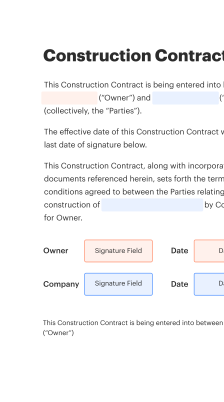
How an official electronic signature transaction proceeds

A signed transaction follows predictable stages to ensure signer intent, identity verification, execution, and preservation of evidence.

  • Initiation: Sender creates envelope and attaches documents.
  • Authentication: Signer confirms identity via chosen method.
  • Execution: Signer applies signature and completes fields.
  • Completion: System records final document and audit trail.
Collect signatures
24x
faster
Reduce costs by
$30
per document
Save up to
40h
per employee / month

Quick setup: creating an official electronic signature transaction

Follow these basic steps to prepare and send a document for an official electronic signature using a compliant eSignature tool.

  • 01
    Prepare document: Finalize content and remove editable errors.
  • 02
    Upload file: Add the document to the eSignature platform.
  • 03
    Place fields: Insert signature, date, and data fields.
  • 04
    Send: Specify signers and send with instructions.

Managing audit trails for official electronic signature transactions

A reliable audit trail documents every action from envelope creation to final execution, supporting compliance and dispute resolution.

01

Record events:

Log every signer action and system event.
02

Timestamping:

Attach server-side timestamps to events.
03

IP capture:

Record IP addresses for signer sessions.
04

Field-level history:

Track edits and field completions.
05

Exportability:

Provide exportable, human-readable reports.
06

Retention:

Preserve audit records per policy.
be ready to get more

Why choose airSlate SignNow

  • Free 7-day trial. Choose the plan you need and try it risk-free.
  • Honest pricing for full-featured plans. airSlate SignNow offers subscription plans with no overages or hidden fees at renewal.
  • Enterprise-grade security. airSlate SignNow helps you comply with global security standards.
illustrations signature

Recommended workflow settings for official electronic signature automation

Configure these core settings to standardize signature workflows and reduce manual tasks while maintaining compliance controls.

Setting Name Configuration
Reminder Frequency 48 hours
Default Signature Type Electronic signature
Authentication Requirement Email + SMS
Document Retention Period 7 years
Audit Log Export Daily export

Platform considerations for official electronic signature usage

Check supported platforms and device compatibility to ensure signers can access and complete signature requests from their preferred devices.

  • Desktop browsers: Chrome, Safari, Edge
  • Mobile platforms: iOS and Android apps
  • Integration endpoints: API and cloud connectors

Ensure the selected eSignature solution supports current browser versions, native mobile apps for common operating systems, and integration options such as REST APIs or prebuilt connectors for systems like Google Drive and major CRMs.

Security mechanisms that support an official electronic signature

Encryption: AES-256 encryption
Access controls: Role-based access
Authentication: Multi-factor options
Audit logs: Comprehensive event logs
Transport security: TLS-encrypted transmission
Data residency: US storage options

Industry examples of official electronic signature use

The following case summaries illustrate practical implementations of official electronic signatures across sectors and typical outcomes.

Financial Services onboarding

A mid-size bank digitized account opening using an official electronic signature workflow to capture investor consent and identity documentation

  • used email OTP plus ID upload for signer verification
  • reduced processing time and improved customer experience

Resulting in faster account activation and clearer regulatory audit records.

Healthcare consent forms

A regional clinic replaced paper consent forms with signed digital versions to capture patient authorization and timestamps

  • applied role-based access and encrypted storage for PHI protection
  • improved tracking of consent and reduced filing errors

Leading to easier compliance with HIPAA and faster administrative processing.

Best practices for secure and compliant official electronic signatures

Adopt consistent practices to ensure signatures are valid, defensible, and operationally efficient.

Confirm identity using multi-factor verification
Select an authentication method appropriate to the transaction risk. Use multi-factor options for high-value or regulated agreements to strengthen signer identity and evidentiary value.
Maintain tamper-evident document seals and versioning
Apply cryptographic sealing and store signed PDFs with immutable metadata so any post-signing changes are detectable and the original executed version remains retrievable.
Standardize templates and signer roles across teams
Use centrally managed templates and clearly defined signer roles to reduce errors, speed execution, and ensure required fields are consistently applied for compliance.
Document retention aligned with legal requirements
Define retention policies that meet industry and regulatory obligations, store signed records securely, and ensure access controls and export capabilities for audits or litigation.

Official electronic signature: common questions and troubleshooting

This FAQ section addresses frequent issues and practical resolutions for common problems encountered with official electronic signature processes.

Feature availability comparison for official electronic signature providers

Quick feature matrix comparing signNow with widely used eSignature vendors on common functional and compliance criteria.

Criteria signNow (Recommended) DocuSign Adobe Sign
US eSignature law compliance ESIGN/UETA compliant ESIGN/UETA compliant ESIGN/UETA compliant
Audit trail detail Comprehensive Comprehensive Comprehensive
Mobile app availability iOS/Android iOS/Android iOS/Android
Bulk Send capability
be ready to get more

Get legally-binding signatures now!

Key retention and deadline considerations for official electronic signatures

Retention and deadline policies differ by document type and industry; plan schedules that satisfy legal, operational, and audit needs.

Employment and payroll records retention requirements:

Follow federal and state retention rules for paystubs, tax forms, and personnel files.

Healthcare record retention under HIPAA:

Retain patient records in accordance with applicable state and federal requirements.

Student records for educational institutions:

Keep FERPA-protected records under institutional retention schedules.

Contractual obligation retention periods:

Preserve executed contracts for the duration of liability and statutory limitation periods.

Document destruction and archival schedules:

Apply periodic archival or secure deletion according to policy and documented approvals.

Risks and penalties tied to improper use of eSignatures

Contract invalidation: Legal challenge
Regulatory fines: Possible penalties
Data breaches: Compliance violations
Operational delays: Business disruption
Reputational harm: Customer distrust
Litigation costs: Defence expenses

Plan and pricing attributes across popular eSignature platforms

Overview of plan attributes and entry-level availability to help compare cost and deployment characteristics without listing transient promotional prices.

Vendors signNow (Recommended) DocuSign Adobe Sign HelloSign PandaDoc
Free plan availability Free tier with limited features No permanent free tier; trial available Trial; limited free tier for some users Free plan available with limited sends Free tier with limited templates
Trial period offering 14-day trial available 30-day trial commonly offered 14-day trial often available 14-day trial offered 14-day trial available
Enterprise plan option Enterprise-grade plans with admin controls Enterprise solutions and CLM options Enterprise cloud and integration plans Business and enterprise tiers Enterprise tier with sales enablement
Billing flexibility Monthly and annual billing Monthly and annual billing Monthly and annual billing Monthly and annual billing Monthly and annual billing
Primary support level Standard support; paid upgrades Standard plus paid priority support Standard support with enterprise SLAs Email support; paid upgrades Standard support with paid upgrades

Streamline complex workflows

Generate, perform, and control workflows of any complexness, digitally from near any place. Scalable eSignature features ensure you can exchange contracts with the right users the right sequence and set up roles for every signee. Stream document workflows faster and easier than ever before.

Automate document management

Improve complicated signing tasks with airSlate SignNow�s powerful features to enhance your operation. Control your automatic signature workflows to ensure they're running at top performance with instant notices and reminders.

Enhance in team communication

Join teams together in a secure, shared environment. Handle documents, use form templates and notifications to deliver more effective cross-organization interaction. Relieve your workers from having to spend time on recurring activities to enable them to concentrate on beneficial, business-essential activities.

Integrate into your existing systems

Run your assignments with best-in-class integration. Assemble Salesforce, Microsoft Teams, and SharePoint in one business flow. Link your applications to a single environment for limitless possibilities and more performance.

Stay compliant with market-leading data protection

Feel confident knowing that your data remains secure by the most up-to-date in encryption security. airSlate SignNow is GDPR and eIDAS certified and offers you visibility into your signing procedure with court-admissible audit trails. Configure user authorization and roles to control who has access to what.


walmart logo
exonMobil logo
apple logo
comcast logo
facebook logo
FedEx logo
be ready to get more

Get legally-binding signatures now!